TEKS ELAR 3.9.E.i
The Standard
identifying the claim
Texas Essential Knowledge and Skills for English Language Arts and Reading · The student recognizes and analyzes genre-specific characteristics, structures, and purposes within and across increasingly complex traditional, contemporary, classical, and diverse texts.
Teacher's field guide
What This Standard Means
What Students Need to Do
- Students read or listen to an argument and identify what the author wants readers to believe or do. They separate that position from supporting reasons and details.
What Mastery Looks Like
- Students can point to or state the author’s position in a short argument. They can explain that the other sentences give reasons or evidence for that position.
Common Misconceptions
- Students may confuse the topic with the author’s position. They may also select a supporting reason, fact, title, or personal opinion instead of the claim.
How to Assess It
- Display: “Our school should add ten minutes to recess. More play helps students return to class ready to learn.” Ask students to underline the claim.
Lesson moves
Ways to Teach It
Give groups sentence strips from a short argument and have them sort the claim from the supporting reasons.
Read a paragraph about school uniforms, then ask, “What does the author want readers to believe or do?”
Play Claim Detective by showing three sentences and awarding a point when teams identify the author’s position.
Examine a toy advertisement and have students name what the company wants buyers to believe about the product.
Free download
Printable 3.9.E.i Worksheet
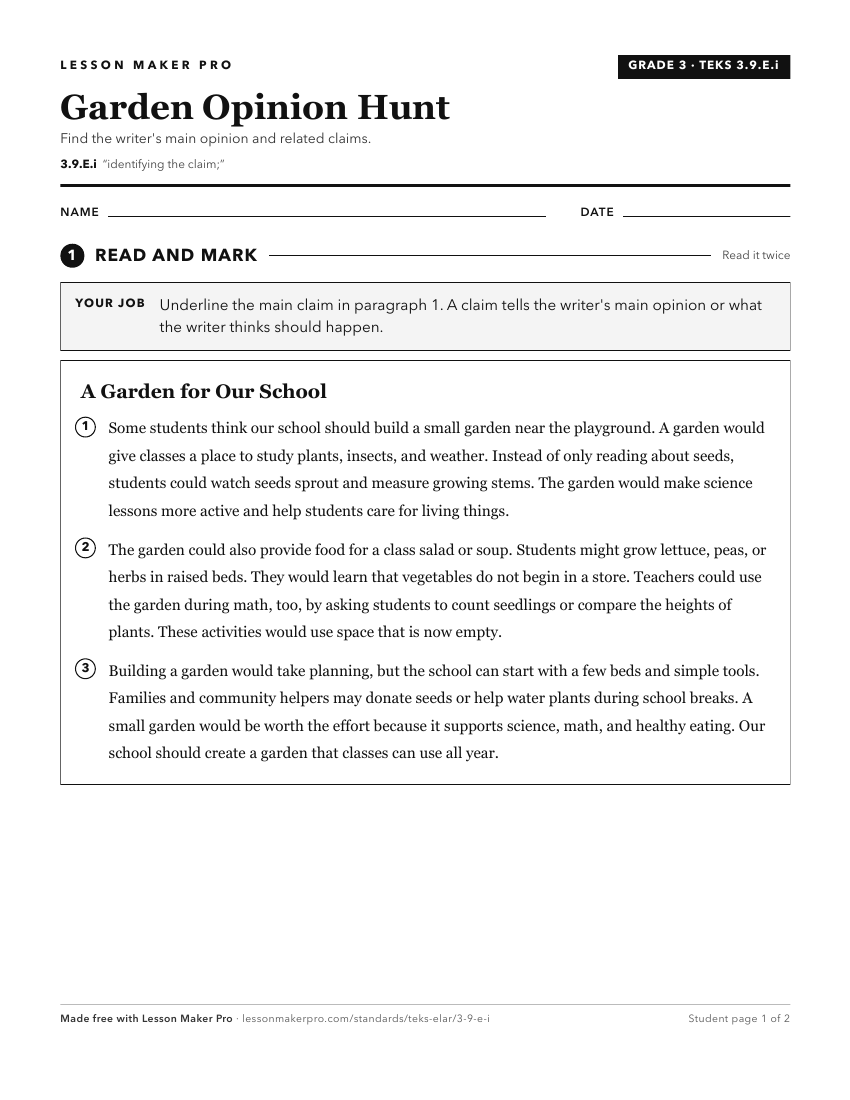
A ready-to-print activity worksheet aligned to 3.9.E.i, with an answer key for the teacher on its own page. No account needed.
PDF, US Letter, prints cleanly in black and white.
Download the worksheetKeep exploring
Related Standards
Turn this exact standard into a lesson
Grade, subject, topic, and the complete standard are prefilled. Create one free, no account needed.
Also for this standard:Make a WorksheetMake a QuizMake a Sub Lesson