TEKS ELAR 7.2.C
The Standard
determine the meaning and usage of grade-level academic English words derived from Greek and Latin roots such as omni, log/logue, gen, vid/vis, phil, luc, and sens/sent
Texas Essential Knowledge and Skills for English Language Arts and Reading · Developing and sustaining foundational language skills: listening, speaking, discussion, and thinking
Teacher's field guide
What This Standard Means
What Students Need to Do
- Students break unfamiliar academic words into roots and affixes. They use the root meaning and sentence context to determine the word’s meaning, then use it accurately.
What Mastery Looks Like
- Students identify a Greek or Latin root inside an unfamiliar word and explain how it shapes the meaning. They confirm the meaning with context and use the word correctly in speech or writing.
Common Misconceptions
- Students may treat a root as the full definition and ignore prefixes, suffixes, or context. They may also confuse similar roots or use a related word in the wrong grammatical form.
How to Assess It
- Exit ticket: In “The translucent panel allowed sunlight through,” define translucent, circle luc, explain how context helps, then use translucent in a new sentence.
Lesson moves
Ways to Teach It
Give pairs root, word, and meaning cards to match, then have them explain each match using the root and affixes.
Ask students to explain how visible, vision, and evidence connect to seeing, then write one sentence using each word correctly.
Play Root Relay: teams build words from root and affix cards, define each word, and earn points for accurate sentences.
Have students collect rooted words from school notices, textbooks, or news headlines and annotate each word’s root, meaning, and use.
Free download
Printable 7.2.C Worksheet
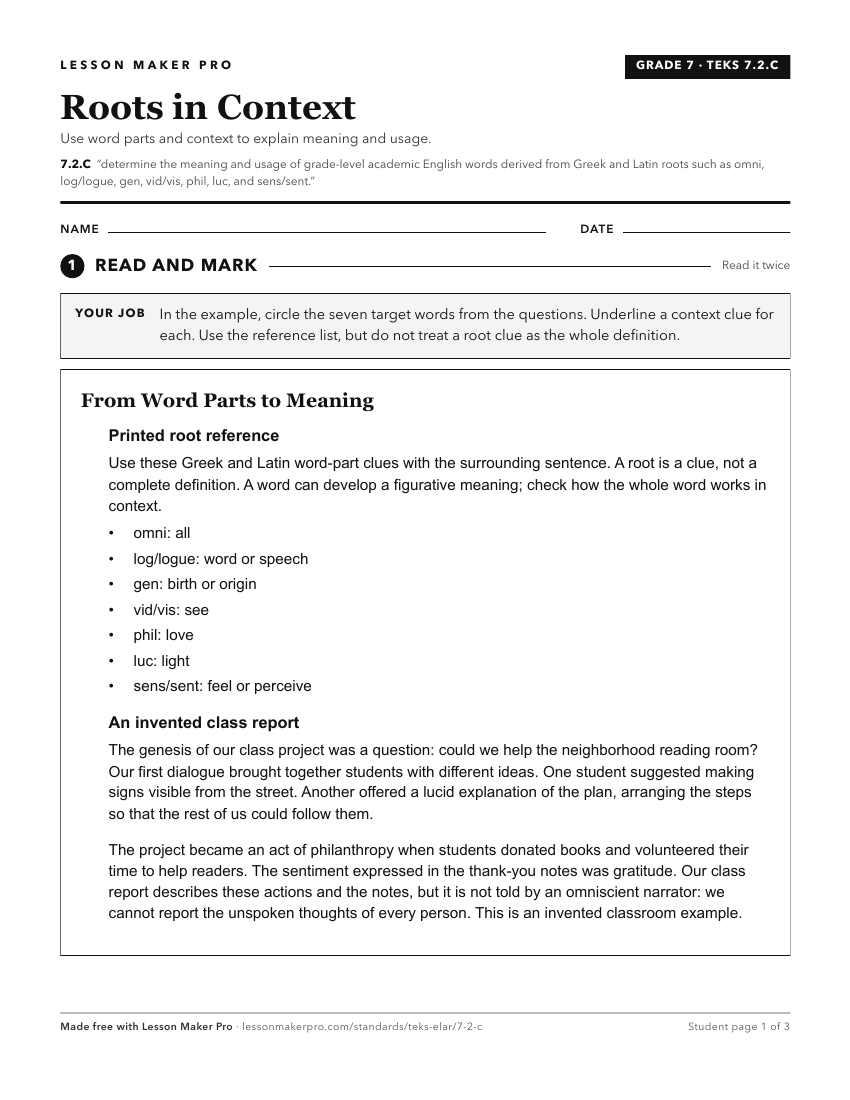
A ready-to-print activity worksheet aligned to 7.2.C, with an answer key for the teacher on its own page. No account needed.
PDF, US Letter, prints cleanly in black and white.
Download the worksheetKeep exploring
Related Standards
- 5.3.C
identify the meaning of and use words with affixes such as trans-, super-, -ive, and -logy and roots such as geo and photo; and
- 8.2.C
determine the meaning and usage of grade-level academic English words derived from Greek and Latin roots such as ast, qui, path, mand/mend, and duc.
- 4.3.C
determine the meaning of and use words with affixes such as mis-, sub-, -ment, and -ity/ty and roots such as auto, graph, and meter; and
- 6.2.C
determine the meaning and usage of grade-level academic English words derived from Greek and Latin roots such as mis/mit, bene, man, vac, scrib/script, and jur/...
Turn this exact standard into a lesson
Grade, subject, topic, and the complete standard are prefilled. Create one free, no account needed.
Also for this standard:Make a WorksheetMake a QuizMake a Sub Lesson