South Dakota Science MS-PS4-3
The Standard
Obtain, evaluate and communicate information to support an evidence-based claim for the reliability of digitized signals to encode and transmit information compared to analog signals. (SEP: 8; DCI: PS4.C; CCC: Structure and Function)
South Dakota Science Standards (2024) · Waves and Their Applications in Technologies for Information Transfer
Teacher's field guide
What This Standard Means
What Students Need to Do
- Students examine how a changing analog signal and a bit code carry the same message. They compare evidence about interference, then explain which signal lets a receiver recover the message more reliably.
What Mastery Looks Like
- A student decodes noisy analog values and noisy bits, then counts the errors in each message. They use those counts to support a claim and explain that enough noise can make bits unreadable too.
Common Misconceptions
- Students may think digital signals never lose data or that any noise changes a bit. Others assume a digitized signal keeps every detail of the original analog signal.
How to Assess It
- Exit ticket: A sensor sends the number 2 as 2.0 volts or as binary bits 10. Interference changes the voltage to 2.3 volts but leaves 10 readable. Which message is recovered exactly, and what evidence supports your answer?
Lesson moves
Ways to Teach It
Give pairs a four-value shading key and a two-bit key; have them encode the same numbers, rub both messages, and trade to decode.
Ask students to write which rubbed message kept more information, using their error counts and explaining when bits might become unreadable.
Play signal relay: students read classmates' shaded cards and bit cards through tracing paper, then score their decoding errors.
Play recordings of a weak FM radio station and a choppy internet call; have students note gradual distortion versus missing chunks.
Free download
Printable MS-PS4-3 Worksheet
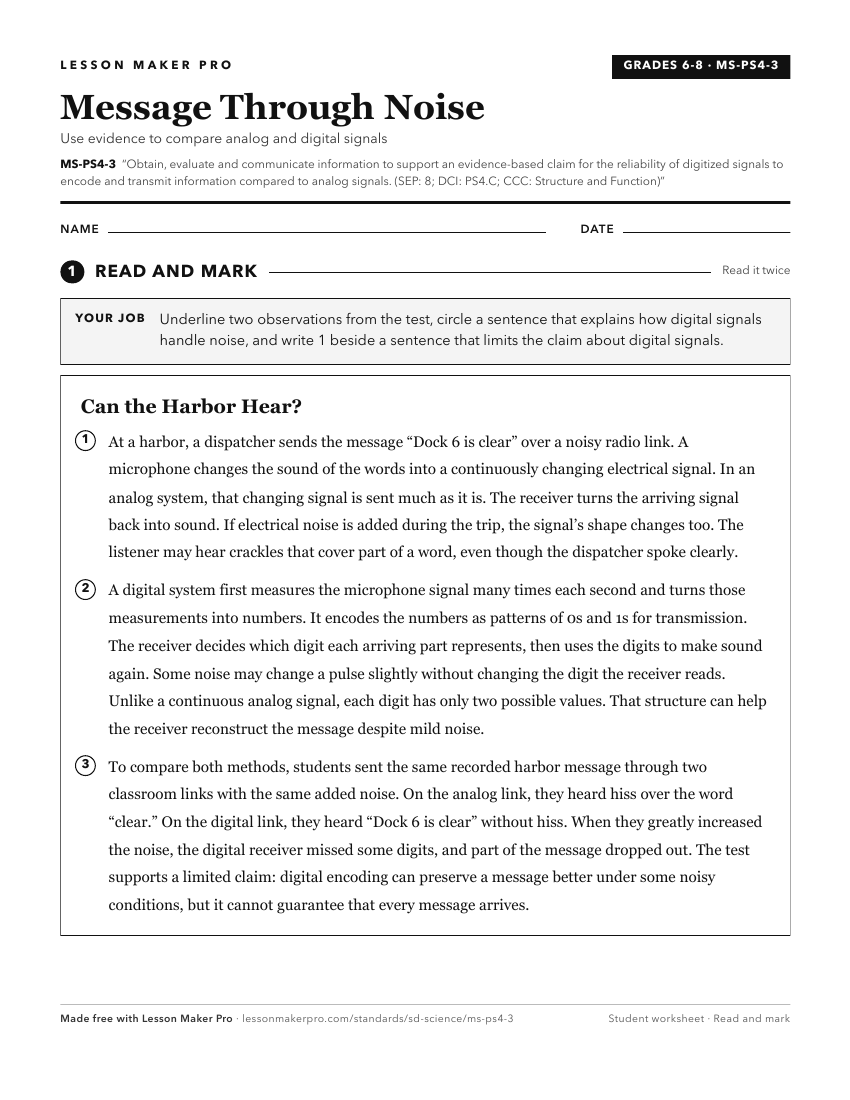
A ready-to-print activity worksheet aligned to MS-PS4-3, with an answer key for the teacher on its own page. No account needed.
PDF, US Letter, prints cleanly in black and white.
Download the worksheetKeep exploring
Related Standards
Turn this exact standard into a lesson
Grade, subject, topic, and the complete standard are prefilled. Create one free, no account needed.
Also for this standard:Make a WorksheetMake a QuizMake a Sub Lesson