South Dakota Science HS-PS4-4
The Standard
Engage in an evidence-based argument for the effects that different frequencies of electromagnetic radiation have when absorbed by matter. (SEP: 7; DCI: PS4.B; CCC: Cause/Effect)
South Dakota Science Standards (2024) · Waves and Their Applications in Technologies for Information Transfer
Teacher's field guide
What This Standard Means
What Students Need to Do
- Students use evidence to explain what happens when materials absorb electromagnetic radiation at different frequencies. They connect frequency to photon energy and explain how the material responds.
What Mastery Looks Like
- Given absorption data and a photon-energy chart, a student explains why microwaves can heat water while X rays can damage DNA. They cite the data and account for how much radiation is absorbed.
Common Misconceptions
- Students may think all electromagnetic radiation is radioactive or that microwaves can break DNA. Some assume higher frequency always means more heating, without considering the material or the amount absorbed.
How to Assess It
- Give students a frequency chart and two facts: water absorbs microwaves and warms, while X rays can ionize molecules in cells. Ask them to explain the different effects using the chart.
Lesson moves
Ways to Teach It
Place UV-sensitive beads under a UV flashlight and a white flashlight, then record which light changes their color.
Use a photon-energy chart to write a claim, evidence, and reasoning response comparing the effects of X rays and microwaves on tissue.
Sort frequency cards from radio to gamma, then match microwaves to water heating, UV to bead color change, and X rays to DNA damage.
Compare a microwave oven safety label with an X-ray clinic warning sign, then explain each risk using frequency and absorption.
Free download
Printable HS-PS4-4 Worksheet
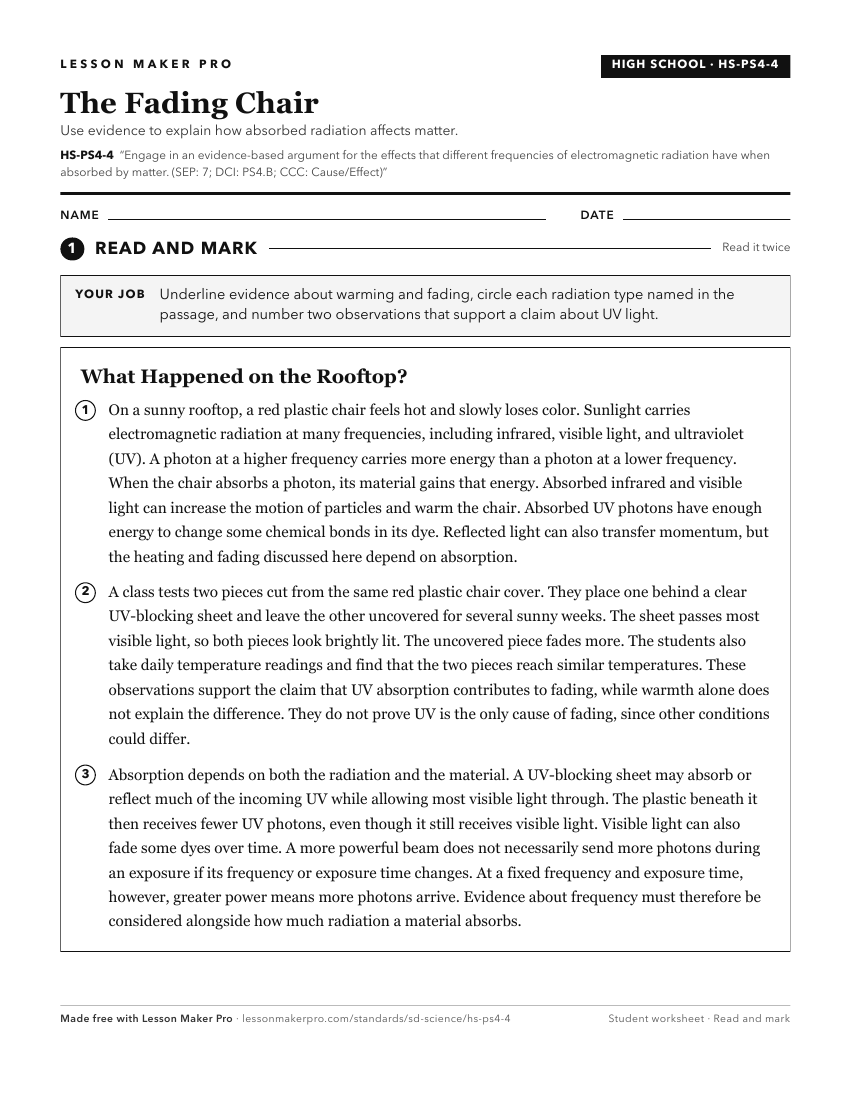
A ready-to-print activity worksheet aligned to HS-PS4-4, with an answer key for the teacher on its own page. No account needed.
PDF, US Letter, prints cleanly in black and white.
Download the worksheetKeep exploring
Related Standards
- MS-LS2-4
Construct an evidence-based argument that articulates how changes to physical or biological components of an ecosystem affect populations.
- MS-PS3-5
Engage in argument from evidence to support the claim that when the kinetic energy of an object changes, energy is transferred to or from the object.
- 4-PS3-2
Make observations to provide evidence for how energy can be transferred from place to place by sound, light, heat, and electric currents.
Turn this exact standard into a lesson
Grade, subject, topic, and the complete standard are prefilled. Create one free, no account needed.
Also for this standard:Make a WorksheetMake a QuizMake a Sub Lesson