South Dakota Science MS-PS3-5
The Standard
Engage in argument from evidence to support the claim that when the kinetic energy of an object changes, energy is transferred to or from the object. (SEP: 7; DCI: PS3.B; CCC: Energy/Matter)
South Dakota Science Standards (2024) · Energy
Teacher's field guide
What This Standard Means
What Students Need to Do
- Students compare how fast the same object moves before and after a push, collision, or braking. They use the speed change and other observations to argue whether energy entered or left the object.
What Mastery Looks Like
- A student can use before-and-after speeds to tell whether an object's kinetic energy increased or decreased. They can name where the energy came from or went and point to evidence that supports their claim.
Common Misconceptions
- Students may say energy disappears when an object stops or that speeding up creates energy. They may think a change in direction means kinetic energy changed, even if speed stayed the same.
How to Assess It
- Exit ticket: A toy car slows from 2 m/s to 1 m/s after hitting a foam block, which starts moving. Did energy enter or leave the car? Name one observation that supports your answer.
Lesson moves
Ways to Teach It
Roll one marble into a stationary marble on a marked tray; use slow-motion video to compare their speeds before and after impact.
Ask: A rolling ball slows on carpet and bends its fibers. What evidence supports energy leaving the ball?
Give pairs toy-car speed cards showing 0 to 2, 2 to 1, and 1 to 3 m/s; sort energy in or out.
Compare a bicycle speeding up when pedaled and slowing under brakes; have students name the energy source or receiver in each case.
Free download
Printable MS-PS3-5 Worksheet
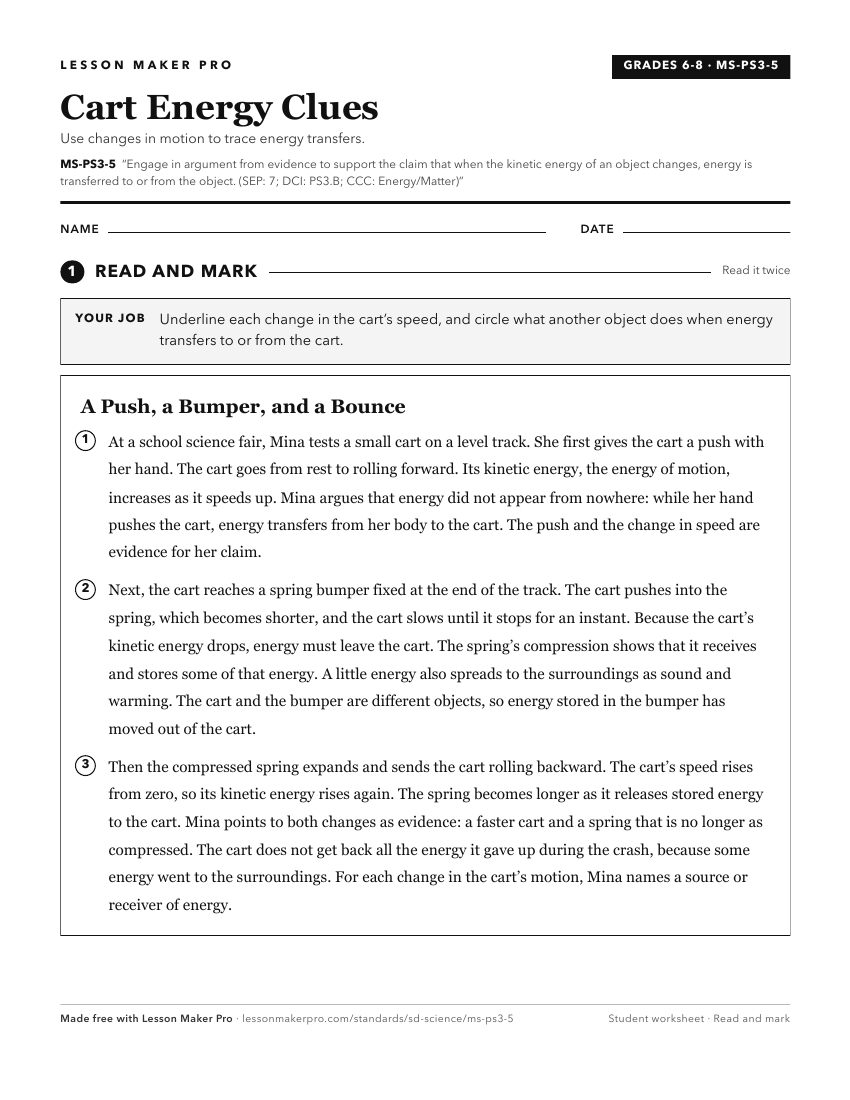
A ready-to-print activity worksheet aligned to MS-PS3-5, with an answer key for the teacher on its own page. No account needed.
PDF, US Letter, prints cleanly in black and white.
Download the worksheetKeep exploring
Related Standards
- K-ESS2-2
Engage in argument from evidence for how plants and animals (including humans) can change the environment to meet their needs.
- HS-PS4-4
Engage in an evidence-based argument for the effects that different frequencies of electromagnetic radiation have when absorbed by matter.
- 4-PS3-2
Make observations to provide evidence for how energy can be transferred from place to place by sound, light, heat, and electric currents.
Turn this exact standard into a lesson
Grade, subject, topic, and the complete standard are prefilled. Create one free, no account needed.
Also for this standard:Make a WorksheetMake a QuizMake a Sub Lesson