South Dakota Science MS-LS4-2
The Standard
Apply scientific ideas to construct an explanation for similarities and differences among modern organisms and between modern and fossil organisms to infer evolutionary relationships. (SEP: 6; DCI: LS4.A; CCC: Patterns)
South Dakota Science Standards (2024) · Biological Unity and Diversity
Teacher's field guide
What This Standard Means
What Students Need to Do
- Students compare body parts in living animals and fossils. They use shared features and differences to explain which organisms likely share a more recent ancestor.
What Mastery Looks Like
- A student can identify matching features in a fossil and two living animals, then choose the likely closer relative. They can explain why one difference does not rule out shared ancestry.
Common Misconceptions
- Students may treat a common trait, such as four legs, as strong evidence as a distinctive shared bone. They may assume a fossil is a direct ancestor or that one different body part rules out a relationship.
How to Assess It
- Exit ticket: Archaeopteryx had feathered wings, a wishbone, teeth, and a long bony tail; a pigeon has feathered wings and a wishbone; a lizard has teeth and a long bony tail. Which living animal likely shares a more recent ancestor with Archaeopteryx, and which two traits support your answer?
Lesson moves
Ways to Teach It
Give groups diagrams of a three-toed fossil horse foot and a modern horse foot; students align toe bones and mark matching structures.
Show labeled skeletons of a fossil whale with hind legs and a modern whale; ask whether matching ear bones support a relationship despite the leg difference.
Play closest relative with Archaeopteryx, pigeon, and lizard trait cards; pairs choose a match and defend it using feathers and wishbones.
Print mammoth and elephant skull photos from a museum collection; students circle matching tusk sockets and explain what those features suggest.
Free download
Printable MS-LS4-2 Worksheet
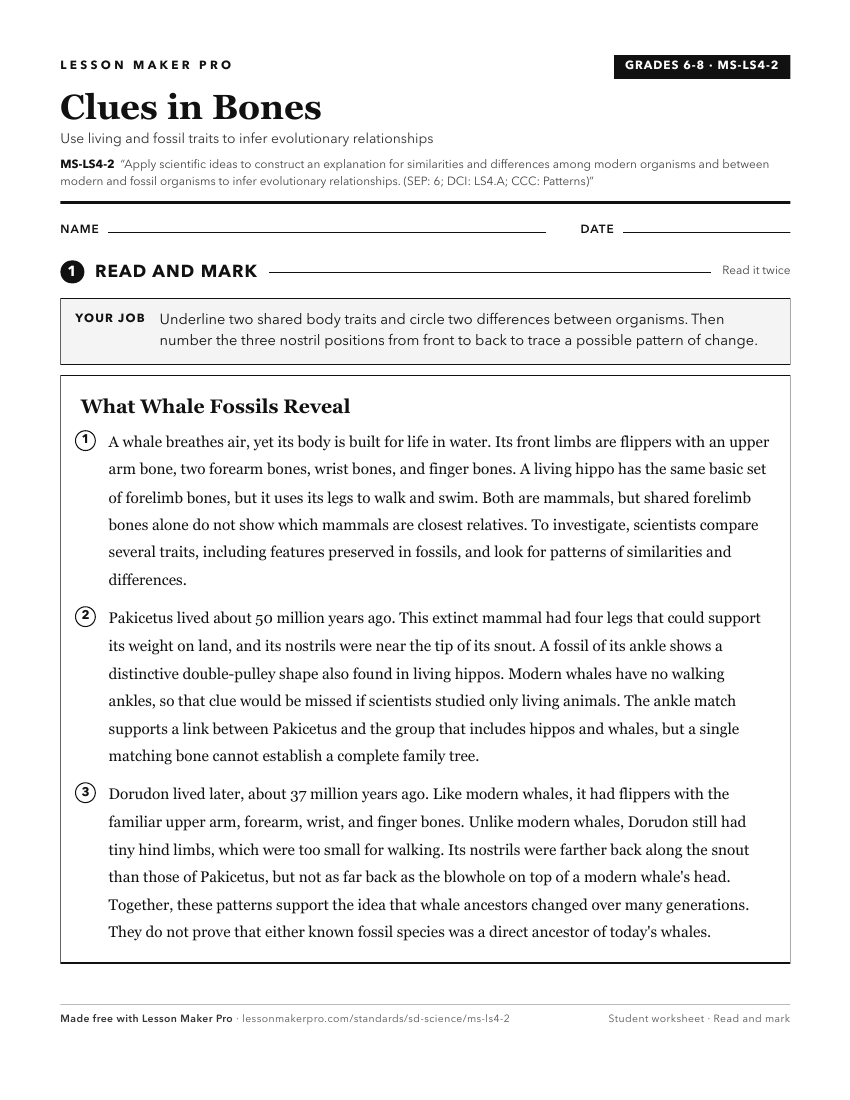
A ready-to-print activity worksheet aligned to MS-LS4-2, with an answer key for the teacher on its own page. No account needed.
PDF, US Letter, prints cleanly in black and white.
Download the worksheetKeep exploring
Related Standards
Turn this exact standard into a lesson
Grade, subject, topic, and the complete standard are prefilled. Create one free, no account needed.
Also for this standard:Make a WorksheetMake a QuizMake a Sub Lesson