South Dakota Science MS-LS4-1
The Standard
Analyze and interpret data for patterns in the fossil record that document the existence, diversity, extinction, and change of life forms throughout the history of life on Earth. (SEP: 4; DCI: LS4.A; CCC: Patterns)
South Dakota Science Standards (2024) · Biological Unity and Diversity
Teacher's field guide
What This Standard Means
What Students Need to Do
- Students use fossil tables and rock-layer diagrams to find which groups appeared, changed, or disappeared over time. They use those patterns to describe past diversity and possible extinction.
What Mastery Looks Like
- Given a fossil chart, a student identifies older and younger layers and tracks a group across them. They cite layer positions and fossil types to support a claim about changes in diversity or a group's last recorded appearance.
Common Misconceptions
- Students may think deeper layers are younger or that fossils show every organism that once lived. They may take a missing fossil in one layer as proof that the species went extinct everywhere.
How to Assess It
- Give students a three-layer chart: the bottom has trilobites and clams, the middle has trilobites, clams, and fish, and the top has clams and fish. Ask, “Which group is absent from the youngest layer, and what can you conclude and not conclude from that absence?”
Lesson moves
Ways to Teach It
Stack three labeled paper rock layers with fossil picture cards, then record which groups appear or disappear in a table.
Show trilobites in two older layers but none above; ask, “Does that prove extinction? What else could explain the gap?”
Give pairs a four-layer fossil chart; have them race to mark first and last appearances, then compare answers with another pair.
Print a museum ammonite fossil timeline; have students mark the last recorded ammonite and explain how a new find could change the record.
Free download
Printable MS-LS4-1 Worksheet
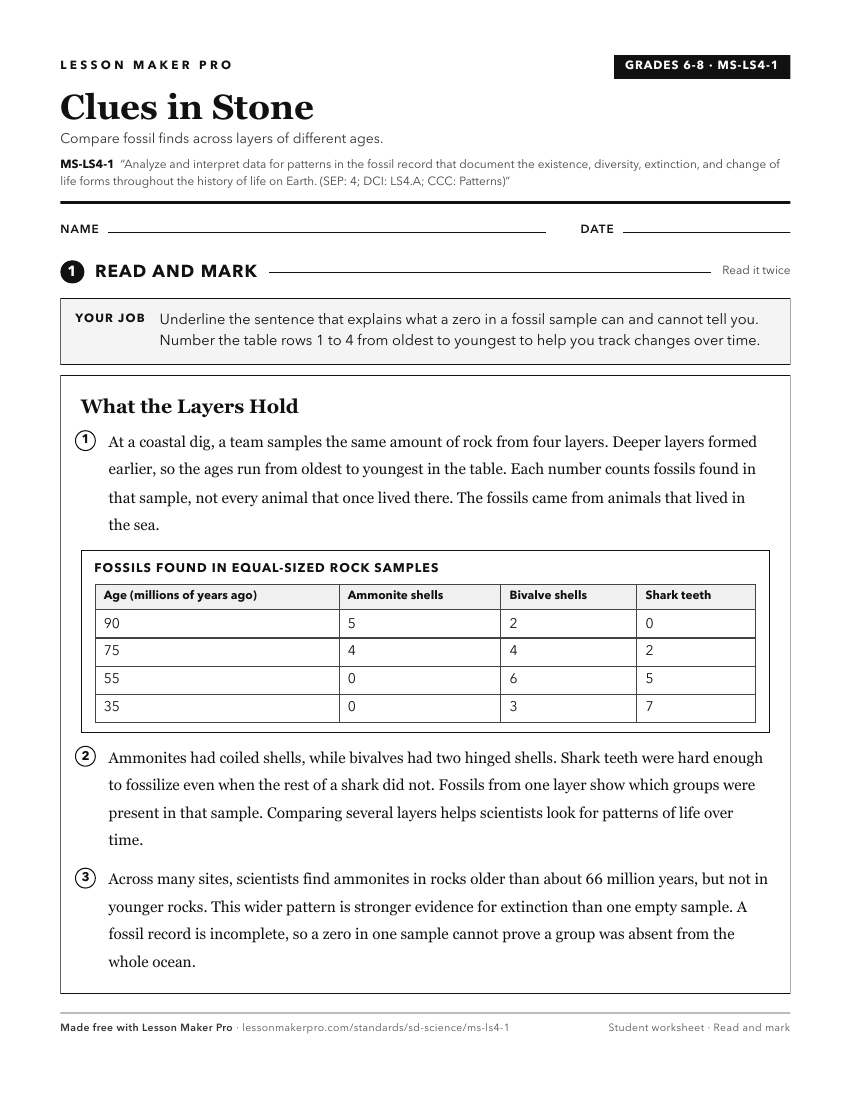
A ready-to-print activity worksheet aligned to MS-LS4-1, with an answer key for the teacher on its own page. No account needed.
PDF, US Letter, prints cleanly in black and white.
Download the worksheetKeep exploring
Related Standards
- MS-ESS2-3
Analyze and interpret data on the age of the Earth, distribution of fossils and rocks, continental shapes, and seafloor structures to provide evidence of the pa...
- MS-LS4-2
Apply scientific ideas to construct an explanation for similarities and differences among modern organisms and between modern and fossil organisms to infer evol...
Turn this exact standard into a lesson
Grade, subject, topic, and the complete standard are prefilled. Create one free, no account needed.
Also for this standard:Make a WorksheetMake a QuizMake a Sub Lesson