South Dakota Science 5-ESS2-2
The Standard
Describe and graph the amounts and percentages of salt water and fresh water in various reservoirs to provide evidence about the distribution of water on Earth. (SEP: 5; DCI: ESS2.C; CCC: Scale/Prop.)
South Dakota Science Standards (2024) · Earth’s Systems
Teacher's field guide
What This Standard Means
What Students Need to Do
- Students sort Earth's water into reservoirs, such as oceans, ice, groundwater, and lakes and rivers. They graph the amounts as percentages of all Earth's water and use the graph to explain where most water is.
What Mastery Looks Like
- A student can label each reservoir on a graph and use a scale that shows small amounts clearly. They can explain that most water is salty ocean water and that much of the fresh water is frozen or underground.
Common Misconceptions
- Students may think most fresh water is in lakes and rivers because they can see it there. Some treat ice as salt water or mistake a percentage of fresh water for a percentage of all Earth's water.
How to Assess It
- Give students these approximate shares of all Earth's water: oceans 97%, ice 2%, groundwater 0.9%, lakes and rivers 0.1%. Ask them to graph the shares and write one sentence explaining where most fresh water is.
Lesson moves
Ways to Teach It
Give pairs 1,000 grid squares to color: 970 for oceans, 20 for ice, 9 for groundwater, and 1 for lakes and rivers.
Ask, 'Why might someone think lakes hold most fresh water?' Have students answer using two values from their graphs.
Give students four reservoir cards and four percentage cards; have them match each pair, then check against their graphs.
Show a local water utility report; have students find its water source and locate that reservoir on their graphs.
Free download
Printable 5-ESS2-2 Worksheet
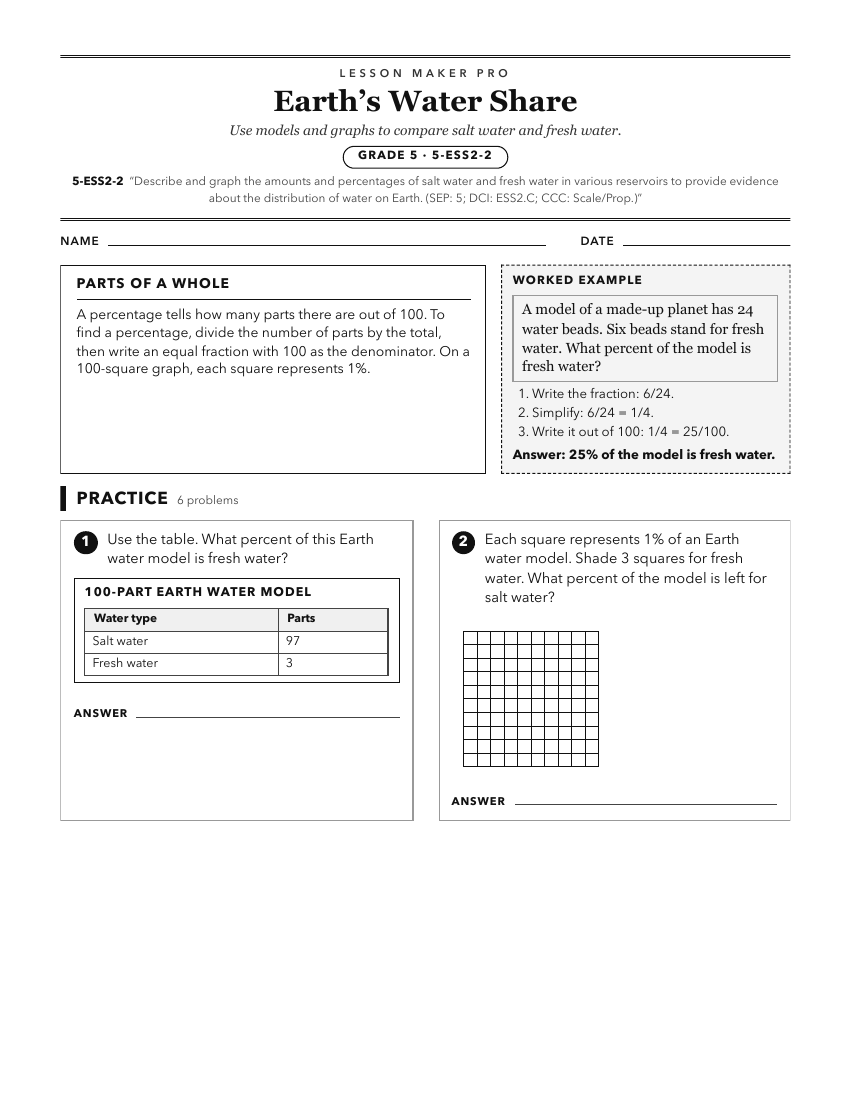
A ready-to-print activity worksheet aligned to 5-ESS2-2, with an answer key for the teacher on its own page. No account needed.
PDF, US Letter, prints cleanly in black and white.
Download the worksheetKeep exploring
Related Standards
Turn this exact standard into a lesson
Grade, subject, topic, and the complete standard are prefilled. Create one free, no account needed.
Also for this standard:Make a WorksheetMake a QuizMake a Sub Lesson