South Dakota ELA 9-10.SL.3
The Standard
Evaluate a speaker’s point of view, reasoning, intended audience, and use of evidence and rhetoric, identifying any faulty reasoning or exaggerated or distorted evidence.
South Dakota English Language Arts Standards (2025)
Teacher's field guide
What This Standard Means
What Students Need to Do
- Students listen to a speaker and identify the speaker’s position and intended audience. They check whether the reasons and evidence support the claim, and notice words that exaggerate or distort it.
What Mastery Looks Like
- A student can explain why one story does not prove a claim about everyone. They can point to the speaker’s exact words and explain how those words might sway the audience.
Common Misconceptions
- Students may mistake a confident tone or a personal story for strong evidence. They may miss words like “everyone” that stretch a claim, or call an opinion faulty without explaining why.
How to Assess It
- Read aloud: “Parents, every student checks a phone during class, so phones must be banned. One student failed a test after texting.” Ask students to name the audience and position, explain why the evidence falls short, and identify the exaggerated word.
Lesson moves
Ways to Teach It
Give pairs a printed phone-ban pitch; have them underline the claim, box its evidence, and circle words such as “every” or “always.”
Ask students to discuss whether one failed test proves phones hurt everyone and why a parent might accept that claim.
Deal cards reading “one friend’s story,” “100-student survey,” and “everyone knows”; teams rank the evidence and explain their choices.
Play a 30-second phone commercial; students name its target buyer and check whether the spoken claim matches the proof on screen.
Free download
Printable 9-10.SL.3 Worksheet
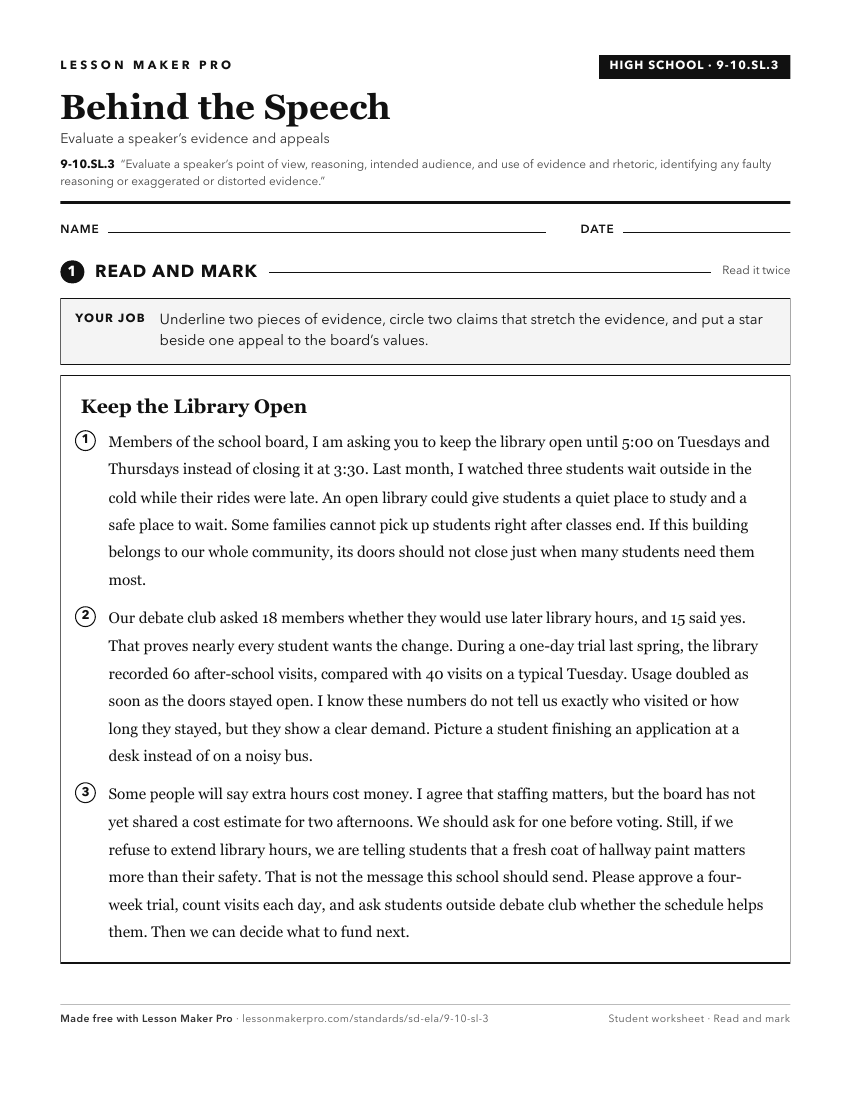
A ready-to-print activity worksheet aligned to 9-10.SL.3, with an answer key for the teacher on its own page. No account needed.
PDF, US Letter, prints cleanly in black and white.
Download the worksheetKeep exploring
Related Standards
- 11-12.SL.3
Evaluate a speaker's point of view, reasoning, intended audience, and use of evidence and rhetoric, assessing the stance, premises, links among ideas, word choi...
- 11-12.RI.6
Determine an author’s point of view or purpose in a text in which the rhetoric is particularly effective, analyzing how style and content contribute to its over...
Turn this exact standard into a lesson
Grade, subject, topic, and the complete standard are prefilled. Create one free, no account needed.
Also for this standard:Make a WorksheetMake a QuizMake a Sub Lesson