South Dakota ELA 11-12.SL.3
The Standard
Evaluate a speaker’s point of view, reasoning, intended audience, and use of evidence and rhetoric, assessing the stance, premises, links among ideas, word choice, points of emphasis, and tone used.
South Dakota English Language Arts Standards (2025)
Teacher's field guide
What This Standard Means
What Students Need to Do
- Students identify a speaker’s position, intended audience, and assumptions. They check whether the reasons and evidence support the claim. They explain how emphasis, word choice, and tone shape the message.
What Mastery Looks Like
- A student can point to a claim, evidence, and an unstated assumption in a short speech. They can explain where the reasoning holds or breaks and how a loaded phrase might affect the intended audience.
Common Misconceptions
- Students may treat a confident tone as proof or assume a statistic is strong evidence without checking what it measures. They may list reasons without checking whether those reasons support the claim.
How to Assess It
- Read aloud: “School board, start classes at 9; 70% of surveyed students feel tired, so anyone opposed ignores students.” On an exit ticket, have students name the claim and audience, question the link between the survey and the claim, and explain the tone of “ignores students.”
Lesson moves
Ways to Teach It
Print the school board statement from the exit ticket; pairs highlight its claim, circle evidence, and draw an arrow between them.
Ask, “Would ‘ignores students’ persuade a school board member or push them away?” Have students explain their answer using tone.
Read four claims with reasons aloud; teams vote “supports” or “does not support,” then name an assumption behind one claim.
Play a 30-second car commercial; students identify its target buyers, check one claim, and note which phrase the voice stresses.
Free download
Printable 11-12.SL.3 Worksheet
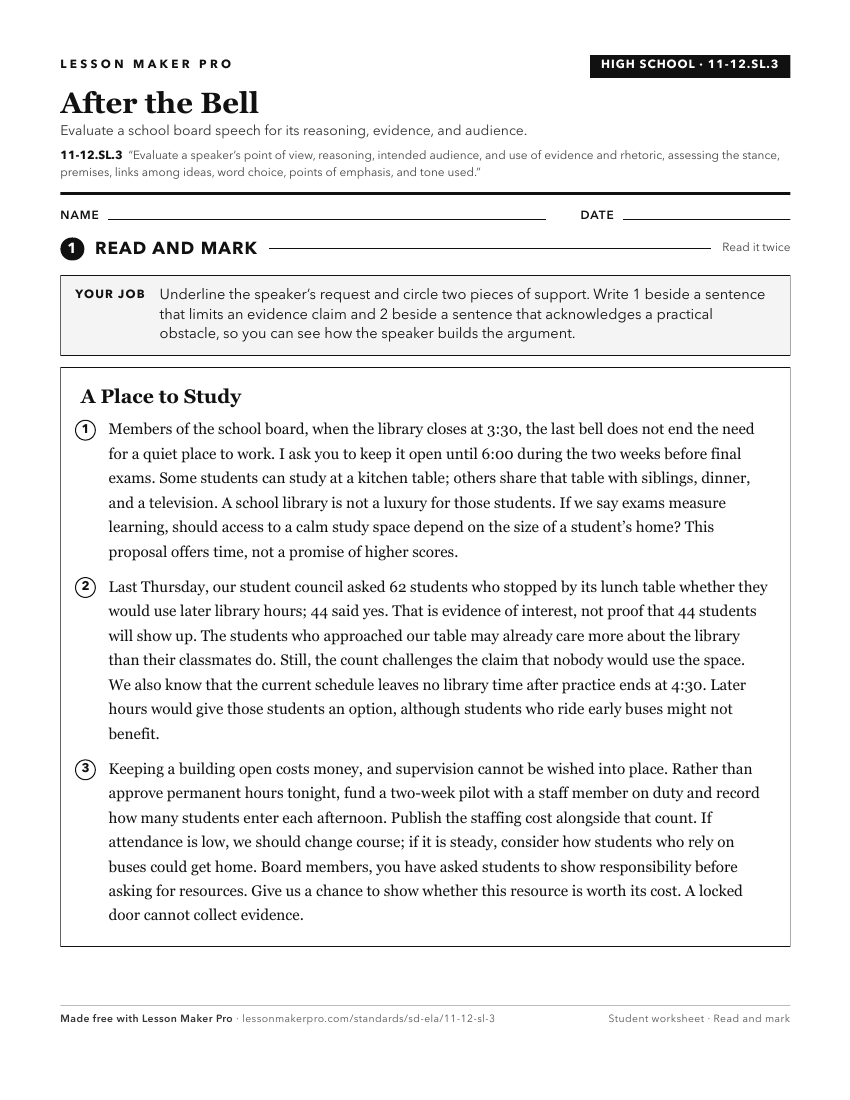
A ready-to-print activity worksheet aligned to 11-12.SL.3, with an answer key for the teacher on its own page. No account needed.
PDF, US Letter, prints cleanly in black and white.
Download the worksheetKeep exploring
Related Standards
- 9-10.SL.3
Evaluate a speaker's point of view, reasoning, intended audience, and use of evidence and rhetoric, identifying any faulty reasoning or exaggerated or distorted...
- 11-12.RI.6
Determine an author’s point of view or purpose in a text in which the rhetoric is particularly effective, analyzing how style and content contribute to its over...
Turn this exact standard into a lesson
Grade, subject, topic, and the complete standard are prefilled. Create one free, no account needed.
Also for this standard:Make a WorksheetMake a QuizMake a Sub Lesson