South Dakota ELA 5.L.2.a
The Standard
- 5.L.2
- Demonstrate command of the conventions of standard English capitalization, punctuation, and spelling when writing.
Use commas to separate phrases and clauses in a series.
South Dakota English Language Arts Standards (2025)
Teacher's field guide
What This Standard Means
What Students Need to Do
- Students find phrases or clauses that form a series in a sentence. They put commas between those parts so readers can follow the list.
What Mastery Looks Like
- A student can write, 'We walked by the pond, along the creek, and past the dock.' They can also punctuate, 'Sam opened the gate, Lee carried the bags, and I held the dog,' and point to each clause.
Common Misconceptions
- Some students put commas inside a phrase, such as between 'tall' and 'bookshelf' in 'behind the tall bookshelf.' Others leave out commas when the parts of the series are full clauses.
How to Assess It
- Exit ticket: Add commas to 'We practiced before lunch after school and on Saturday' and 'I packed my bag my brother checked the map and we left.'
Lesson moves
Ways to Teach It
Give pairs a We looked strip, three location strips, and comma tiles; ask them to build a sentence and add commas.
Ask students to write three complete clauses about yesterday's class, join them with and, and explain where they placed each comma.
Teams race to punctuate 'We waited after lunch before recess and at dismissal,' then read each phrase aloud.
Have students draft a field trip reminder: 'Refill your water bottle before boarding, at lunch, and after hiking.'
Free download
Printable 5.L.2.a Worksheet
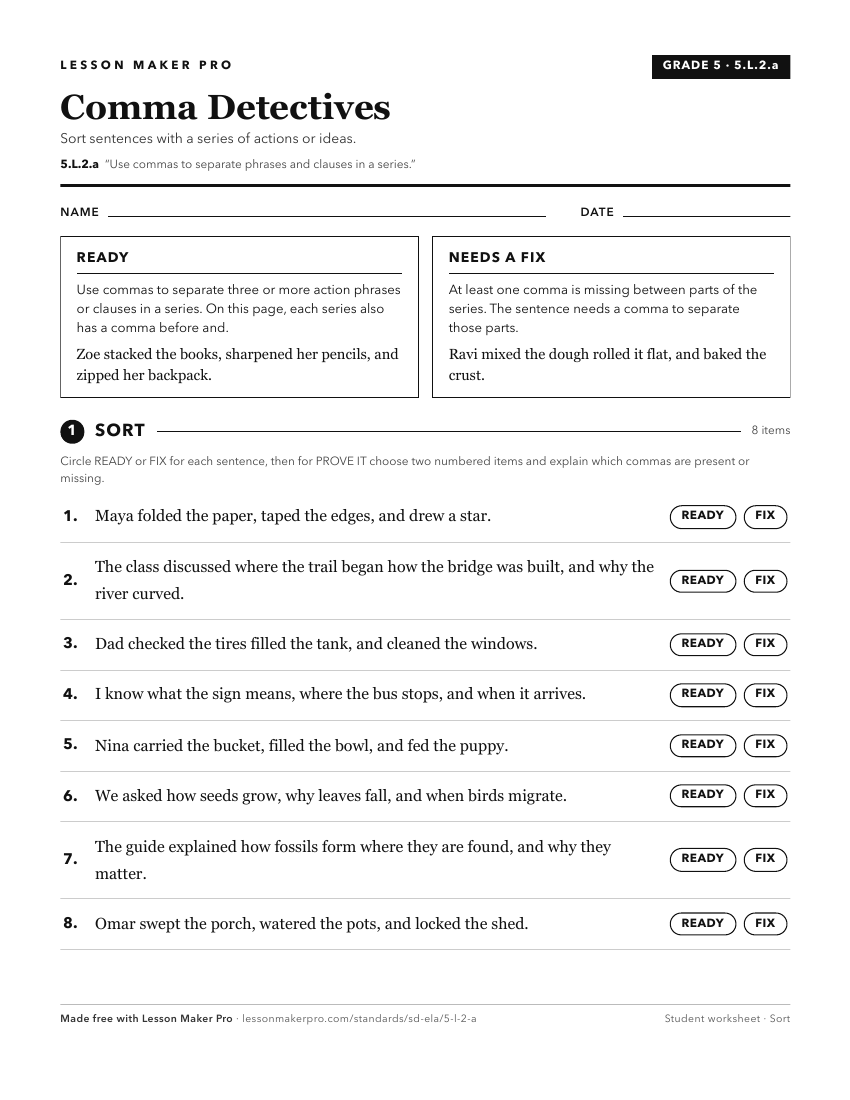
A ready-to-print activity worksheet aligned to 5.L.2.a, with an answer key for the teacher on its own page. No account needed.
PDF, US Letter, prints cleanly in black and white.
Download the worksheetKeep exploring
Related Standards
- 2.L.2.c
Use commas in greetings and closings of letters. Use commas to separate single words in a series. Use commas in compound sentences.
- 1.L.2.d
Use commas in dates.
- 3.L.2.c
Use commas in greetings and closings of letters, in addresses, to separate single words in a series and in compound sentences.
- 7.L.2.b
Use commas and semicolons appropriately in compound and complex sentence structure.
Turn this exact standard into a lesson
Grade, subject, topic, and the complete standard are prefilled. Create one free, no account needed.
Also for this standard:Make a WorksheetMake a QuizMake a Sub Lesson