South Dakota ELA 3.L.2.c
The Standard
- 3.L.2
- Demonstrate command of the conventions of standard English capitalization, punctuation, and spelling when writing.
Use commas in greetings and closings of letters, in addresses, to separate single words in a series and in compound sentences.
South Dakota English Language Arts Standards (2025)
Teacher's field guide
What This Standard Means
What Students Need to Do
- Students add commas to letter greetings and closings, addresses, and lists of single words. They also use a comma before a joining word when it connects two complete thoughts.
What Mastery Looks Like
- A student writes “Dear Sam,” and “Your friend,” and formats an address as “12 Oak St., Pierre, SD 57501.” They write “pens, tape, and glue” and “I wrote the note, and Dad mailed it.”
Common Misconceptions
- Students may write “Dear, Sam” or put a comma between a state and ZIP code. They may also put a comma before every “and,” even when the words after it are not a complete thought.
How to Assess It
- Exit ticket: Ask students to add commas to “Dear Mia,” “Your friend,” “12 Oak St. Pierre SD 57501,” “pens tape and glue,” and “I wrote the note and Dad mailed it.”
Lesson moves
Ways to Teach It
Give pairs strips with an unpunctuated greeting, closing, address, and list; have them place comma stickers and explain each choice.
Compare “I fed the dog and washed the bowl” with “I fed the dog and Mom washed the bowl”; explain the comma choice.
Play comma relay: teams correct four cards, one greeting, one address, one list, and one compound sentence.
Have students write a thank-you letter to the school custodian with a greeting, closing, return address, and two complete thoughts joined in one sentence.
Free download
Printable 3.L.2.c Worksheet
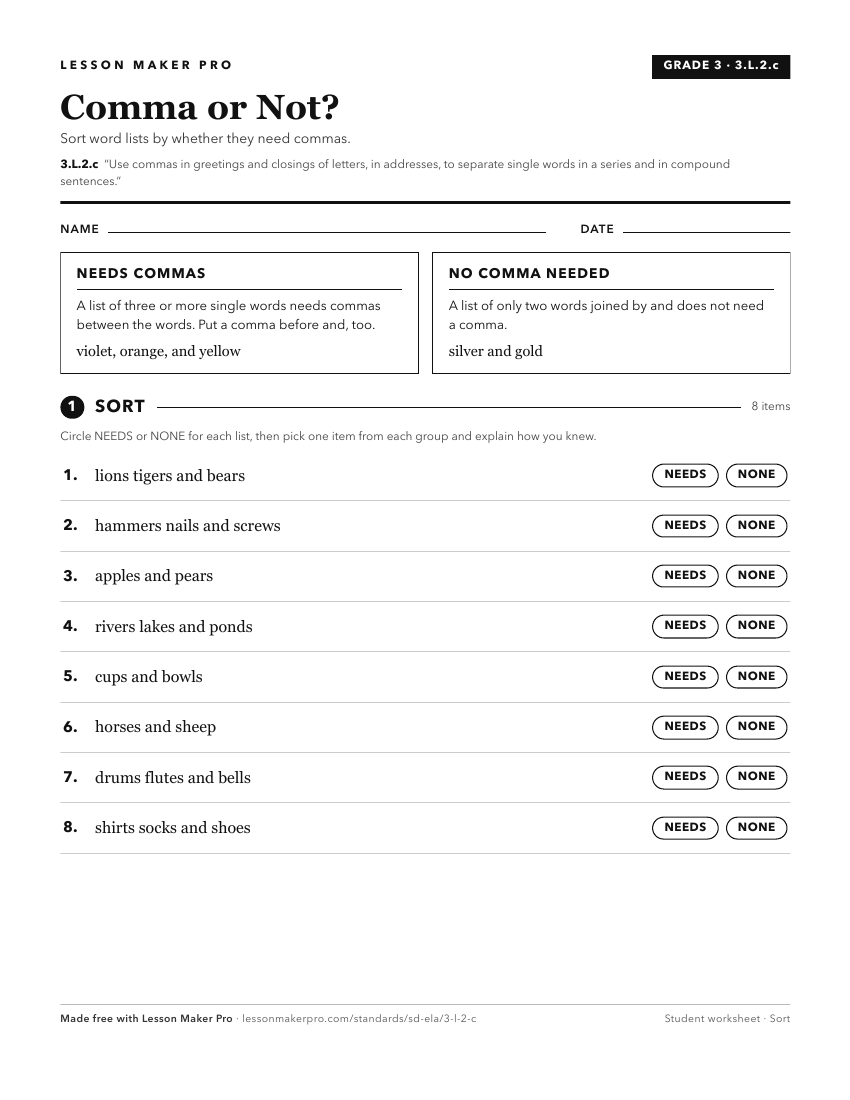
A ready-to-print activity worksheet aligned to 3.L.2.c, with an answer key for the teacher on its own page. No account needed.
PDF, US Letter, prints cleanly in black and white.
Download the worksheetKeep exploring
Related Standards
- 2.L.2.c
Use commas in greetings and closings of letters. Use commas to separate single words in a series. Use commas in compound sentences.
- 5.L.2.a
Use commas to separate phrases and clauses in a series.
- 1.L.2.d
Use commas in dates.
- 7.L.2.b
Use commas and semicolons appropriately in compound and complex sentence structure.
Turn this exact standard into a lesson
Grade, subject, topic, and the complete standard are prefilled. Create one free, no account needed.
Also for this standard:Make a WorksheetMake a QuizMake a Sub Lesson