South Dakota ELA 11-12.RI.10
Standard Cluster
By the end of the year, independently read and comprehend literary nonfiction and informational texts representing a variety of genres, cultures, and perspectives that exhibit complexity appropriate for at least grade 11 and 12. Demonstrate proficiency in reading and comprehending grade-appropriate texts. Self-select texts for personal enjoyment, interest, and academic tasks. Read widely to understand diverse perspectives and viewpoints.
South Dakota English Language Arts Standards (2025)
Cluster contents
Standards in This Cluster
11-12.RI.10 is a cluster heading. These are the individual standards under it.
Teacher's field guide
What This Cluster Means
What Students Need to Do
- Students read challenging nonfiction on their own, including speeches, essays, memoirs, and reporting. They explain what each writer says and how the writer’s perspective shapes the account. They choose texts for pleasure, curiosity, and schoolwork, including texts with unfamiliar viewpoints.
What Mastery Looks Like
- A student reads a demanding essay or speech without help and explains its main idea with accurate details. They identify clues to the writer’s viewpoint in word choice and context. They choose texts for different purposes and compare views on a shared issue.
Common Misconceptions
- Some students name the topic but miss the writer’s actual point. Others treat a personal account as an objective report or assume an unfamiliar viewpoint is wrong. They may pick only short, familiar texts and mistake finishing for understanding.
How to Assess It
- Offer one-page excerpts from Frederick Douglass’s 1852 Fourth of July speech and George Orwell’s “Shooting an Elephant.” Students choose one and write its main point, one supporting line, and how the writer’s position shapes the account.
Lesson moves
Ways to Teach It
Set out printed excerpts from a speech, memoir, and news feature; students choose one, annotate the writer’s viewpoint, and post a supporting line.
After reading Douglass’s Fourth of July speech, ask: “Who is his audience, and which lines show his view of them?”
In pairs, students draw excerpt cards from Douglass’s speech and Orwell’s essay, identify an implied point, and earn a point for quoted support.
Students choose a local news story on a school board decision, then compare its account with the board meeting minutes.
Free download
Printable 11-12.RI.10 Worksheet
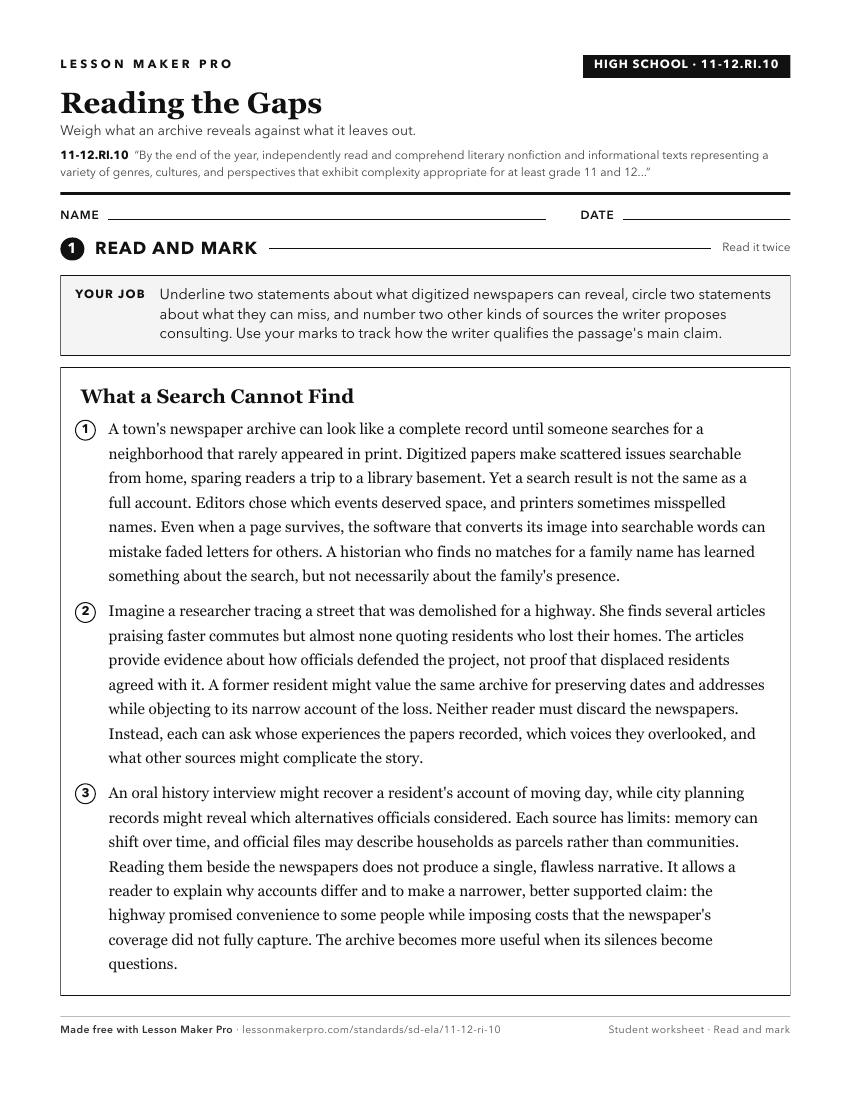
A ready-to-print activity worksheet aligned to 11-12.RI.10, with an answer key for the teacher on its own page. No account needed.
PDF, US Letter, prints cleanly in black and white.
Download the worksheetKeep exploring
Related Standards
- 9-10.RI.10
By the end of the year, independently read and comprehend literary nonfiction and informational texts representing a variety of genres, cultures, and perspectiv...
- 9-10.RL.10
By the end of the year, independently read and comprehend literary texts representing a variety of genres, cultures, and perspectives that exhibit complexity ap...
- 11-12.RL.10
By the end of the year, independently read and comprehend literary texts representing a variety of genres, cultures, and perspectives that exhibit complexity ap...
- 8.RI.10
By the end of the year, independently read and comprehend literary nonfiction and informational texts representing a variety of genres, cultures, and perspectiv...
Turn this cluster into a lesson
Grade, subject, topic, and the complete cluster are prefilled. Create one free, no account needed.
Also for this cluster:Make a WorksheetMake a QuizMake a Sub Lesson