South Dakota ELA 11-12.L.5.b
The Standard
- 11-12.L.5
- Demonstrate understanding of semantics.
Analyze word relationships (morphology, etymology, linguistics) and their role in creating nuanced meaning.
South Dakota English Language Arts Standards (2025)
Teacher's field guide
What This Standard Means
What Students Need to Do
- Students break related words into roots, prefixes, and suffixes. They use word history and sentence context to explain why related words have different shades of meaning.
What Mastery Looks Like
- A student can trace “credible,” “credulous,” and “incredulous” to a Latin word meaning believe. They can explain what the added parts change and choose the right word for a sentence.
Common Misconceptions
- Students may treat words with the same root as synonyms and use “incredible” to describe a skeptical listener. They may also assume a word’s oldest meaning is its only meaning, missing how “incredible” can mean hard to believe or impressive.
How to Assess It
- On an exit ticket, ask: Why are “an incredible story” and “an incredulous listener” not interchangeable? Identify their shared root and explain what each ending adds.
Lesson moves
Ways to Teach It
Give students tiles marked cred, in-, -ible, and -ulous; have them build words, check dictionary entries, and match each word to a person or claim.
Ask students to write why “an incredulous witness” differs from “an incredible witness,” using the word parts and sentence context.
Give teams sentence cards with blanks for credible, credulous, incredible, and incredulous; have them fill each blank and defend their choices.
Show a news headline calling a claim “incredible” and a reader comment calling its source “credible”; ask how each word affects trust.
Free download
Printable 11-12.L.5.b Worksheet
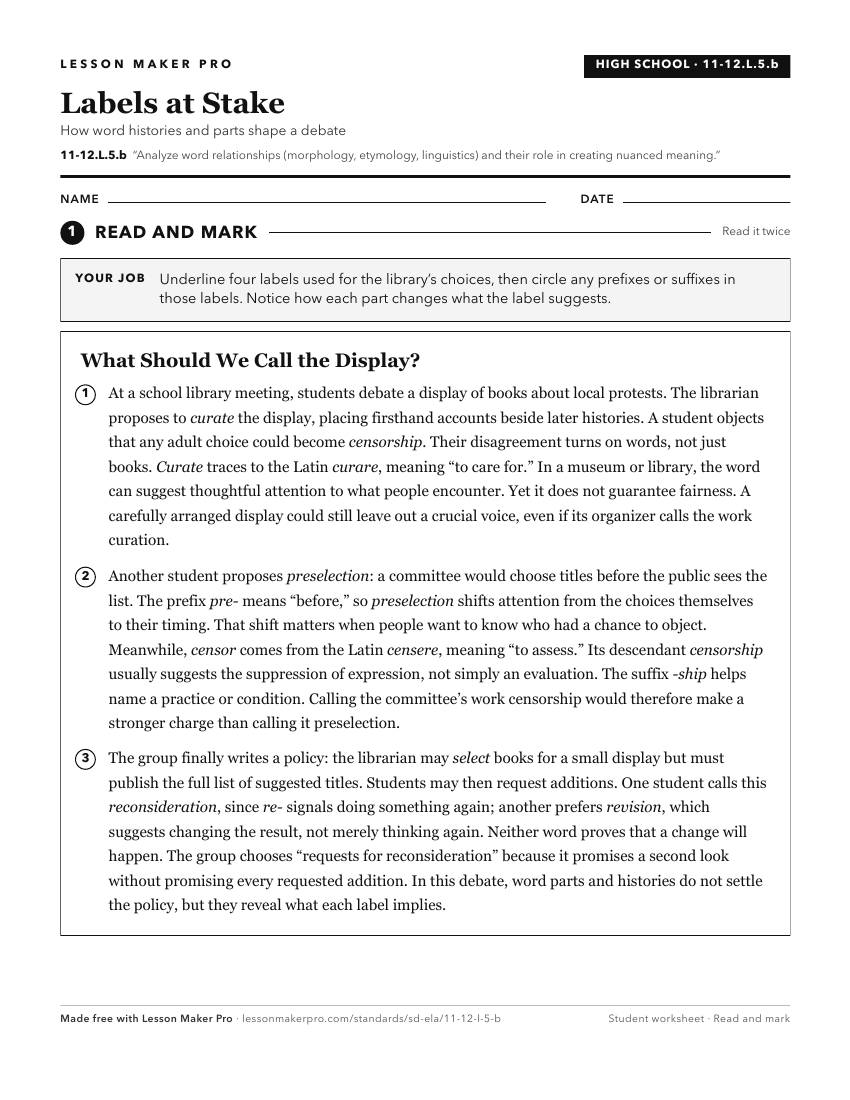
A ready-to-print activity worksheet aligned to 11-12.L.5.b, with an answer key for the teacher on its own page. No account needed.
PDF, US Letter, prints cleanly in black and white.
Download the worksheetKeep exploring
Related Standards
- 3.L.5
Demonstrate understanding of word relationships and subtle differences in word meanings.
- 9-10.L.5.b
Analyze word relationships (morphology, etymology, and linguistics) and their role in creating nuanced meaning.
- 11-12.L.4.b
Analyze morphology to explore different meanings or parts of speech (e.g., conceive, conception, conceivable).
- 9-10.L.4.b
Use morphology to indicate different meanings or parts of speech (e.g., analyze, analysis, analytical; advocate, advocacy).
Turn this exact standard into a lesson
Grade, subject, topic, and the complete standard are prefilled. Create one free, no account needed.
Also for this standard:Make a WorksheetMake a QuizMake a Sub Lesson