South Dakota ELA 11-12.L.4.b
The Standard
- 11-12.L.4
- Determine or clarify the meaning of unknown and multiple-meaning words and phrases based on grades 11–12 reading and content, choosing flexibly from a range of strategies.
Analyze morphology to explore different meanings or parts of speech (e.g., conceive, conception, conceivable).
South Dakota English Language Arts Standards (2025)
Teacher's field guide
What This Standard Means
What Students Need to Do
- Students break related words into base words, prefixes, and suffixes. They explain how those parts change meaning or a word’s role in a sentence.
What Mastery Looks Like
- A student can explain why predict is a verb, prediction is a noun, and predictable is an adjective. They can use each in a sentence and explain what the ending adds.
Common Misconceptions
- Some students call prediction a verb because predict is a verb. Others treat prediction and predictable as synonyms and miss that -able means “able to be.”
How to Assess It
- Exit ticket: Complete “The outcome was ___” with predict, prediction, or predictable. Name its part of speech and explain what -able adds.
Lesson moves
Ways to Teach It
Give pairs cards with predict, prediction, predictable, and unpredictable; have them sort by part of speech and mark the parts that change meaning.
Write two sentences using persuade and persuasive, then explain why swapping the words would break each sentence.
Play suffix swap: show create, creation, and creative beside sentence blanks; teams choose the fitting word and name its part of speech.
Give students a mock job posting with “analyze data” and “analytical skills”; ask why each word form fits its phrase.
Free download
Printable 11-12.L.4.b Worksheet
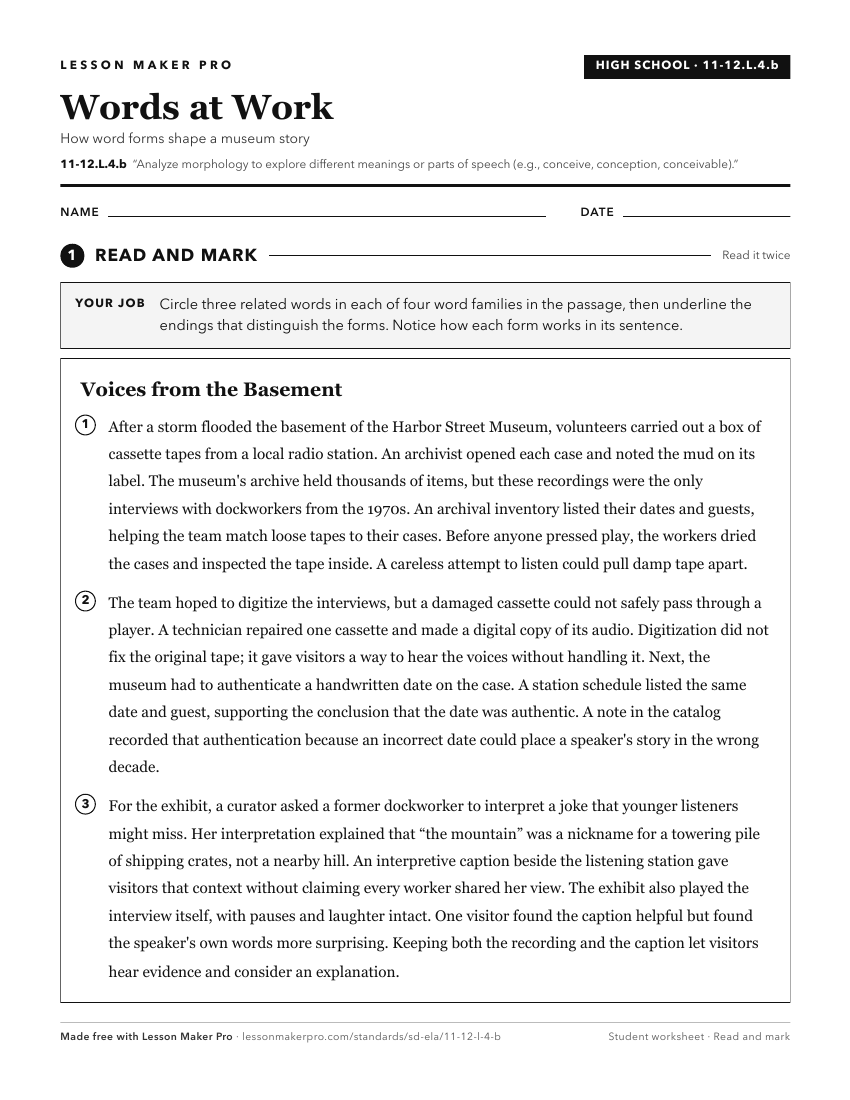
A ready-to-print activity worksheet aligned to 11-12.L.4.b, with an answer key for the teacher on its own page. No account needed.
PDF, US Letter, prints cleanly in black and white.
Download the worksheetKeep exploring
Related Standards
- 11-12.L.5.c
Analyze connotative meanings of words with similar denotations.
- 11-12.L.5.b
Analyze word relationships (morphology, etymology, linguistics) and their role in creating nuanced meaning.
- 9-10.L.5.b
Analyze word relationships (morphology, etymology, and linguistics) and their role in creating nuanced meaning.
- 9-10.L.4.b
Use morphology to indicate different meanings or parts of speech (e.g., analyze, analysis, analytical; advocate, advocacy).
Turn this exact standard into a lesson
Grade, subject, topic, and the complete standard are prefilled. Create one free, no account needed.
Also for this standard:Make a WorksheetMake a QuizMake a Sub Lesson