South Dakota ELA 1.RL.4
The Standard
Identify words and phrases in stories, poems, songs, or other texts that have literal (e.g., explicit language) and non-literal meanings (e.g., figurative language) including but not limited to emotions (e.g., feelings or appealing to the senses).
South Dakota English Language Arts Standards (2025)
Teacher's field guide
What This Standard Means
What Students Need to Do
- Students find words and phrases in a story, poem, or song that describe feelings or what someone senses. They tell whether the words mean exactly what they say or mean something else.
What Mastery Looks Like
- A student explains that “my heart sank” means a character felt sad, not that a heart moved. They point to “cold rain” and say it helps them imagine how the rain feels.
Common Misconceptions
- Students may picture a heart falling when they hear “my heart sank.” They may also call every feeling word figurative, even a plain word like “sad.”
How to Assess It
- Give students these lines: “Cold rain hit Mia’s face. Her heart sank when she saw the empty bench.” Ask them to circle a touch detail and explain what “her heart sank” means.
Lesson moves
Ways to Teach It
Give pairs phrase cards, such as “cold hands” and “my heart sank,” to sort into literal and nonliteral piles.
Read “My stomach did flips before the show” aloud, then ask, “Did it really flip, and how does the speaker feel?”
Play a sorting race with cards reading “hot soup,” “buzzing bees,” and “butterflies in my stomach”; have partners explain each choice.
At lunch, point to an apple and ask, “Is ‘crunchy apple’ literal, and what might ‘a mountain of fries’ mean?”
Free download
Printable 1.RL.4 Worksheet
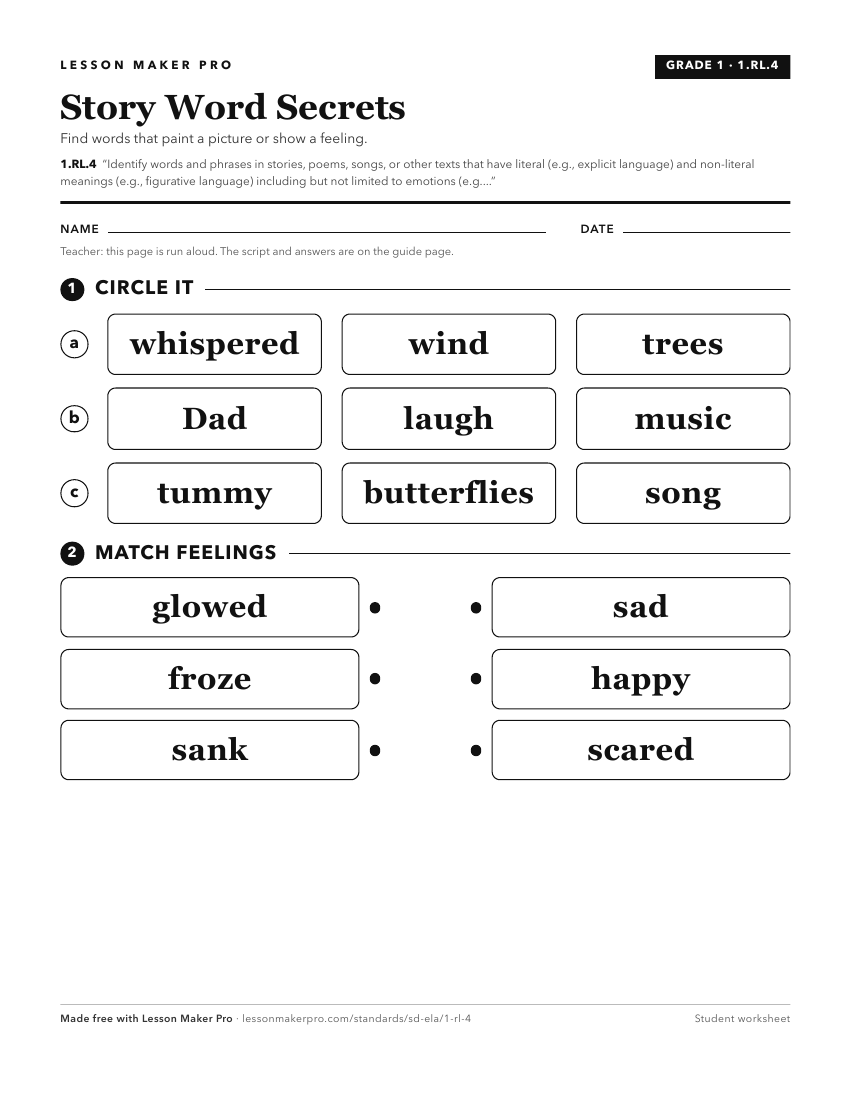
A ready-to-print activity worksheet aligned to 1.RL.4, with an answer key for the teacher on its own page. No account needed.
PDF, US Letter, prints cleanly in black and white.
Download the worksheetKeep exploring
Related Standards
- 3.RL.4
Identify and explain the meaning of words and phrases as they are used in a text, distinguishing literal from nonliteral language.
- 5.RL.4
Determine the meaning of words and phrases as they are used in a text, including figurative language (e.g., personification, hyperbole) and connotative meanings...
- 2.RL.4
Identify and explain how words and phrases create meaning or tone in stories, poems, songs or other texts that have literal and non-literal meanings including b...
Turn this exact standard into a lesson
Grade, subject, topic, and the complete standard are prefilled. Create one free, no account needed.
Also for this standard:Make a WorksheetMake a QuizMake a Sub Lesson