South Dakota ELA 3.RL.4
The Standard
Identify and explain the meaning of words and phrases as they are used in a text, distinguishing literal from nonliteral language.
South Dakota English Language Arts Standards (2025)
Teacher's field guide
What This Standard Means
What Students Need to Do
- Students figure out what a word or phrase means in a story by looking at nearby details. They tell whether it describes something that really happened or means something else.
What Mastery Looks Like
- A student reads, 'When everyone shouted at once, the classroom was a zoo,' and explains that the room was noisy, not full of animals. They point to 'everyone shouted' as a clue.
Common Misconceptions
- Students may picture actual animals when they read 'the classroom was a zoo.' They may also know what an expression means but struggle to point to the words that helped them figure it out.
How to Assess It
- Read: 'Before her turn onstage, Mia had butterflies in her stomach.' Ask students to write what the phrase means, whether the butterflies are real, and which words helped them decide.
Lesson moves
Ways to Teach It
Give pairs two sticky notes to sketch real butterflies and nervous feelings beside the sentence about Mia's turn onstage.
Ask partners: 'Why does the writer call the noisy classroom a zoo? Which words help you tell?'
Play a card sort with 'My backpack weighs a ton' and 'The truck carries a ton of gravel'; students explain each choice.
Show a lunch poster reading 'Our pizza is out of this world'; have students write what the cook means.
Free download
Printable 3.RL.4 Worksheet
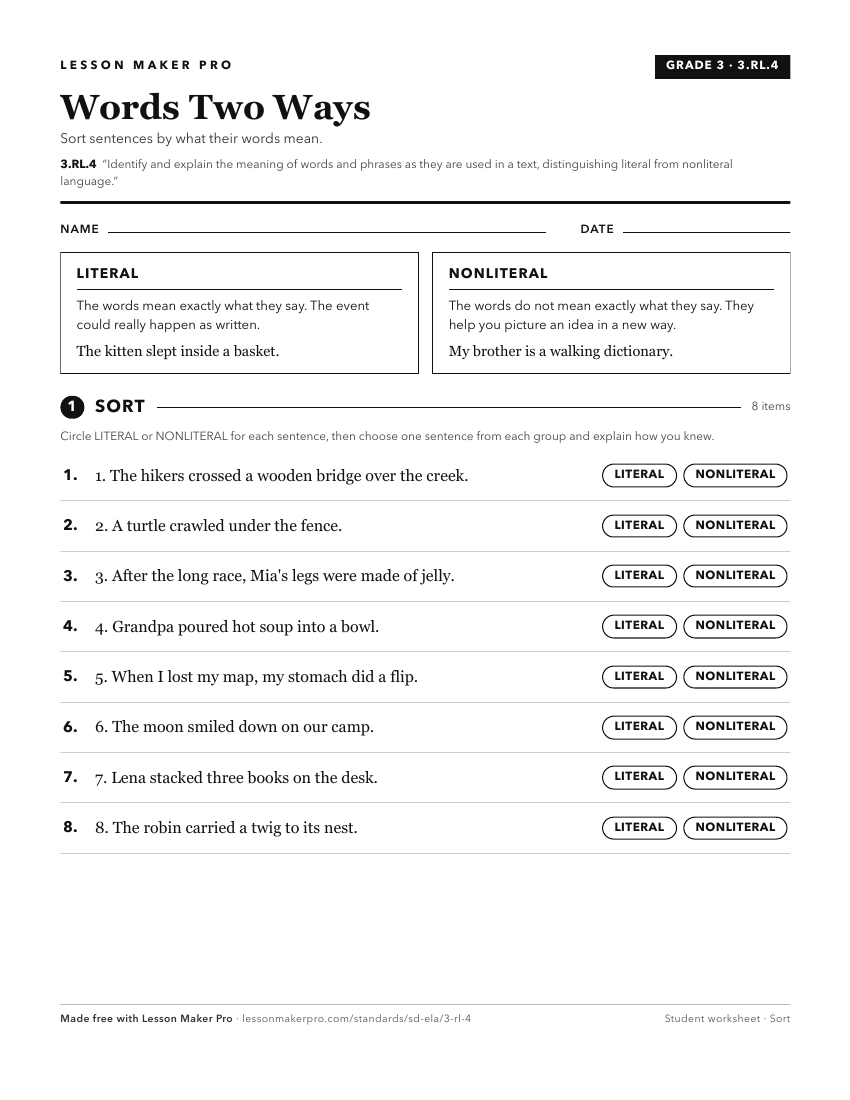
A ready-to-print activity worksheet aligned to 3.RL.4, with an answer key for the teacher on its own page. No account needed.
PDF, US Letter, prints cleanly in black and white.
Download the worksheetKeep exploring
Related Standards
- 5.RL.4
Determine the meaning of words and phrases as they are used in a text, including figurative language (e.g., personification, hyperbole) and connotative meanings...
- 4.RL.4
Determine the meaning of words and phrases as they are used in a text, including figurative language (e.g., metaphors and similes).
Turn this exact standard into a lesson
Grade, subject, topic, and the complete standard are prefilled. Create one free, no account needed.
Also for this standard:Make a WorksheetMake a QuizMake a Sub Lesson