Oklahoma Social Studies USG.P.3.2.A
The Standard
- USG.P.3
- Engage in critical, active reading of primary and secondary sources related to social studies concepts.
- USG.P.3.2
- Apply critical reading and thinking skills to interpret, evaluate, and respond to a variety of complex texts and perspectives.
Evaluate the extent to which historical or cultural perspectives affect an author’s stated or implied purpose.
Oklahoma Academic Standards for Social Studies (2026) · USG.P.3.2
Teacher's field guide
What This Standard Means
What Students Need to Do
- Students identify what a writer wants readers to think or do, even when the writer does not say it outright. They use the writer’s words and background to judge how much that background shaped the purpose.
What Mastery Looks Like
- A student can point to a phrase in Douglass’s Fourth of July speech and explain how his experience with slavery shaped his purpose. They can also explain why his audience matters, rather than claiming his background explains everything.
Common Misconceptions
- Students may mistake the topic for the purpose, saying a speech is about slavery rather than meant to challenge its audience. They may assume a writer’s identity proves intent without citing words from the source.
How to Assess It
- Exit ticket: Give students Douglass’s line, “What, to the American slave, is your 4th of July?” Ask them to name his implied purpose and explain how much his experience with slavery shapes it, using one word or phrase as evidence.
Lesson moves
Ways to Teach It
Give pairs printed lines from Douglass’s Fourth of July speech; have them sort lines into appeals to shared ideals and challenges to slavery.
Ask: How much does Douglass’s experience with slavery explain his purpose, and what words suggest another reason for addressing his audience?
Hand out cards with lines from Douglass’s speech and purpose claims; pairs match cards, then reject one claim using a quoted phrase.
Compare a city fireworks notice with a veterans group’s July Fourth message; circle wording that shows how each group’s view shapes its purpose.
Free download
Printable USG.P.3.2.A Worksheet
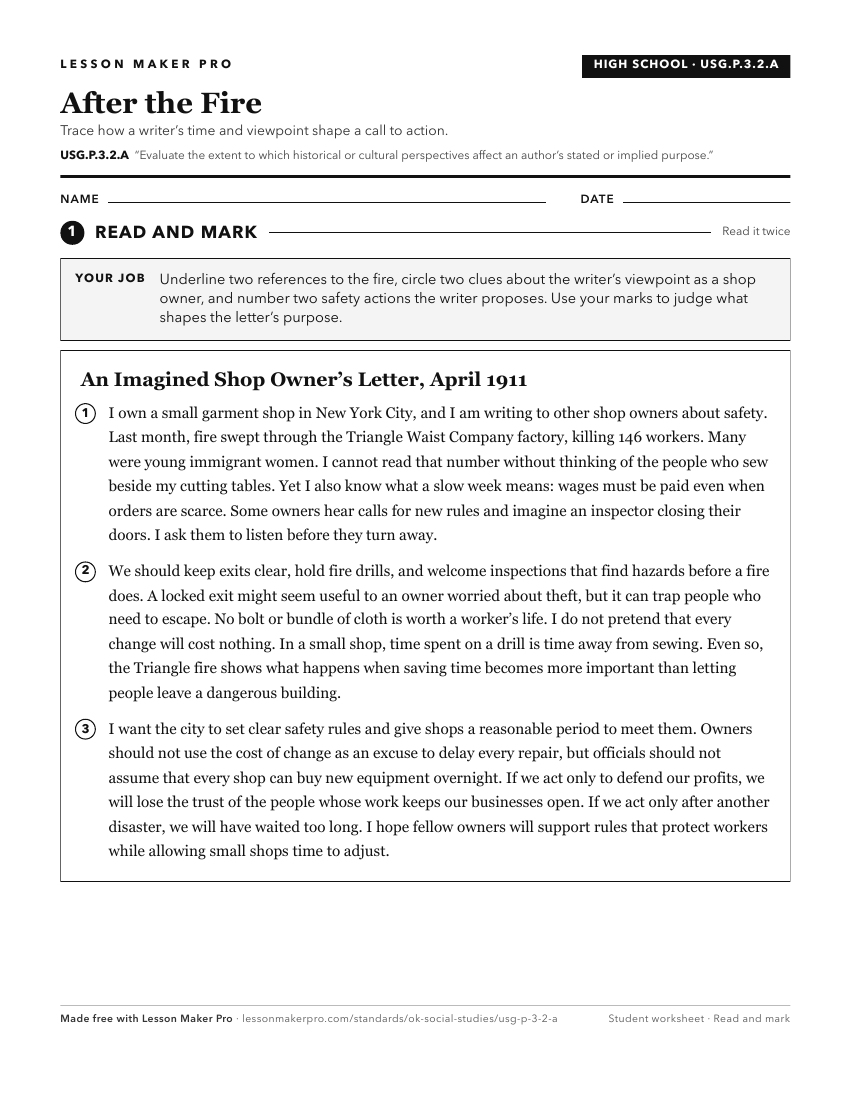
A ready-to-print activity worksheet aligned to USG.P.3.2.A, with an answer key for the teacher on its own page. No account needed.
PDF, US Letter, prints cleanly in black and white.
Download the worksheetKeep exploring
Related Standards
- WG.P.3.2.A
Evaluate the extent to which historical or cultural perspectives affect an author’s stated or implied purpose.
- E.P.3.2.A
Evaluate the extent to which historical or cultural perspectives affect an author’s stated or implied purpose.
- USH.P.3.2.A
Evaluate the extent to which historical or cultural perspectives affect an author’s stated or implied purpose.
- MWH.P.3.2.A
Evaluate the extent to which historical or cultural perspectives affect an author’s stated or implied purpose.
Turn this exact standard into a lesson
Grade, subject, topic, and the complete standard are prefilled. Create one free, no account needed.
Also for this standard:Make a WorksheetMake a QuizMake a Sub Lesson