Oklahoma Social Studies PS.4
Standard Cluster
Describe physical, cognitive, and social development across the lifespan, including processes of human learning. Explain the interaction of environmental and biological factors in human development, including the role of the brain in all aspects of development. Examine major theories of human development. Describe the theories of Jean Piaget, Lawrence Kohlberg, and Erik Erikson regarding human development. Explain the social, cognitive and neurological factors in learning. Identify and explain the major theories of learning including classical conditioning, operant conditioning, social learning theory, and insight learning.
Oklahoma Academic Standards for Social Studies (2026)
Cluster contents
Standards in This Cluster
PS.4 is a cluster heading. These are the individual standards under it.
- PS.4.1
Explain the interaction of environmental and biological factors in human development, including the role of the brain in all aspects of development.
- PS.4.2
Examine major theories of human development.
- PS.4.3
Describe the theories of Jean Piaget, Lawrence Kohlberg, and Erik Erikson regarding human development.
- PS.4.4
Explain the social, cognitive and neurological factors in learning.
- PS.4.5
Identify and explain the major theories of learning including classical conditioning, operant conditioning, social learning theory, and insight learning.
Teacher's field guide
What This Cluster Means
What Students Need to Do
- Trace changes in bodies, thinking, and relationships from infancy through old age. Use Piaget, Kohlberg, and Erikson to explain those changes. Explain how genes, surroundings, and the brain affect learning through conditioning, observation, and insight.
What Mastery Looks Like
- A student can place first steps, abstract reasoning, and changing friendships on a lifespan timeline. They can match a conservation task, a moral dilemma, and an identity question to Piaget, Kohlberg, and Erikson. They can distinguish learned responses, rewards, imitation, and insight, then explain how practice changes brain pathways.
Common Misconceptions
- Students may think Piaget, Kohlberg, and Erikson describe the same kind of growth. They may assume everyone reaches stages at a fixed age or mistake learning through rewards for classical conditioning. They may overlook learning by watching others.
How to Assess It
- Exit ticket: A 10-year-old learns to ride a bike by watching a sibling and practicing after receiving praise. Name two learning theories at work, then explain how practice affects the brain.
Lesson moves
Ways to Teach It
Give groups cards showing first steps, pretend play, peer friendships, and retirement; have them sort by life stage and label each type of change.
Ask students whether a child learns to share differently at home and school, then compare brain development with family rules.
Read four short scenarios aloud, then have pairs hold up cards labeled classical conditioning, operant conditioning, social learning, or insight learning.
Ask students how a family member learned a phone app, then identify the roles of practice and help from others.
Free download
Printable PS.4 Worksheet
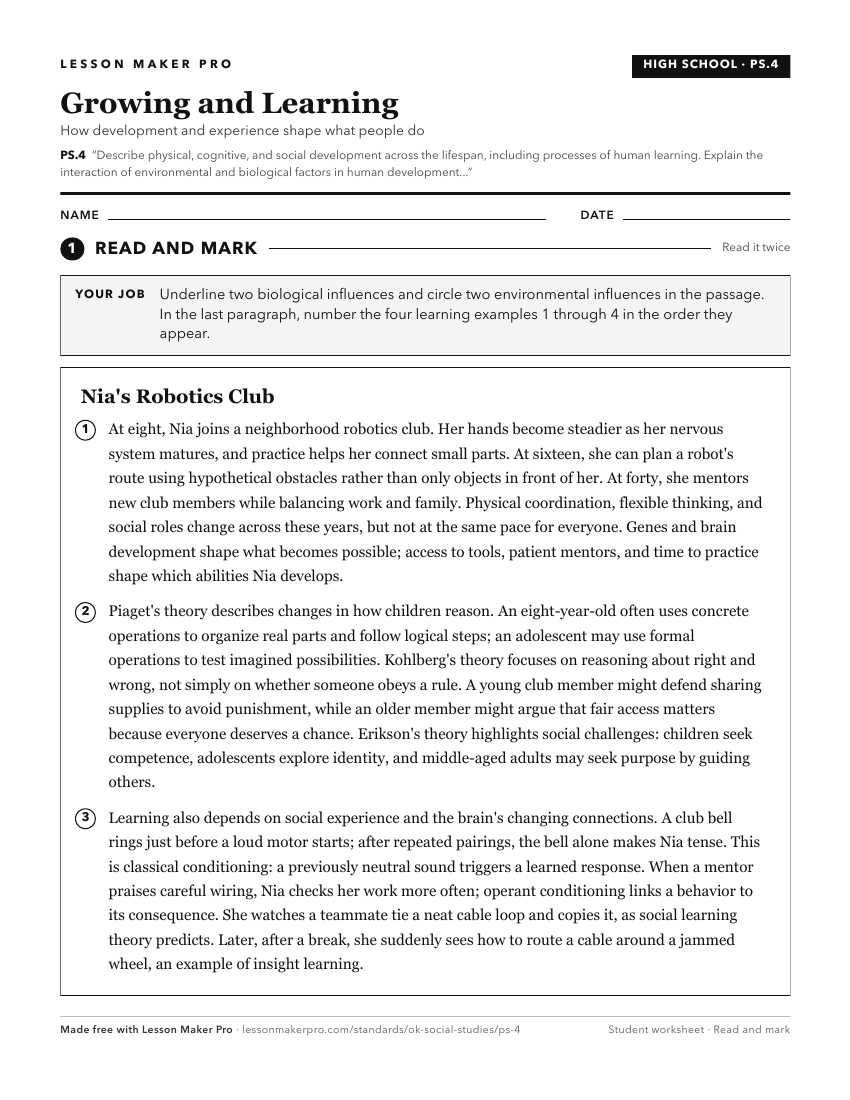
A ready-to-print activity worksheet aligned to PS.4, with an answer key for the teacher on its own page. No account needed.
PDF, US Letter, prints cleanly in black and white.
Download the worksheetTurn this cluster into a lesson
Grade, subject, topic, and the complete cluster are prefilled. Create one free, no account needed.
Also for this cluster:Make a WorksheetMake a QuizMake a Sub Lesson