Oklahoma Social Studies E.P.2.1.C
The Standard
- E.P.2
- Use interdisciplinary tools to acquire, apply, and evaluate content understanding of the four strands of social studies.
- E.P.2.1
- Demonstrate an understanding of the principles of government, the benefits of democratic systems, and their responsibilities as citizens.
Analyze the impact of constitutions, laws, treaties, and international agreements, by comparing how various governmental powers and responsibilities have changed over time.
Oklahoma Academic Standards for Social Studies (2026) · E.P.2.1
Teacher's field guide
What This Standard Means
What Students Need to Do
- Students track how a constitution, law, treaty, or international agreement changes government powers and duties. They compare what officials could or had to do before and after, using details from the documents.
What Mastery Looks Like
- Given the 14th Amendment and the 1964 Civil Rights Act, a student can explain how federal civil rights rules came to cover businesses open to the public. They identify who must follow each rule and support the comparison with words from both documents.
Common Misconceptions
- Students may assume NATO Article 5 requires the U.S. to declare war automatically. They may also apply the 14th Amendment's equal protection rule directly to private businesses, though it restricts state governments.
How to Assess It
- Show students the 14th Amendment's equal protection clause and the 1964 Civil Rights Act's public accommodations rule. Ask: Who must follow each rule, and how did federal authority change?
Lesson moves
Ways to Teach It
Give pairs paper cards for the 14th Amendment, 1964 Civil Rights Act, and 26th Amendment; have them order cards and label shifts in authority.
Read NATO Article 5 beside the Constitution's war powers clauses; ask what U.S. defense commitment was added and what power Congress kept.
Match cards: Louisiana Purchase treaty to U.S. territorial control, 14th Amendment to state equal protection, 1964 Civil Rights Act to federal enforcement.
Check your state's voter registration page against the 26th Amendment; explain why officials cannot set the voting age above 18.
Free download
Printable E.P.2.1.C Worksheet
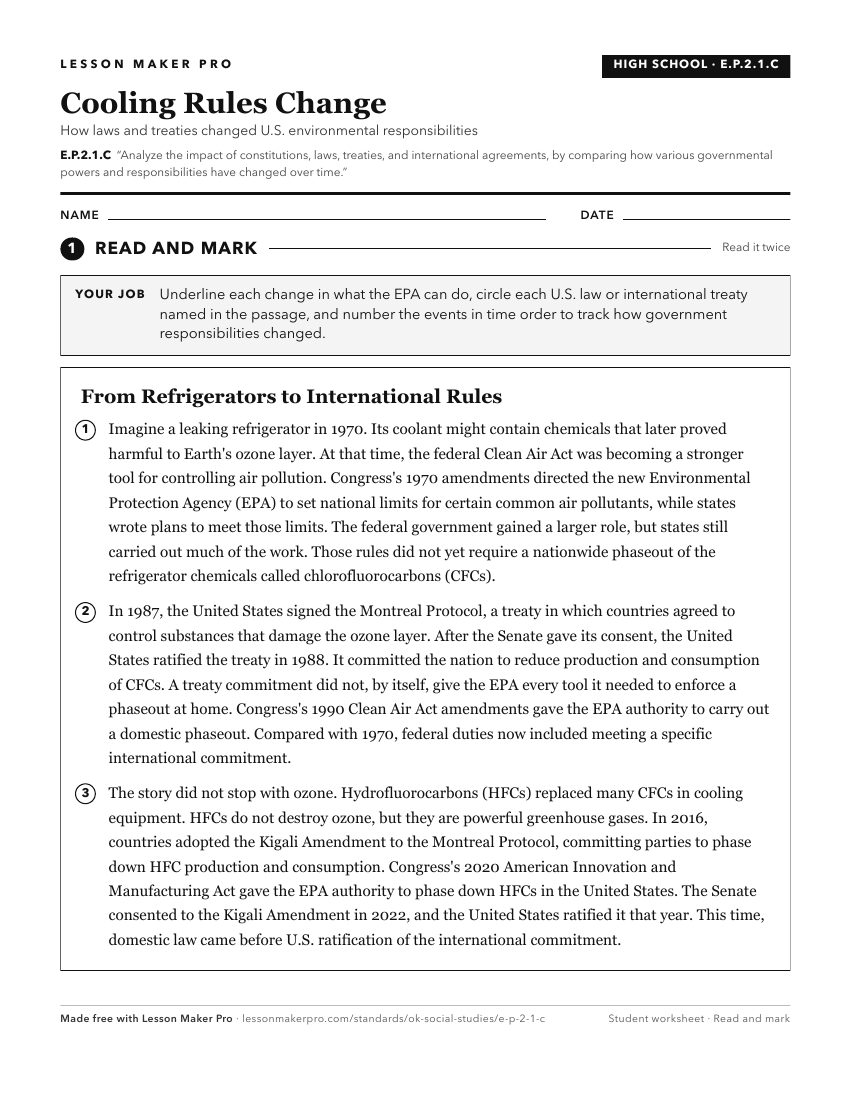
A ready-to-print activity worksheet aligned to E.P.2.1.C, with an answer key for the teacher on its own page. No account needed.
PDF, US Letter, prints cleanly in black and white.
Download the worksheetKeep exploring
Related Standards
- MWH.P.2.1.C
Analyze the impact of constitutions, laws, treaties, and international agreements, by comparing how various governmental powers and responsibilities have change...
- OKH.P.2.1.C
Analyze the impact of constitutions, laws, treaties, and international agreements, by comparing how various governmental powers and responsibilities have change...
- TOT.P.2.1.C
Analyze the impact of constitutions, laws, treaties, and international agreements, by comparing how various governmental powers and responsibilities have change...
- AWH.P.2.1.C
Analyze the impact of constitutions, laws, treaties, and international agreements, by comparing how various governmental powers and responsibilities have change...
Turn this exact standard into a lesson
Grade, subject, topic, and the complete standard are prefilled. Create one free, no account needed.
Also for this standard:Make a WorksheetMake a QuizMake a Sub Lesson