Oklahoma Social Studies E.C.7
Standard Cluster
Analyze the role of entrepreneurs and laborers within a market economy. Define the roles of entrepreneurs and laborers in production of goods and services, including how entrepreneurs organize resources and assume risk while labor provides the human effort necessary for production. Evaluate the role of labor in the economy, explaining how worker productivity influences wages and employment relationships in a market economy. Describe how decisions made by an entrepreneur and a laborer affect job opportunities for others (e.g., profit-maximizing level of output, hiring the optimal number of workers, comparing marginal costs and benefits of producing more or less of a resource). Explain the function of profit as a reward for risk-taking and as a signal guiding entrepreneurial decision-making and resource allocation. Analyze the potential risks and gains to entrepreneurs establishing new businesses or inventing a new product. Evaluate the costs and benefits of incorporation including the expansion of resources and reduction of risks. Analyze the role of labor unions and collective bargaining in market economies, examining how workers organize to negotiate wages, benefits, and working conditions, and evaluating arguments both supporting and opposing unionization and their effects on workers, employers, and economic productivity.
Oklahoma Academic Standards for Social Studies (2026)
Cluster contents
Standards in This Cluster
E.C.7 is a cluster heading. These are the individual standards under it.
- E.C.7.1
Define the roles of entrepreneurs and laborers in production of goods and services, including how entrepreneurs organize resources and assume risk while labor p...
- E.C.7.2
Evaluate the role of labor in the economy, explaining how worker productivity influences wages and employment relationships in a market economy.
- E.C.7.3
Describe how decisions made by an entrepreneur and a laborer affect job opportunities for others (e.g., profit-maximizing level of output, hiring the optimal nu...
- E.C.7.4
Explain the function of profit as a reward for risk-taking and as a signal guiding entrepreneurial decision-making and resource allocation.
- E.C.7.5
Analyze the potential risks and gains to entrepreneurs establishing new businesses or inventing a new product.
- E.C.7.6
Evaluate the costs and benefits of incorporation including the expansion of resources and reduction of risks.
- E.C.7.7
Analyze the role of labor unions and collective bargaining in market economies, examining how workers organize to negotiate wages, benefits, and working conditi...
Teacher's field guide
What This Cluster Means
What Students Need to Do
- Students explain what entrepreneurs and workers each contribute to production. They use output, sales, and costs to decide when hiring another worker makes sense and how those choices affect other jobs. They compare startup risks, incorporation, and union contracts from worker and owner viewpoints.
What Mastery Looks Like
- Given a bakery's sales and cost table, students choose an output and staffing level by comparing added revenue with added cost. They explain how worker productivity can affect wages and hiring, and how profit can reward risk and guide investment. They weigh incorporation's access to money and protection of personal assets against shared control, and give arguments for and against union bargaining.
Common Misconceptions
- Students may treat sales as profit or assume every new hire increases profit. They may think more productive workers always get higher wages, incorporation removes all risk, or unions always help or always hurt workers.
How to Assess It
- Exit ticket: A bakery earns $60 from one more batch. Added supplies and worker pay cost $45, or $65 after a union pay increase. Ask students whether to make the batch in each case, and to name one worker benefit and one possible hiring cost of the raise.
Lesson moves
Ways to Teach It
Give groups paper cups, play money, and price cards; have them hire tower builders, sell towers, and compare owner profit with worker pay.
Have pairs write two claims, one for and one against a bakery union contract that raises pay and sets safety rules.
Give pairs sales, wage, and supply cards to choose staffing, then investor cards to weigh incorporation's added cash against shared control.
Use a local café menu and posted hourly wage to estimate coffees sold per shift to cover pay, then add ingredient costs.
Free download
Printable E.C.7 Worksheet
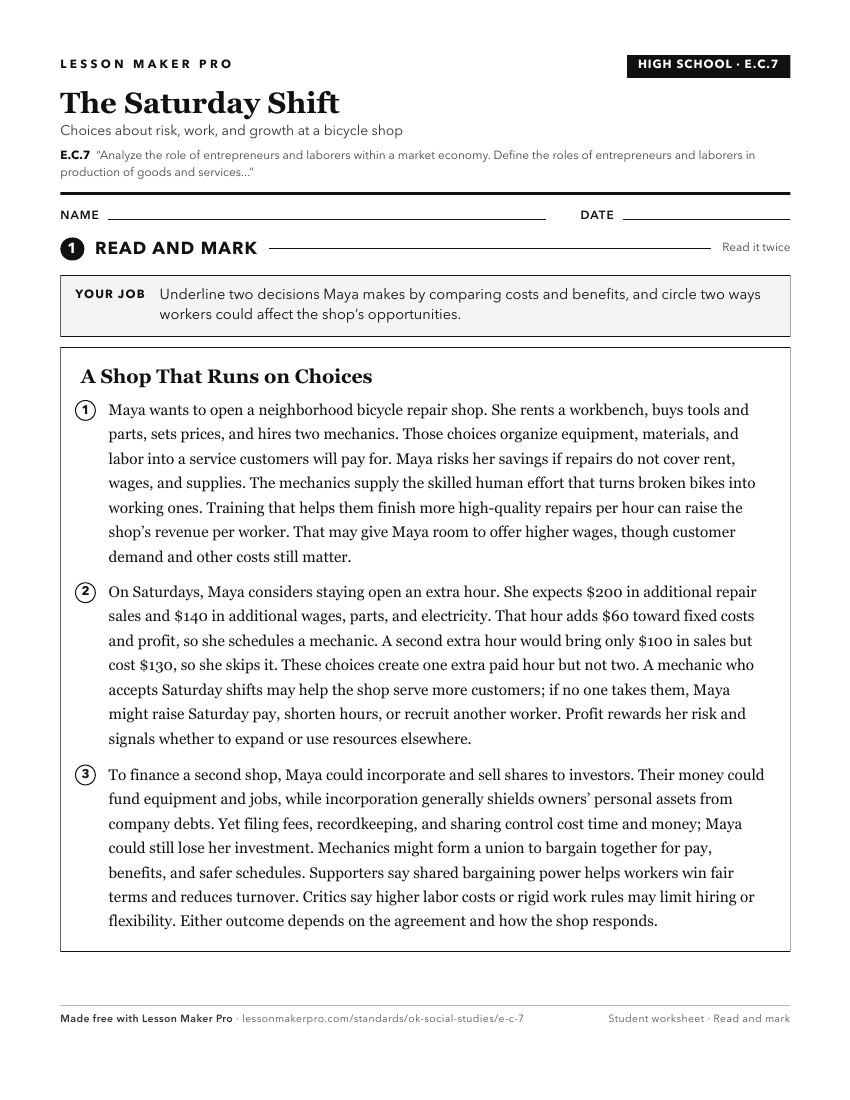
A ready-to-print activity worksheet aligned to E.C.7, with an answer key for the teacher on its own page. No account needed.
PDF, US Letter, prints cleanly in black and white.
Download the worksheetKeep exploring
Related Standards
Turn this cluster into a lesson
Grade, subject, topic, and the complete cluster are prefilled. Create one free, no account needed.
Also for this cluster:Make a WorksheetMake a QuizMake a Sub Lesson