Oklahoma Social Studies 4.P.1.2
Standard Cluster
- 4.P.1
- Apply critical thinking skills to address authentic civic issues.
Develop practices which demonstrate an understanding that social studies involves the evaluation of evidence. Ask and examine essential questions that are important to others, as well as enduring across social studies topics. Compare points of agreement from reliable information used to answer supporting questions related to social studies content. Demonstrate critical thinking skills by frequently developing and answering various depth of knowledge questions. Reinforce understanding of social studies content through collaborative inquiries and the completion of authentic tasks and assessments.
Oklahoma Academic Standards for Social Studies (2026) · 4.P.1
Cluster contents
Standards in This Cluster
4.P.1.2 is a cluster heading. These are the individual standards under it.
- 4.P.1.2.A
Ask and examine essential questions that are important to others, as well as enduring across social studies topics.
- 4.P.1.2.B
Compare points of agreement from reliable information used to answer supporting questions related to social studies content.
- 4.P.1.2.C
Demonstrate critical thinking skills by frequently developing and answering various depth of knowledge questions.
- 4.P.1.2.D
Reinforce understanding of social studies content through collaborative inquiries and the completion of authentic tasks and assessments.
Teacher's field guide
What This Cluster Means
What Students Need to Do
- Students ask a broad question about the past, then break it into smaller questions they can answer with sources. They compare reliable sources for shared facts and work with classmates to support an answer.
What Mastery Looks Like
- A student can ask both “Who decides what a monument honors?” and “Why was the Statue of Liberty given?” They can find a fact supported by two sources and use it in a museum label written with classmates.
Common Misconceptions
- Students may trust the first website they find or think similar wording means two sources agree. They may give an opinion without checking whether the sources support it.
How to Assess It
- Give students short National Park Service and Library of Congress descriptions of the Statue of Liberty. Ask: “What fact do both sources support, and what bigger question about monuments would you ask?”
Lesson moves
Ways to Teach It
Give groups fact strips from two source excerpts about the Statue of Liberty to sort into both sources, one source, or unsupported.
Ask students to discuss: “Who decides what a monument honors, and whose views might be left out?”
Play question swap: pairs write one fact question and one big-picture question about the statue, then trade and answer using source cards.
Show a photo of a named local park and its city webpage. Ask students whose story the name tells and what evidence supports it.
Free download
Printable 4.P.1.2 Worksheet
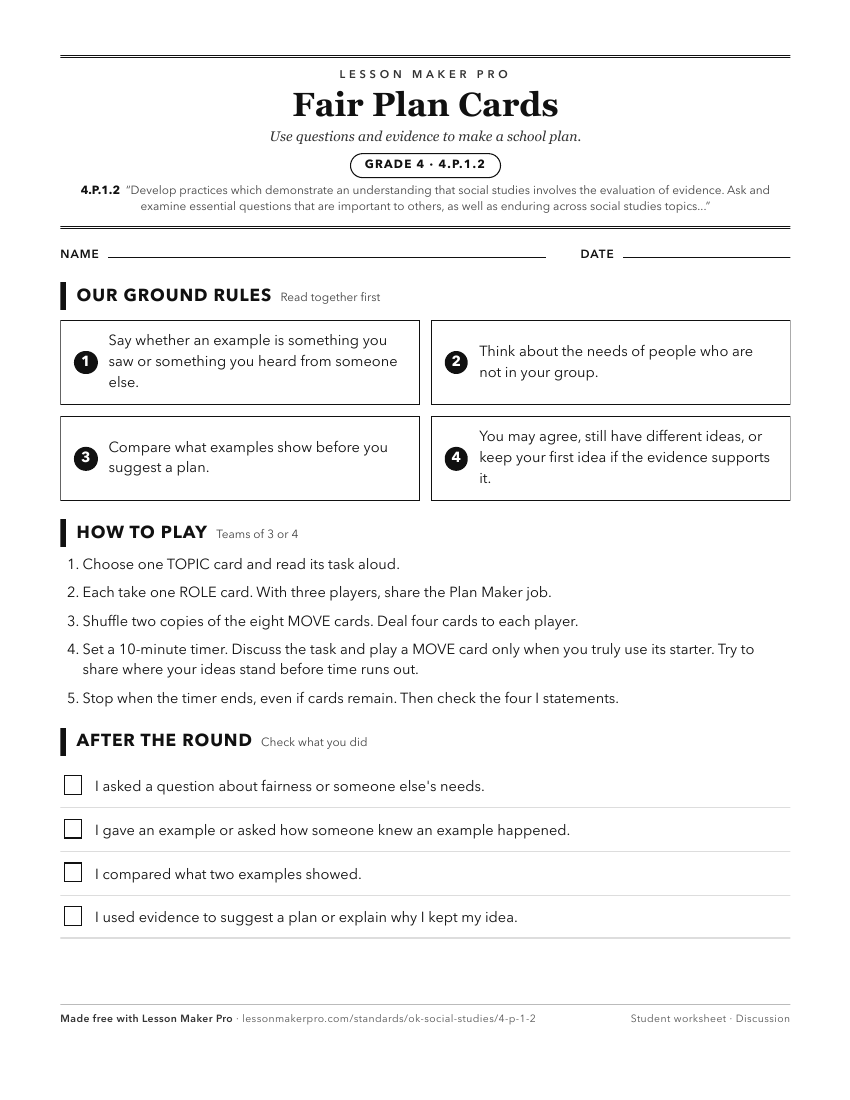
A ready-to-print activity worksheet aligned to 4.P.1.2, with an answer key for the teacher on its own page. No account needed.
PDF, US Letter, prints cleanly in black and white.
Download the worksheetKeep exploring
Related Standards
- 5.P.1.2
The 5th Grade version of this standard.
- 2.P.1.2
The 2nd Grade version of this standard.
- TOT.P.1.2
Develop practices which demonstrate an understanding that social studies involves the evaluation of evidence.
- E.P.1.2
Develop practices which demonstrate an understanding that social studies involves the evaluation of evidence.
Turn this cluster into a lesson
Grade, subject, topic, and the complete cluster are prefilled. Create one free, no account needed.
Also for this cluster:Make a WorksheetMake a QuizMake a Sub Lesson