Oklahoma Science PS.PS2.1
The Standard
Analyze and interpret data to support the claim that a causal relationship exists between the net force exerted on an object and the resulting change in motion, as described in Newton’s second law of motion.
Oklahoma Academic Standards for Science (2026)
Teacher's field guide
What This Standard Means
What Students Need to Do
- Students read tables and graphs of net force and acceleration for an object whose mass stays the same. They use the pattern to explain how changing the net force changes the object's velocity over time.
What Mastery Looks Like
- A student can graph data for the same cart and show that doubling net force doubles acceleration. They can explain why mass must stay the same and predict the direction of acceleration when the net force reverses.
Common Misconceptions
- Some students think a force is needed to keep a cart moving at a steady speed. Others confuse pulling force with net force, or think greater force always means greater speed rather than a faster change in velocity.
How to Assess It
- Exit ticket: For one cart, net forces of 1, 2, and 3 N produce accelerations of 0.5, 1, and 1.5 m/s². Have students graph the pairs and explain what the pattern shows when mass stays fixed.
Lesson moves
Ways to Teach It
Measure rolling friction with a spring scale, then pull a cart at 1 N and 2 N and compare accelerations on slow-motion video.
Show pairs same-cart data: 1 N gives 0.5 m/s², 2 N gives 1 m/s²; ask what the numbers show.
Give groups cards for net force, mass, and acceleration; they race to match triples using F = ma, then check each other's work.
Show a bicycle braking video; have students compare positions at equal time intervals and explain how the backward net force changes its motion.
Free download
Printable PS.PS2.1 Worksheet
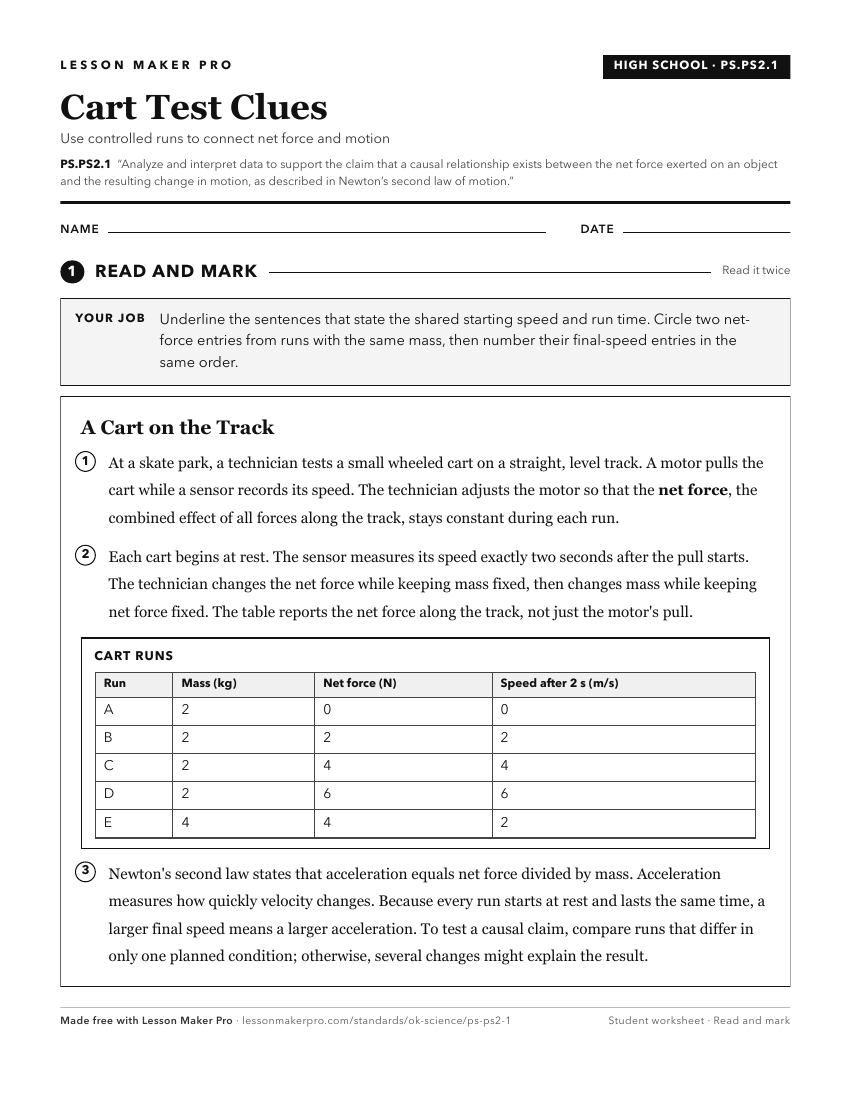
A ready-to-print activity worksheet aligned to PS.PS2.1, with an answer key for the teacher on its own page. No account needed.
PDF, US Letter, prints cleanly in black and white.
Download the worksheetKeep exploring
Related Standards
Turn this exact standard into a lesson
Grade, subject, topic, and the complete standard are prefilled. Create one free, no account needed.
Also for this standard:Make a WorksheetMake a QuizMake a Sub Lesson