Oklahoma Science 3.PS2.1
The Standard
Plan and conduct investigations on the effects of balanced and unbalanced forces on the motion of an object.
Oklahoma Academic Standards for Science (2026)
Teacher's field guide
What This Standard Means
What Students Need to Do
- Students plan and run a fair test with pushes or pulls on an object. They observe when its motion stays the same and when it starts, stops, speeds up, slows down, or turns.
What Mastery Looks Like
- A student keeps the object and surface the same while changing one pull. They record what happened and explain that balanced forces leave motion unchanged, while unbalanced forces change it.
Common Misconceptions
- Students may think a moving object always needs a forward push. They may also think balanced forces mean no forces are acting, or that any push will make an object move.
How to Assess It
- Give pairs a toy car and two identical rubber bands. Ask them to test equal and unequal pulls from opposite ends, then sketch the car's motion in each trial.
Lesson moves
Ways to Teach It
Give pairs a toy car and two identical rubber bands; have them plan matching and mismatched stretches, then record how the car moves.
Ask, "A wagon rolls at a steady speed. Are the forces balanced?" Have students explain their answer in two sentences.
Sort cards showing a still book, a steadily moving wagon, a speeding scooter, and a slowing ball into balanced or unbalanced forces.
Show a bicycle photo and ask students what force slows the bike when the rider squeezes the brakes.
Free download
Printable 3.PS2.1 Worksheet
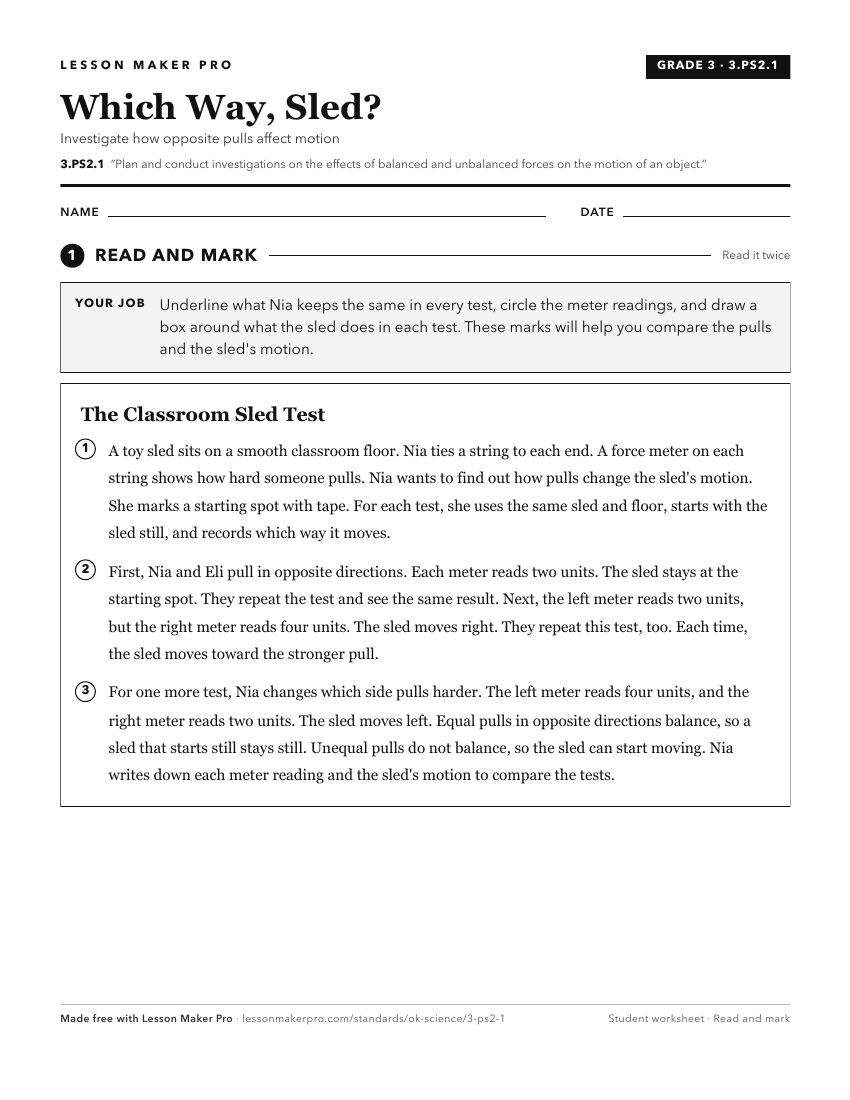
A ready-to-print activity worksheet aligned to 3.PS2.1, with an answer key for the teacher on its own page. No account needed.
PDF, US Letter, prints cleanly in black and white.
Download the worksheetTurn this exact standard into a lesson
Grade, subject, topic, and the complete standard are prefilled. Create one free, no account needed.
Also for this standard:Make a WorksheetMake a QuizMake a Sub Lesson