Oklahoma Science CH.PS1.6
The Standard
Refine the design of a chemical system by specifying a change in conditions that would affect the amounts of reactants or products at equilibrium.*
Oklahoma Academic Standards for Science (2026)
Teacher's field guide
What This Standard Means
What Students Need to Do
- Students predict how a change in pressure, temperature, or concentration affects the amounts present at equilibrium. They choose a change that increases a target product and explain why it works.
What Mastery Looks Like
- For ammonia formation, a student recommends higher pressure to increase the amount of ammonia at equilibrium. They explain that the product side has fewer gas molecules. They know a catalyst gets the system to equilibrium faster but does not change the final amounts.
Common Misconceptions
- Students may think a catalyst increases the final amount of product. They may also think heating always increases product yield, even when the reaction releases heat.
How to Assess It
- Exit ticket: N₂ + 3H₂ ⇌ 2NH₃ + heat. Name one change to pressure or temperature that increases the amount of ammonia at equilibrium, and explain why.
Lesson moves
Ways to Teach It
Give pairs one N₂ card, three H₂ cards, and two NH₃ cards; have them compare gas molecule counts before choosing a pressure change.
Ask students to write why cooling can increase ammonia yield at equilibrium even though it slows the reaction.
Play a four-round sort: students label heating, cooling, compression, and adding a catalyst as raising, lowering, or not changing ammonia yield.
Sketch an ammonia fertilizer reactor; students mark the compressor and explain why the plant also heats the reactor.
Free download
Printable CH.PS1.6 Worksheet
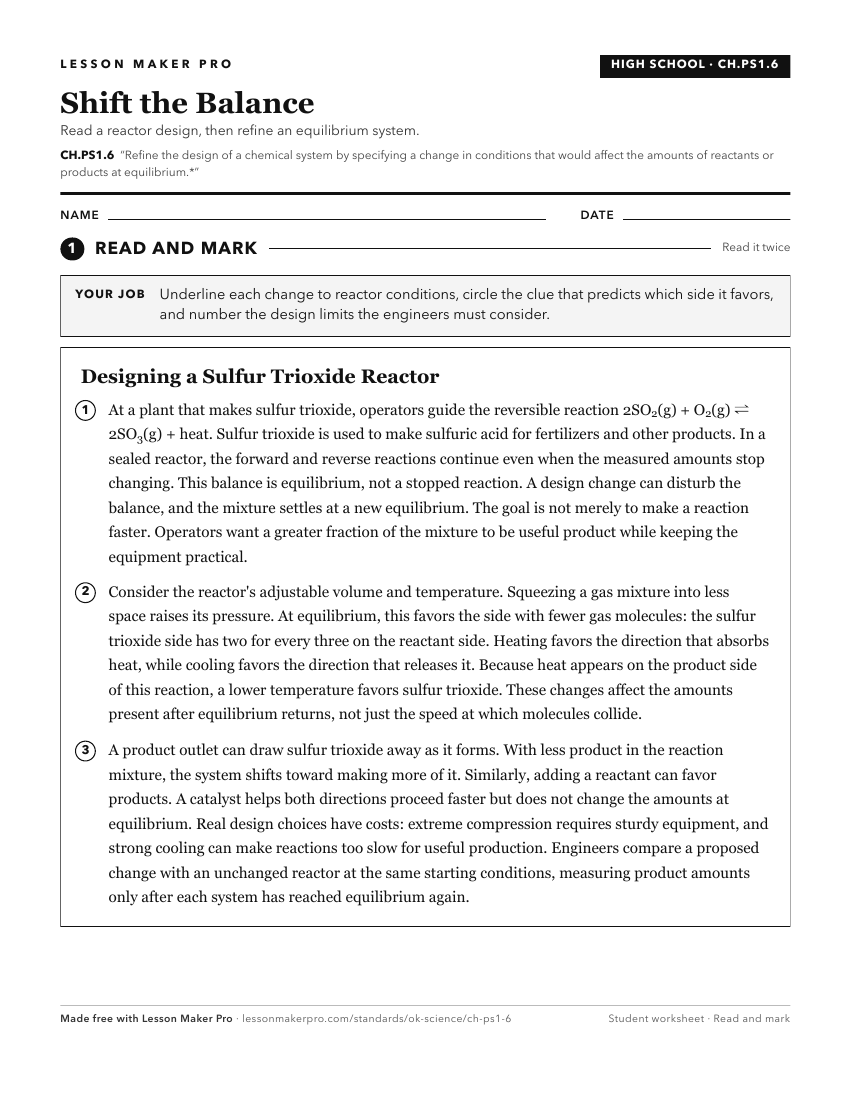
A ready-to-print activity worksheet aligned to CH.PS1.6, with an answer key for the teacher on its own page. No account needed.
PDF, US Letter, prints cleanly in black and white.
Download the worksheetKeep exploring
Related Standards
- 7.PS1.2
Analyze and interpret patterns of data related to the properties of substances before and after the substances interact to determine if a chemical reaction has ...
- CH.PS1.2
Construct and revise an explanation for the outcome of a simple chemical reaction based on the outermost electron states of atoms, trends in the periodic table,...
- PS.PS1.2
Construct and revise an explanation for the outcome of a simple chemical reaction based on the outermost electron states of atoms, trends in the periodic table,...
Turn this exact standard into a lesson
Grade, subject, topic, and the complete standard are prefilled. Create one free, no account needed.
Also for this standard:Make a WorksheetMake a QuizMake a Sub Lesson