Oklahoma Science 8.PS2.1
The Standard
Apply Newton’s Third Law to design a solution to a problem involving the motion of two objects in a system.*
Oklahoma Academic Standards for Science (2026)
Teacher's field guide
What This Standard Means
What Students Need to Do
- Students identify the equal, opposite forces two objects exert on each other. They use those forces to plan, test, and improve a way to control how both objects move.
What Mastery Looks Like
- A student draws one force arrow on each object and explains why the forces do not cancel. They predict how adding mass to one toy car will change its motion, then use a test to check their design.
Common Misconceptions
- Students often draw both force arrows on one object and say the forces cancel. They may think the heavier object pushes harder, or that equal forces make both objects move the same way.
How to Assess It
- Exit ticket: A compressed sponge pushes two toy cars apart. Draw the force on each car, then explain how you could keep one car closer to its starting mark.
Lesson moves
Ways to Teach It
Place a compressed sponge between toy cars; add washers until one stays behind its tape mark while the other crosses its mark.
Ask partners to sketch force arrows and explain why the washer-loaded car moves less when the sponge pushes both cars equally.
Give pairs cards showing two skaters pushing off; have them match each force arrow to a skater and check with a partner.
Draw two skaters pushing apart at a rink; ask which should carry a heavy backpack to stay near the starting spot.
Free download
Printable 8.PS2.1 Worksheet
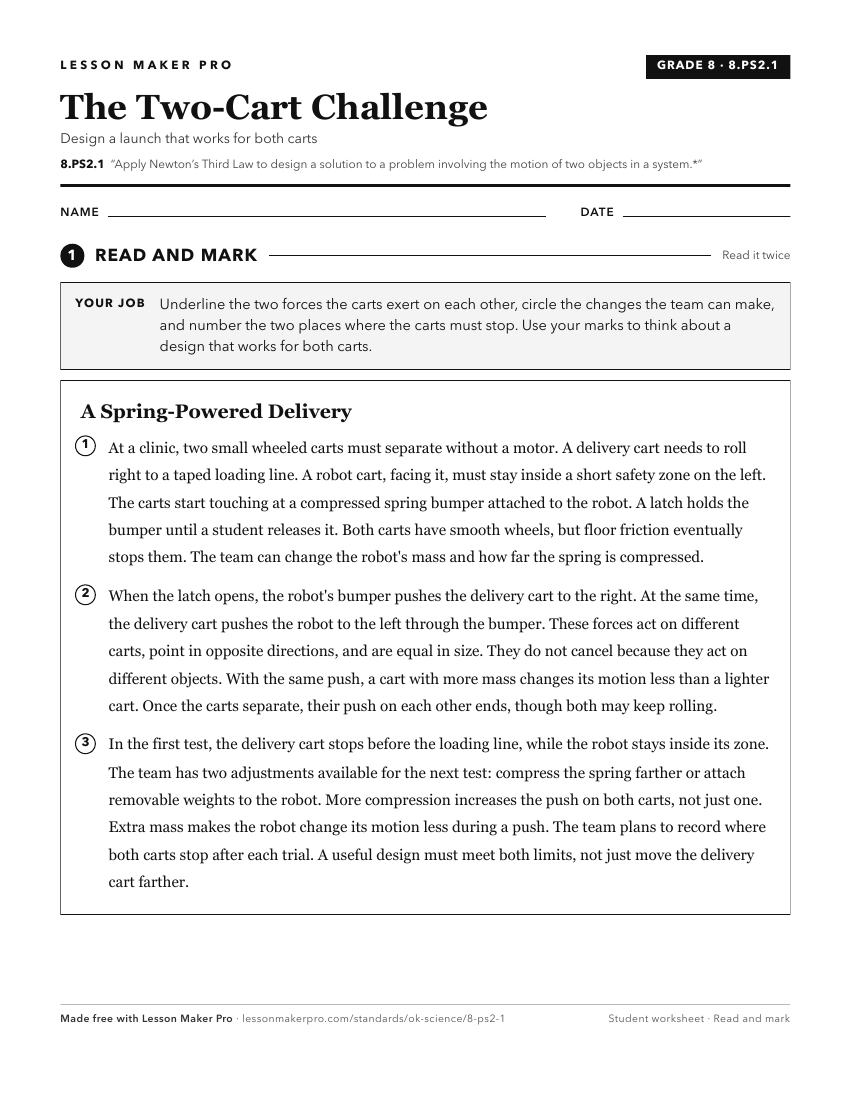
A ready-to-print activity worksheet aligned to 8.PS2.1, with an answer key for the teacher on its own page. No account needed.
PDF, US Letter, prints cleanly in black and white.
Download the worksheetKeep exploring
Related Standards
Turn this exact standard into a lesson
Grade, subject, topic, and the complete standard are prefilled. Create one free, no account needed.
Also for this standard:Make a WorksheetMake a QuizMake a Sub Lesson