Oklahoma Math PC.F.3
Standard Cluster
Predict and verify solutions involving functions. Predict solutions involving functions that are quadratic, polynomial of higher order, rational, exponential, and logarithmic. Graphically verify solutions involving functions that are quadratic, polynomial of higher order, rational, exponential, and logarithmic. Algebraically verify solutions involving functions that are quadratic, polynomial of higher order, rational, exponential, and logarithmic.
Oklahoma Academic Standards for Mathematics (2022)
Cluster contents
Standards in This Cluster
PC.F.3 is a cluster heading. These are the individual standards under it.
- PC.F.3.1
Predict solutions involving functions that are quadratic, polynomial of higher order, rational, exponential, and logarithmic.
- PC.F.3.2
Graphically verify solutions involving functions that are quadratic, polynomial of higher order, rational, exponential, and logarithmic.
- PC.F.3.3
Algebraically verify solutions involving functions that are quadratic, polynomial of higher order, rational, exponential, and logarithmic.
Teacher's field guide
What This Cluster Means
What Students Need to Do
- Students predict where a function equals zero or where two functions have the same value. They check their predictions on a graph and by solving or substituting, while watching for inputs the function does not allow.
What Mastery Looks Like
- A student can estimate solutions for quadratic, higher-degree polynomial, rational, exponential, and logarithmic equations. They can confirm each solution on a graph and algebraically, and reject values outside the domain.
Common Misconceptions
- Students may read a graph's near-intersection as an exact answer. They may keep a value that makes a denominator zero or a logarithm's input nonpositive. Some miss extra crossings on higher-degree polynomial graphs.
How to Assess It
- Exit ticket: Predict the zeros of (x² − 4)/(x − 2), check them on a graph, then verify algebraically and explain any rejected value.
Lesson moves
Ways to Teach It
Give students printed graphs of x²−4, x³−x, 1/(x−2), 2^x−4, and log₂(x)−2; have them mark predicted zeros with sticky notes, then substitute.
Ask: Why does (x²−4)/(x−2)=0 have only one solution, even though its numerator has two zeros? Use the graph to explain.
Play match-and-check with equation and graph cards for 2^x=8, log₂(x)=3, and x³−x=0; pairs earn a point per predicted root verified algebraically.
Plot $100 growing 5% yearly against a $150 savings goal; estimate when it reaches the goal, then check using logarithms.
Free download
Printable PC.F.3 Worksheet
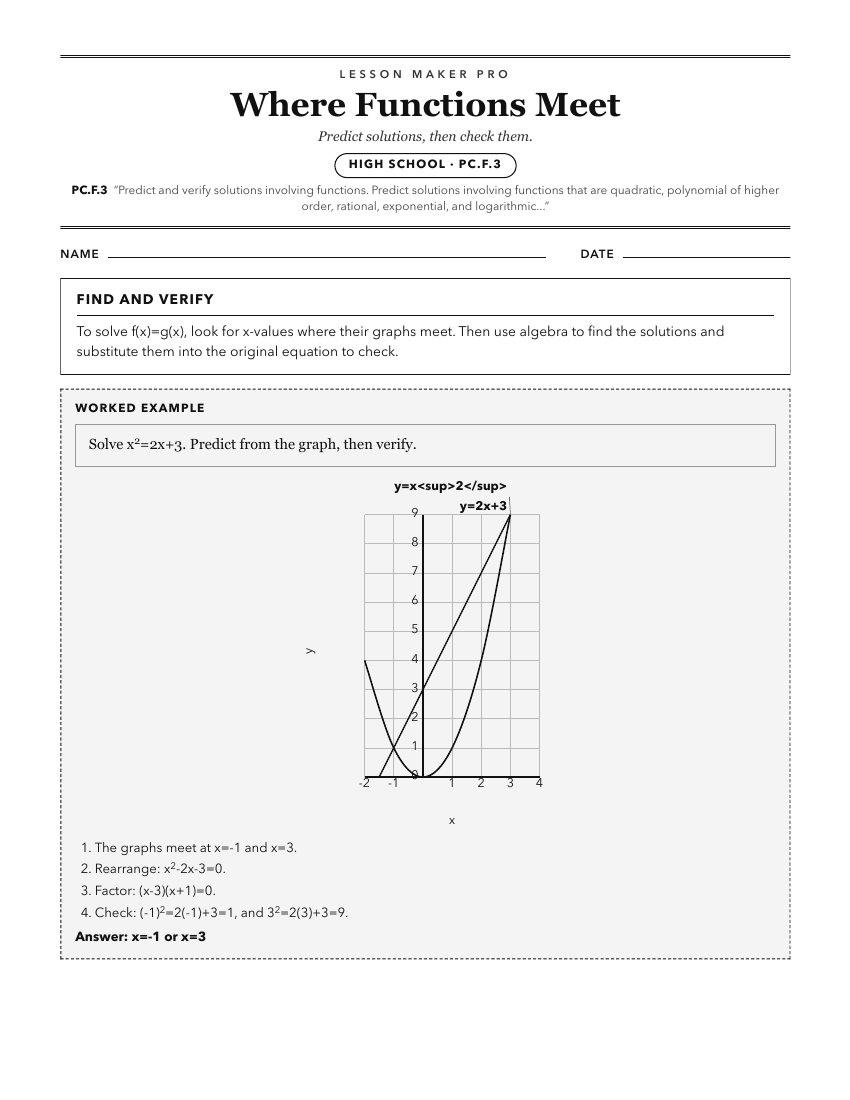
A ready-to-print activity worksheet aligned to PC.F.3, with an answer key for the teacher on its own page. No account needed.
PDF, US Letter, prints cleanly in black and white.
Download the worksheetKeep exploring
Related Standards
Turn this cluster into a lesson
Grade, subject, topic, and the complete cluster are prefilled. Create one free, no account needed.
Also for this cluster:Make a WorksheetMake a QuizMake a Sub Lesson