Oklahoma Math PC.F.2
Standard Cluster
Build functions to model and validate relationships among functions. Model relationships through composition, and attend to the restrictions of the domain. Rewrite a function as a composition of functions. Interpret the meanings of quantities involving functions and their inverses. Verify by analytical methods that one function is the inverse of another.
Oklahoma Academic Standards for Mathematics (2022)
Cluster contents
Standards in This Cluster
PC.F.2 is a cluster heading. These are the individual standards under it.
- PC.F.2.1
Model relationships through composition, and attend to the restrictions of the domain.
- PC.F.2.2
Rewrite a function as a composition of functions.
- PC.F.2.3
Interpret the meanings of quantities involving functions and their inverses.
- PC.F.2.4
Verify by analytical methods that one function is the inverse of another.
Teacher's field guide
What This Cluster Means
What Students Need to Do
- Students combine rules to model two-step situations and decide which inputs work. They break a rule into two functions, explain what an inverse does to the quantities, and check inverse pairs with algebra.
What Mastery Looks Like
- Given h(x)=√(3x−6), a student writes h as f(g(x)), with g(x)=3x−6 and f(x)=√x, and states that x≥2. They can explain what an inverse's input and output mean, then show both compositions equal x on the stated domains.
Common Misconceptions
- Students may treat f(g(x)) as multiplication or apply the rules in reverse order. They may use x=1 in √(3x−6) or forget that an inverse takes the original outputs as inputs. Checking one number does not prove two functions are inverses.
How to Assess It
- Given h(x)=√(x−2) and k(x)=x²+2 for x≥0, ask students to write h as a composition, state its domain, and check both compositions algebraically.
Lesson moves
Ways to Teach It
Give students operation cards for g(x)=3x−6 and f(x)=√x; have them chain x=1, 2, and 3 and flag invalid results.
Ask: A tank starts with 3 gallons and fills at 4 gallons per minute; what does the inverse take in and return?
Race pairs to expand f(g(x)) and g(f(x)) for f(x)=2x+3 and g(x)=(x−3)/2, then explain why both equal x.
Use C(F)=(F−32)×5/9 and F(C)=9C/5+32 to convert a 68°F forecast to Celsius and back, checking the result.
Free download
Printable PC.F.2 Worksheet
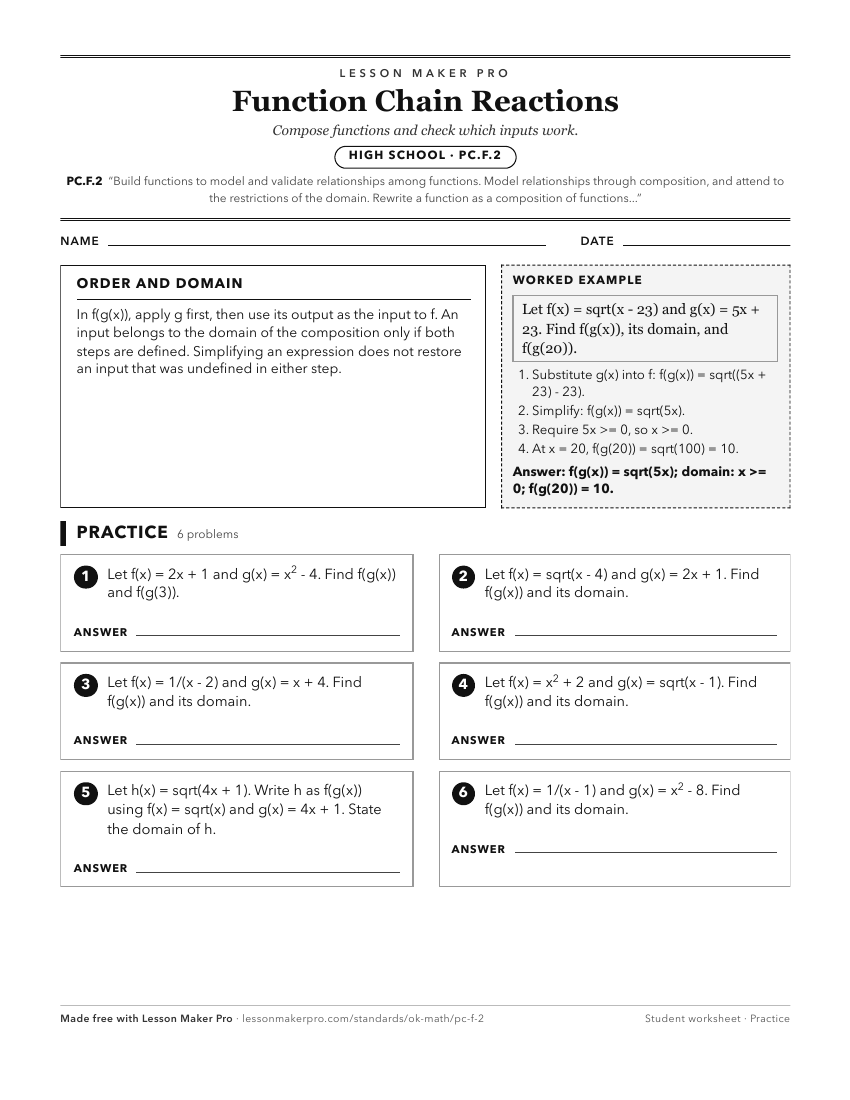
A ready-to-print activity worksheet aligned to PC.F.2, with an answer key for the teacher on its own page. No account needed.
PDF, US Letter, prints cleanly in black and white.
Download the worksheetKeep exploring
Related Standards
Turn this cluster into a lesson
Grade, subject, topic, and the complete cluster are prefilled. Create one free, no account needed.
Also for this cluster:Make a WorksheetMake a QuizMake a Sub Lesson