Oklahoma Math G.RL.1
Standard Cluster
Use appropriate tools and logic, including algebraic methods, to evaluate mathematical arguments. Use undefined terms, definitions, postulates, and theorems in logical arguments/proofs. Analyze and draw conclusions based on a set of conditions using inductive and deductive reasoning. Recognize the logical relationships between a conditional statement and its inverse, converse, and contrapositive. Assess the validity of a logical argument and give counterexamples to disprove a statement.
Oklahoma Academic Standards for Mathematics (2022)
Cluster contents
Standards in This Cluster
G.RL.1 is a cluster heading. These are the individual standards under it.
- G.RL.1.1
Use undefined terms, definitions, postulates, and theorems in logical arguments/proofs.
- G.RL.1.2
Analyze and draw conclusions based on a set of conditions using inductive and deductive reasoning. Recognize the logical relationships between a conditional sta...
- G.RL.1.3
Assess the validity of a logical argument and give counterexamples to disprove a statement.
Teacher's field guide
What This Cluster Means
What Students Need to Do
- Students use examples to spot a pattern, then use algebra or geometry facts to decide whether it always holds. They check conditional statements and test arguments for missing steps or false claims.
What Mastery Looks Like
- Students justify proof steps with definitions, postulates, theorems, or algebraic rules, treating points and lines as starting terms. They match a conditional with its contrapositive and reject a false converse with a counterexample.
Common Misconceptions
- Students may treat three examples as proof. They may assume a converse is true because the original claim is true. Some divide by a variable without checking whether it equals zero.
How to Assess It
- Exit ticket: “If an integer is divisible by 4, it is even.” Write its converse and contrapositive, give a counterexample to the converse, and justify the contrapositive.
Lesson moves
Ways to Teach It
Mark two points, draw their line with a ruler, then sort “point,” “segment,” and “two points determine a line” by logical role.
Ask whether 1+3, 3+5, and 5+7 prove all consecutive odd pairs sum to a multiple of 4; request an algebraic proof.
Give teams four cards: square implies rectangle, its converse, inverse, and contrapositive; have them match logically equivalent pairs and test with sketches.
Show a sign reading “Spend $50, get free shipping” and a $35 receipt with free shipping; ask whether the sign’s promise was broken.
Free download
Printable G.RL.1 Worksheet
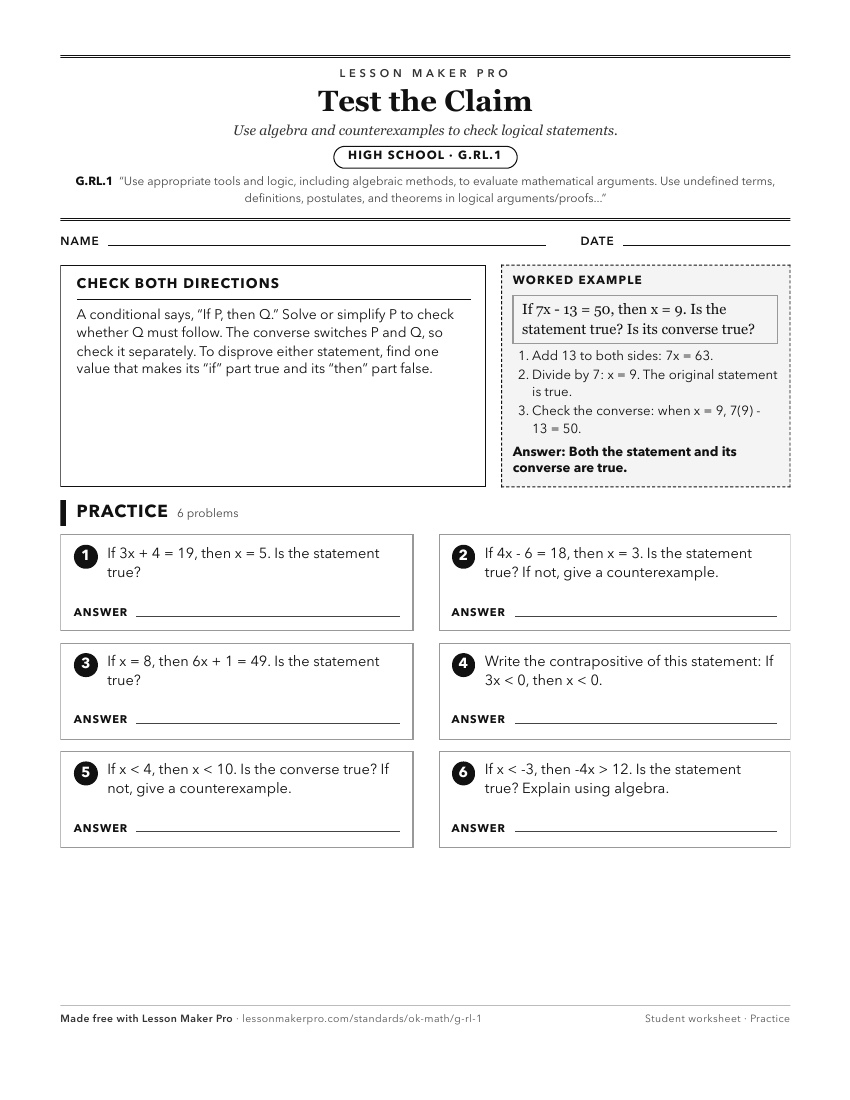
A ready-to-print activity worksheet aligned to G.RL.1, with an answer key for the teacher on its own page. No account needed.
PDF, US Letter, prints cleanly in black and white.
Download the worksheetKeep exploring
Related Standards
- 7.GM.3
Use mathematical models and reasoning with proportions and ratios to determine measurements, justify formulas, and solve problems.
- 7.A.4.2
Evaluate numerical expressions using calculators and other technologies and justify solutions using order of operations and grouping symbols.
- A1.A.1.1
Use knowledge of solving equations with rational values to represent, use and apply mathematical models (e.g., angle measures, geometric formulas, dimensional a...
- 7.A.4
Use order of operations and properties of operations to generate and evaluate equivalent numerical and algebraic expressions.
Turn this cluster into a lesson
Grade, subject, topic, and the complete cluster are prefilled. Create one free, no account needed.
Also for this cluster:Make a WorksheetMake a QuizMake a Sub Lesson