Oklahoma Math A2.A.3.2
The Standard
- A2.A.3
- Represent and solve mathematical and real-world problems involving arithmetic and geometric sequences and series.
Recognize that geometric sequences are exponential using equations, tables, graphs, and verbal descriptions. Given the formula f(x) = a(r)ˣ, find the next term and define the meaning of a and r within the context of the problem.
Oklahoma Academic Standards for Mathematics (2022)
Teacher's field guide
What This Standard Means
What Students Need to Do
- Students find a constant multiplier in an equation, table, graph, or story. They use the starting value and multiplier to find the next term and explain what both numbers mean.
What Mastery Looks Like
- Given 50 bacteria at hour 0, doubling each hour, a student writes 50(2)^x and predicts 800 bacteria at hour 4. They explain that 50 is the starting count and 2 is the hourly multiplier. They can match the equation to a table and plotted points.
Common Misconceptions
- Students may add the same amount each step instead of multiplying. They may call a the value at step 1 when it represents step 0. They may assume values between the plotted points are terms in the sequence.
How to Assess It
- Exit ticket: A tank holds 6 liters at minute 0 and the amount triples each minute. Write an equation, find the amount at minute 3, and explain what each number in your equation means.
Lesson moves
Ways to Teach It
Use counters to build rows of 3, 6, 12, and 24, starting at step 0, then record each count and multiplier.
Show the values 5, 15, 45, and 135, then ask students why adding 10 fails to predict the later terms.
Give pairs cards with equations, tables, plotted points, and stories; have them match patterns and calculate the next term.
Give students a phone at 100% charge that retains 80% each hour; ask for its charge after three hours.
Free download
Printable A2.A.3.2 Worksheet
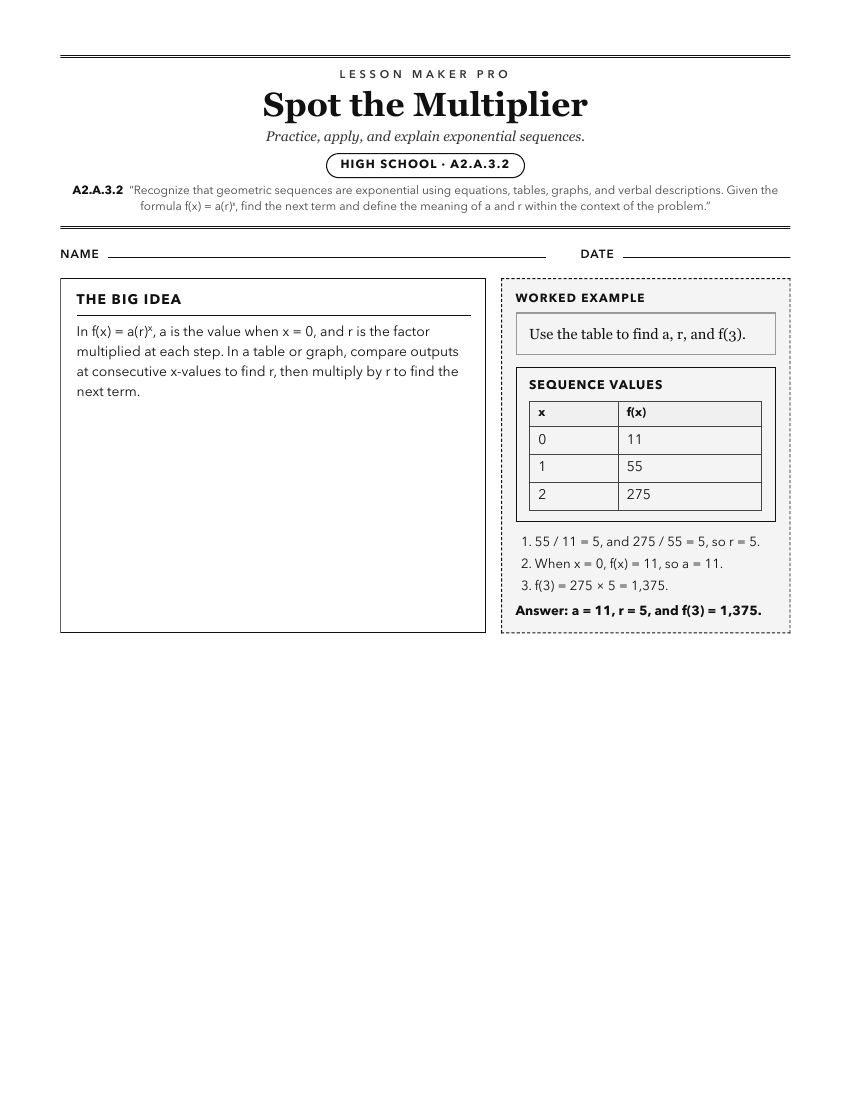
A ready-to-print activity worksheet aligned to A2.A.3.2, with an answer key for the teacher on its own page. No account needed.
PDF, US Letter, prints cleanly in black and white.
Download the worksheetKeep exploring
Related Standards
- A2.A.3.1
Recognize that arithmetic sequences are linear using equations, tables, graphs, and verbal descriptions. Using the pattern, find the next term.
- A2.A.3.4
Solve problems that can be modeled using finite geometric sequences and series given the nth terms and sum formulas. Graphing calculators or other appropriate t...
- A2.A.3
Represent and solve mathematical and real-world problems involving arithmetic and geometric sequences and series.
- A1.F.2.1
Distinguish between linear and nonlinear (including exponential) functions. Understand that linear functions grow by equal intervals (arithmetic) and that expon...
Turn this exact standard into a lesson
Grade, subject, topic, and the complete standard are prefilled. Create one free, no account needed.
Also for this standard:Make a WorksheetMake a QuizMake a Sub Lesson