Oklahoma Math A2.A.3
Standard Cluster
Represent and solve mathematical and real-world problems involving arithmetic and geometric sequences and series. Recognize that arithmetic sequences are linear using equations, tables, graphs, and verbal descriptions. Using the pattern, find the next term. Recognize that geometric sequences are exponential using equations, tables, graphs, and verbal descriptions. Given the formula f(x) = a(r)ˣ, find the next term and define the meaning of a and r within the context of the problem. Solve problems that can be modeled using arithmetic sequences or series given the nth terms and sum formulas. Graphing calculators or other appropriate technology may be used. Solve problems that can be modeled using finite geometric sequences and series given the nth terms and sum formulas. Graphing calculators or other appropriate technology may be used.
Oklahoma Academic Standards for Mathematics (2022)
Cluster contents
Standards in This Cluster
A2.A.3 is a cluster heading. These are the individual standards under it.
- A2.A.3.1
Recognize that arithmetic sequences are linear using equations, tables, graphs, and verbal descriptions. Using the pattern, find the next term.
- A2.A.3.2
Recognize that geometric sequences are exponential using equations, tables, graphs, and verbal descriptions. Given the formula f(x) = a(r)x, find the next term ...
- A2.A.3.3
Solve problems that can be modeled using arithmetic sequences or series given the n^th terms and sum formulas. Graphing calculators or other appropriate technol...
- A2.A.3.4
Solve problems that can be modeled using finite geometric sequences and series given the nth terms and sum formulas. Graphing calculators or other appropriate t...
Teacher's field guide
What This Cluster Means
What Students Need to Do
- Students identify equal differences or equal ratios in tables, graphs, formulas, and word problems. They find the next or nth term and the sum of a set number of terms. They explain the starting value and multiplier in a geometric model.
What Mastery Looks Like
- For rows with 8, 11, and 14 seats, a student writes a rule for row n, predicts 17 seats next, and totals the first 10 rows. For 5, 10, and 20 at x = 0, they predict 40, sum the first six terms, and identify a = 5 and r = 2. They recognize that the seat counts lie on a line and the doubling counts lie on an exponential curve.
Common Misconceptions
- Students may call any growing list geometric, even when it adds the same amount each time. They may treat r as an amount added, or assume a is the first term when the sequence starts at x = 1. Some use an nth-term formula when the question asks for a total.
How to Assess It
- Exit ticket: A theater has 8 seats in its first row and adds 3 per row; a video has 8 views on day 0 and doubles daily. For each, find the fifth term and the sum of the first four terms, identify its graph as linear or exponential, and explain a and r for the video.
Lesson moves
Ways to Teach It
Use counters to build two five-term patterns starting with two counters: add three each time to one and double the other.
Show the tables 2, 5, 8, 11 and 2, 6, 18, 54; ask which graph is linear and why.
Hand pairs cards showing sequences, nth-term formulas, and four-term sums; have them match each set and find the fifth term.
Model weekly savings starting with $5 and adding $5 more each week; find the eight-week total using a table and formula.
Free download
Printable A2.A.3 Worksheet
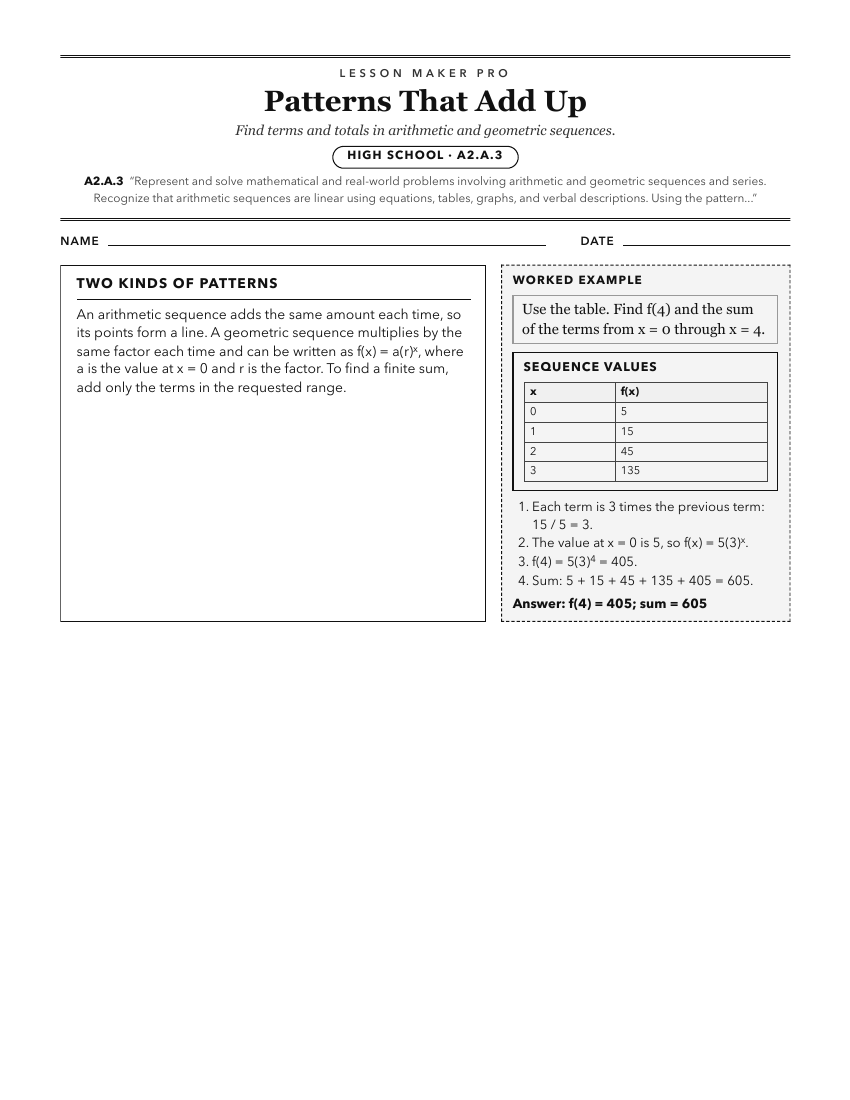
A ready-to-print activity worksheet aligned to A2.A.3, with an answer key for the teacher on its own page. No account needed.
PDF, US Letter, prints cleanly in black and white.
Download the worksheetKeep exploring
Related Standards
- PA.A.4
Represent and solve problems using mathematical models and situations with equations and inequalities involving linear expressions.
- A1.A.1
Represent and solve mathematical and real-world problems using linear equations, absolute value equations, and systems of equations; interpret solutions in the ...
Turn this cluster into a lesson
Grade, subject, topic, and the complete cluster are prefilled. Create one free, no account needed.
Also for this cluster:Make a WorksheetMake a QuizMake a Sub Lesson