Oklahoma Math A2.A.1.1
The Standard
- A2.A.1
- Represent and solve mathematical and real-world problems using nonlinear equations, systems of linear equations, and systems of linear inequalities; interpret the solutions in the original context.
Use mathematical models to represent quadratic relationships and solve using factoring, completing the square, the quadratic formula, and various methods (including graphing calculator or other appropriate technology). Find non-real roots when they exist.
Oklahoma Academic Standards for Mathematics (2022)
Teacher's field guide
What This Standard Means
What Students Need to Do
- Students model situations with quadratic equations and solve by factoring, completing the square, or using the quadratic formula. They check real roots on a graph and use the formula to find non-real roots. They explain what the solutions mean in the situation.
What Mastery Looks Like
- Given a rectangle with perimeter 20 and area 24, a student writes x(10−x)=24 and finds sides of 4 and 6. They can check those answers on a graph. For x²+4x+8=0, they find −2±2i and explain why the graph has no x-intercepts.
Common Misconceptions
- Students may write x(20−x)=24, forgetting that perimeter counts each side twice. They may see no x-intercepts and claim an equation has no solutions. They may drop the ± in the quadratic formula or accept a negative length.
How to Assess It
- Exit ticket: A rectangle has perimeter 20 units and area 24 square units. Write and solve an equation for its sides, then find the roots of x²+4x+8=0.
Lesson moves
Ways to Teach It
Give pairs 24 square tiles to build rectangles; find one with perimeter 20, then write and solve x(10−x)=24.
Ask: Why does y=x²+4x+8 have no x-intercepts even though x²+4x+8=0 has two complex roots?
Set four cards: factor x²−5x+6=0, complete the square for x²+4x−1=0, use the formula for 2x²+3x−2=0, and graph x²−9=0.
Use h(t)=−5t²+20t for a ball thrown from ground; find when it returns and explain what both zeros mean.
Free download
Printable A2.A.1.1 Worksheet
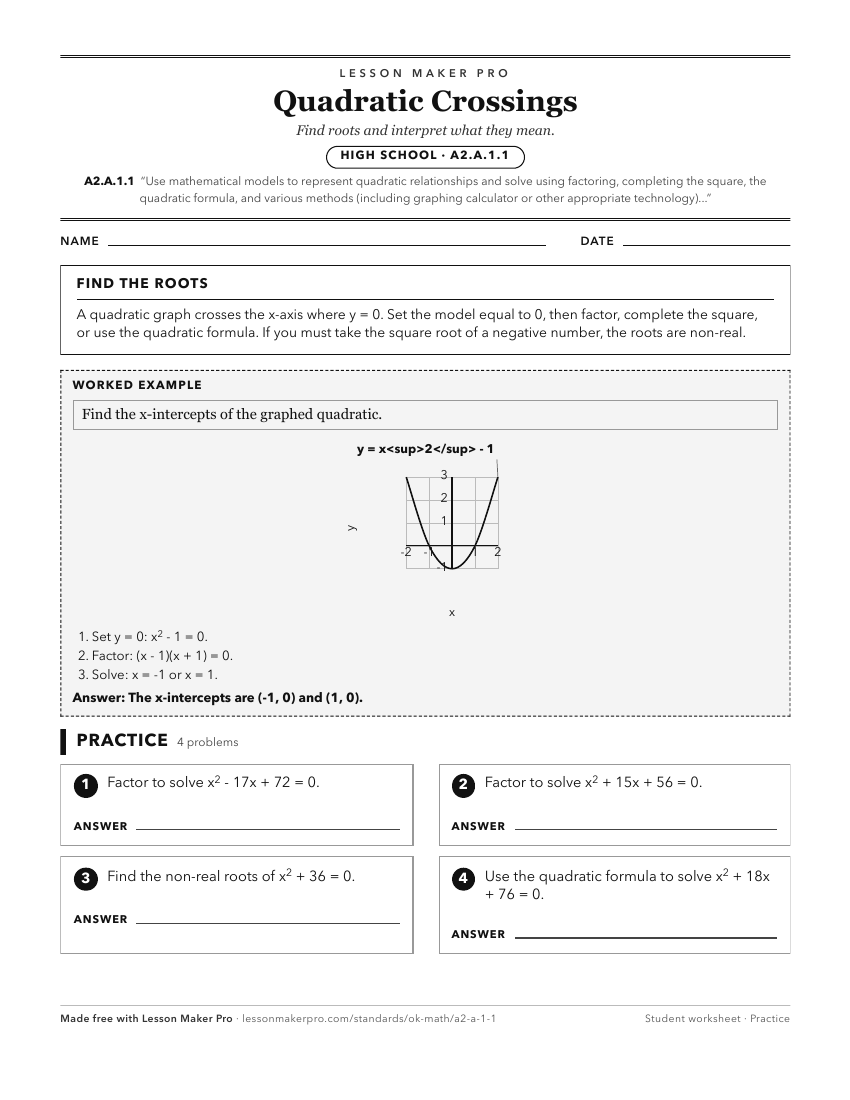
A ready-to-print activity worksheet aligned to A2.A.1.1, with an answer key for the teacher on its own page. No account needed.
PDF, US Letter, prints cleanly in black and white.
Download the worksheetKeep exploring
Related Standards
- A2.A.1.4
Solve polynomial equations with real roots using various methods (e.g., polynomial division, synthetic division, using graphing calculators or other appropriate...
- A1.A.1.3
Analyze, use and apply mathematical models to solve problems involving systems of linear equations with a maximum of two variables by graphing, substitution, an...
- A2.A.2.4
Recognize that a quadratic function has different equivalent representations [f(x) = ax² + bx + c, f(x) = a(x - h)² + k, and f(x) = a(x - p)(x - q)]. Identify a...
- A2.A.1.2
Use mathematical models to represent exponential relationships, such as compound interest, depreciation, and population growth. Solve these equations algebraica...
Turn this exact standard into a lesson
Grade, subject, topic, and the complete standard are prefilled. Create one free, no account needed.
Also for this standard:Make a WorksheetMake a QuizMake a Sub Lesson