Oklahoma Math 2.GM.2
Standard Cluster
Understand length as a measurable attribute and explore capacity. Explain the relationship between the size of the unit of measurement and the number of units needed to measure the length of an object. Explain the relationship between length and the numbers on a ruler by using a ruler to measure lengths to the nearest whole unit. Explore how varying shapes and styles of containers can have the same capacity.
Oklahoma Academic Standards for Mathematics (2022)
Cluster contents
Standards in This Cluster
2.GM.2 is a cluster heading. These are the individual standards under it.
- 2.GM.2.1
Explain the relationship between the size of the unit of measurement and the number of units needed to measure the length of an object.
- 2.GM.2.2
Explain the relationship between length and the numbers on a ruler by using a ruler to measure lengths to the nearest whole unit.
- 2.GM.2.3
Explore how varying shapes and styles of containers can have the same capacity.
Teacher's field guide
What This Cluster Means
What Students Need to Do
- Students measure lengths with equal-size units and a ruler, starting at zero and reading to the nearest whole unit. They explain why smaller units take more repeats to measure the same length. They use equal scoops to compare how much differently shaped containers hold.
What Mastery Looks Like
- A student lines up a pencil with zero on a ruler and reads its length to the nearest whole centimeter. They explain that shorter units need more repeats to cover the pencil. They can check whether a tall cup and a wide cup hold the same number of scoops.
Common Misconceptions
- Students may start at the ruler's edge instead of zero or count tick marks instead of the spaces between them. They may think smaller units give a smaller count. They may assume a taller container always holds more.
How to Assess It
- Give each student a ruler, a 7 cm paper strip, and a drawing of two differently shaped cups labeled "4 scoops each." Ask them to measure the strip, explain what happens to the count with smaller units, and decide whether the cups hold the same amount.
Lesson moves
Ways to Teach It
Give pairs a 12 cm ribbon and 2 cm and 4 cm paper strips; have them measure the ribbon with each strip and compare counts.
Ask: "Why does a 10 cm strip take more 1 cm tiles than 2 cm tiles?" Have students write one sentence using both counts.
Play ruler relay: partners measure a crayon, eraser, and glue stick from zero, then check each other's nearest-centimeter readings.
Compare a tall drink cup and a short, wide mug prechecked to hold four scoops each; have students verify with rice.
Free download
Printable 2.GM.2 Worksheet
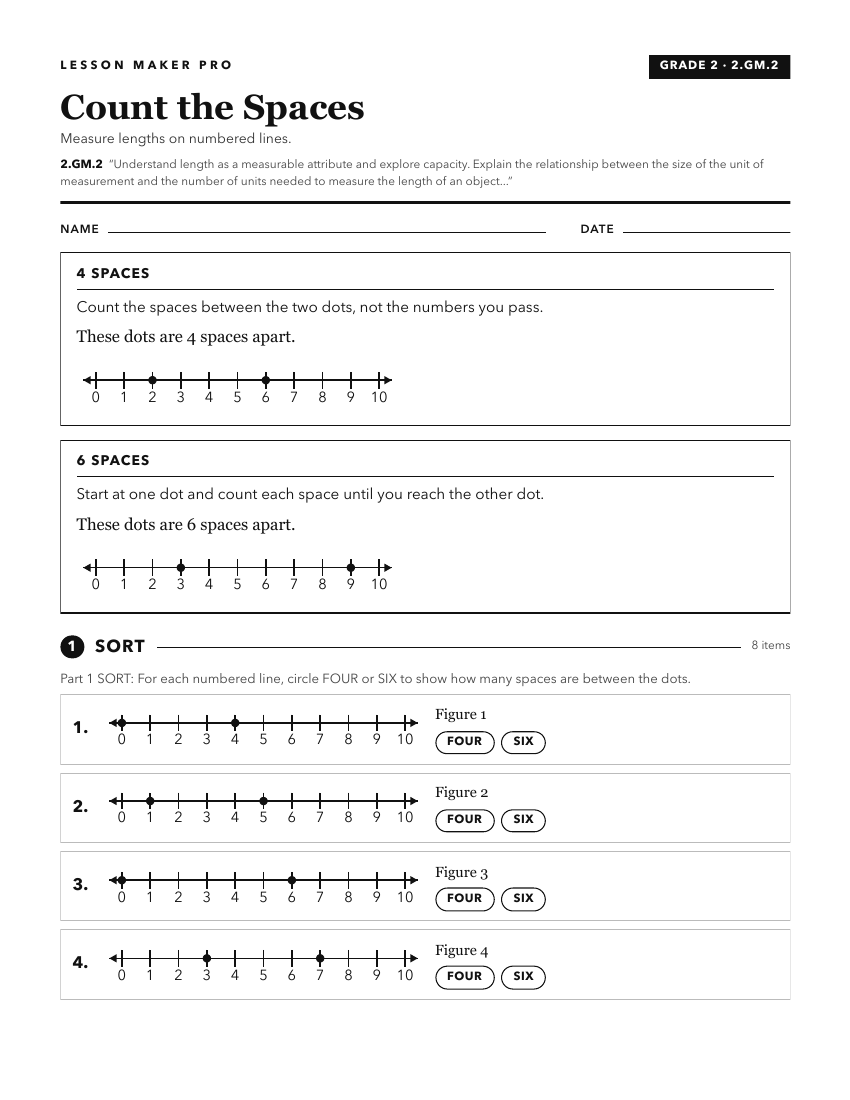
A ready-to-print activity worksheet aligned to 2.GM.2, with an answer key for the teacher on its own page. No account needed.
PDF, US Letter, prints cleanly in black and white.
Download the worksheetKeep exploring
Related Standards
- 5.GM.3
Understand angle, length, weight, and capacity as measurable attributes of real-world and mathematical objects, using various tools to measure them. Solve real-...
- 1.GM.2
Select and use nonstandard and standard units to describe length and volume/capacity.
- 3.GM.2
Understand measurable attributes of real-world and mathematical objects using various tools.
Turn this cluster into a lesson
Grade, subject, topic, and the complete cluster are prefilled. Create one free, no account needed.
Also for this cluster:Make a WorksheetMake a QuizMake a Sub Lesson