NY Social Studies 9.10c
The Standard
The decimation of indigenous populations in the Americas influenced the growth of the Atlantic slave trade. The trade of enslaved peoples resulted in exploitation, death, and the creation of wealth.
New York State K–12 Social Studies Framework
Key Idea 9.10
INTERACTIONS AND DISRUPTIONS: Efforts to reach the Indies resulted in the encounter between the people of Western Europe, Africa, and the Americas. This encounter led to a devastating impact on populations in the Americas, the rise of the transatlantic slave trade, and the reorientation of trade networks.
Teacher's field guide
What This Standard Means
What Students Need to Do
- Students connect Indigenous population loss and expanding sugar plantations to the growth of Atlantic slavery. They distinguish labor systems: silver mining at Potosí relied heavily on Indigenous drafted and paid workers, while sugar plantations were a major destination for enslaved Africans. They identify roles of European traders and states, particular African rulers and brokers, and enslaved people, explaining how exploitation caused death and generated profits.
What Mastery Looks Like
- A student can build an evidence based cause and effect chain from population loss and commodity demand to expanded trafficking across the Atlantic. The student can use ship plans, personal accounts, and plantation records to describe conditions, distinguish roles, and identify who gained wealth.
Common Misconceptions
- Students often assume disease was the only cause of Indigenous population loss, overlooking warfare, forced labor, and displacement. They may treat Africans as one group, rather than distinguish captors, brokers, victims, and resisting communities. They may also assume the wealth created was shared widely.
How to Assess It
- Give students an Indigenous population graph, a slave ship diagram, and a sugar ledger excerpt. Ask them to link population loss, labor demand, conditions, and profit in four sentences using two source details.
Lesson moves
Ways to Teach It
Compare sugar plantation and Potosí silver mining labor systems, then use evidence to connect commodity demand, coercion, population loss, and profit without treating all workers as one group.
Ask students to write: Who gained wealth from Atlantic slavery, who bore its costs, and what evidence supports your answer?
Run a source sorting challenge where teams label excerpts as labor demand, trafficking role, Middle Passage, exploitation, resistance, or profit.
Examine a chocolate bar label and cocoa sourcing map, then list who performs the labor and who profits along the supply chain.
Free download
Printable 9.10c Worksheet
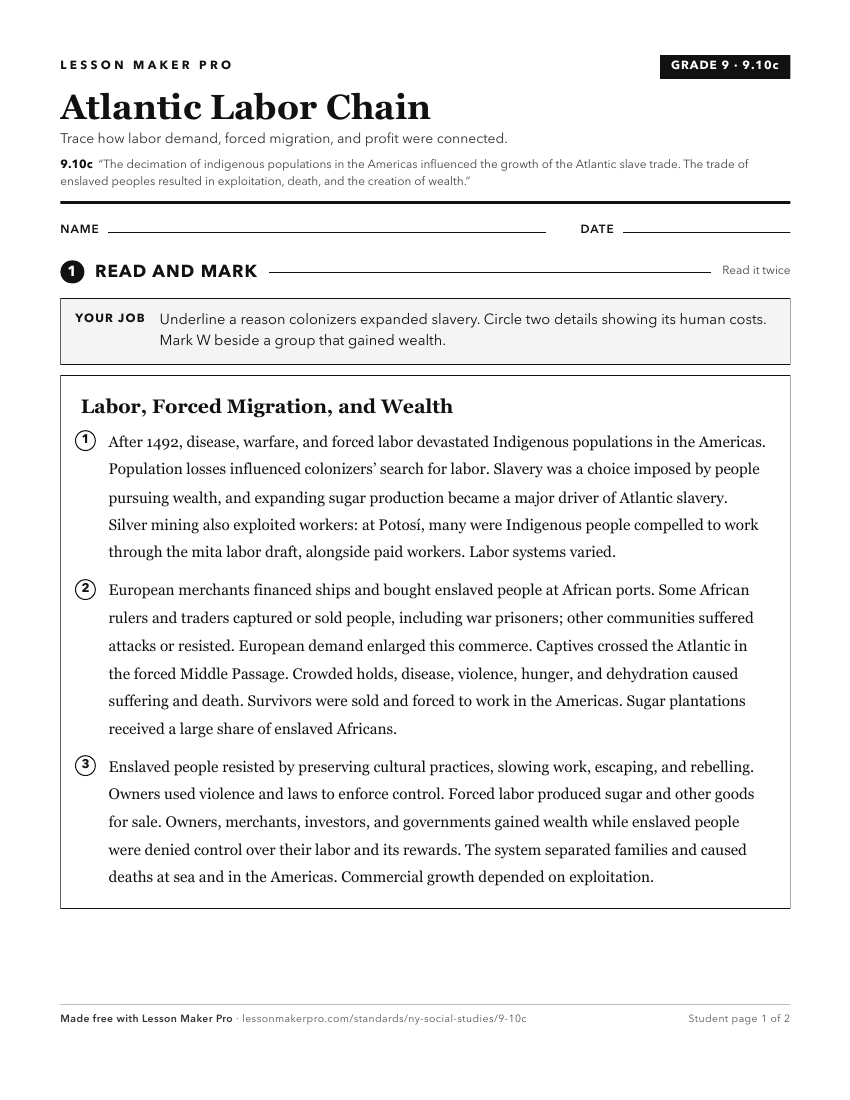
A ready-to-print activity worksheet aligned to 9.10c, with an answer key for the teacher on its own page. No account needed.
PDF, US Letter, prints cleanly in black and white.
Download the worksheetTurn this exact standard into a lesson
Grade, subject, topic, and the complete standard are prefilled. Create one free, no account needed.
Also for this standard:Make a WorksheetMake a QuizMake a Sub Lesson