NY Social Studies 8.9a
The Standard
The civil rights movement began in the postwar era in response to long-standing inequalities in American society, and eventually brought about equality under the law, but slower progress on economic improvements.
New York State K–12 Social Studies Framework
Key Idea 8.9
DOMESTIC POLITICS AND REFORM: The civil rights movement and the Great Society were attempts by people and the government to address major social, legal, economic, and environmental problems. Subsequent economic recession called for a new economic program. (Standards: 1, 4, 5; Themes: TCC, SOC, CIV, ECO)
Teacher's field guide
What This Standard Means
What Students Need to Do
- Students compare the goals and methods of major civil rights leaders and activists. They explain how court rulings, laws, and federal actions expanded legal rights. They also use evidence to judge whether economic conditions improved at the same pace.
What Mastery Looks Like
- Students can distinguish litigation, boycotts, nonviolent protest, federal action, and calls for Black self-determination. They can explain how major victories changed schools, voting, public spaces, and the military. They can use income, employment, or housing evidence to show that economic inequality continued.
Common Misconceptions
- Students may treat the movement as the work of one leader or assume all activists used the same strategy. They may confuse legal equality with equal living conditions. They may also assume discrimination ended after the major laws passed.
How to Assess It
- Give students an exit ticket: Name one activist strategy, explain one legal victory it helped produce, and cite one sign that economic inequality remained.
Lesson moves
Ways to Teach It
Students sort primary source cards from Marshall, Parks, King, and Malcolm X by strategy, goal, and intended audience.
Ask students to write: Which strategy created lasting change most effectively, and what evidence supports your claim?
Run a matching relay connecting events, leaders, strategies, and outcomes, then have teams correct one mismatched set.
Students compare 1960 and 1970 data on Black income, unemployment, or homeownership, then explain what changed and what persisted.
Free download
Printable 8.9a Worksheet
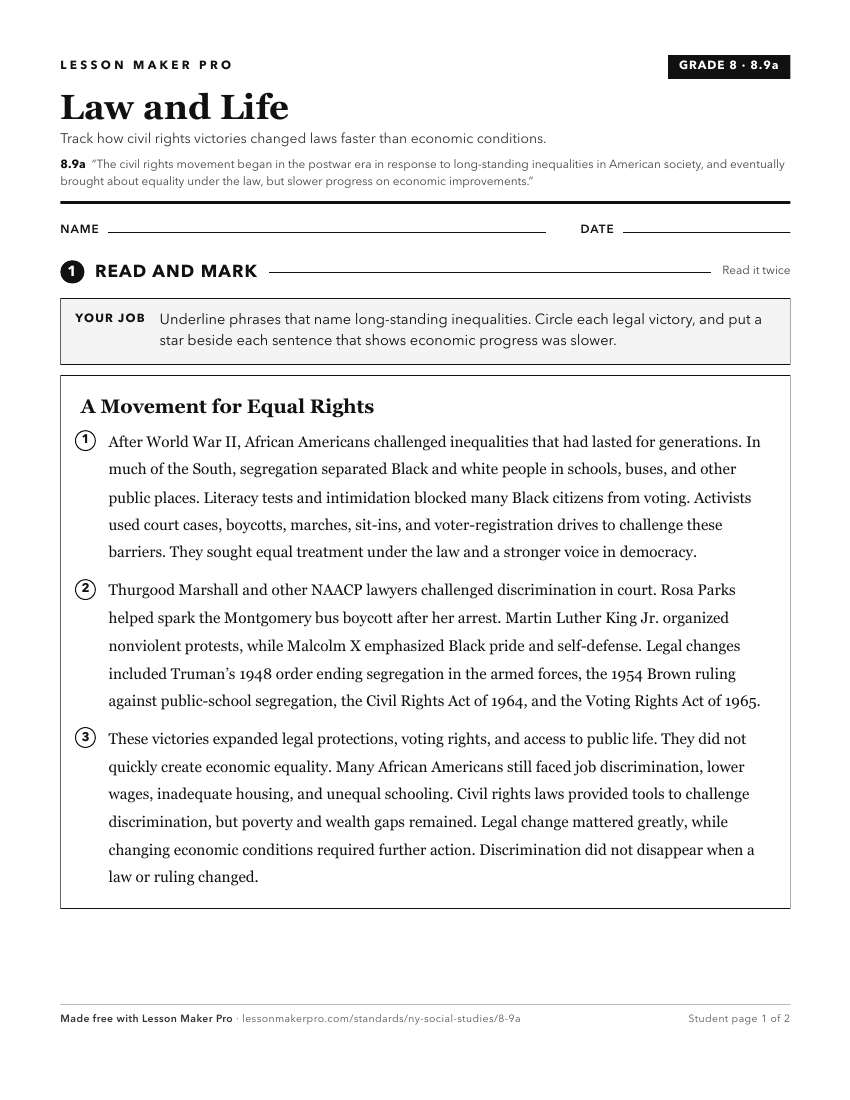
A ready-to-print activity worksheet aligned to 8.9a, with an answer key for the teacher on its own page. No account needed.
PDF, US Letter, prints cleanly in black and white.
Download the worksheetTurn this exact standard into a lesson
Grade, subject, topic, and the complete standard are prefilled. Create one free, no account needed.
Also for this standard:Make a WorksheetMake a QuizMake a Sub Lesson