NY Social Studies 8.7a
The Standard
The Cold War was an ongoing struggle between the two nuclear superpowers, the United States and the Soviet Union. The Cold War shaped the reconstruction of national boundaries and political alliances across the globe.
New York State K–12 Social Studies Framework
Key Idea 8.7
FOREIGN POLICY: The period after World War II has been characterized by an ideological and political struggle, first between the United States and communism during the Cold War, then between the United States and forces of instability in the Middle East. Increased economic interdependence and competition, as well as environmental concerns, are challenges faced by the United States.
Teacher's field guide
What This Standard Means
What Students Need to Do
- Students use a dated Cold War map to locate U.S. allies, Soviet allies, and non-aligned nations. They explain how fear and weapons development fed the nuclear arms race.
What Mastery Looks Like
- Given a blank map and country list, a student accurately labels the three groups and identifies regional patterns. The student explains how one side's nuclear buildup led to fear and further buildup by the other side.
Common Misconceptions
- Students may think non-aligned nations had no political interests or never cooperated with either superpower. They may assume any country with one nuclear weapon was a superpower. Some see the arms race as a single contest rather than repeated action and reaction.
How to Assess It
- Using a 1965 reference map, have students locate France, Poland, India, and Yugoslavia and identify their alignment. Ask: How could a Soviet missile increase U.S. weapons spending?
Lesson moves
Ways to Teach It
Students place country cards on a world map showing alliances in 1965, then color-code U.S. allies, Soviet allies, and non-aligned nations.
Prompt: Why could one superpower's new nuclear weapon make the other build more, even if neither planned to attack?
Run a three-column card sort with Britain, Poland, India, and Yugoslavia, then check answers against a 1965 Cold War atlas.
Compare a 1960 alliance map with a current NATO map, then list two changes and one continuity.
Free download
Printable 8.7a Worksheet
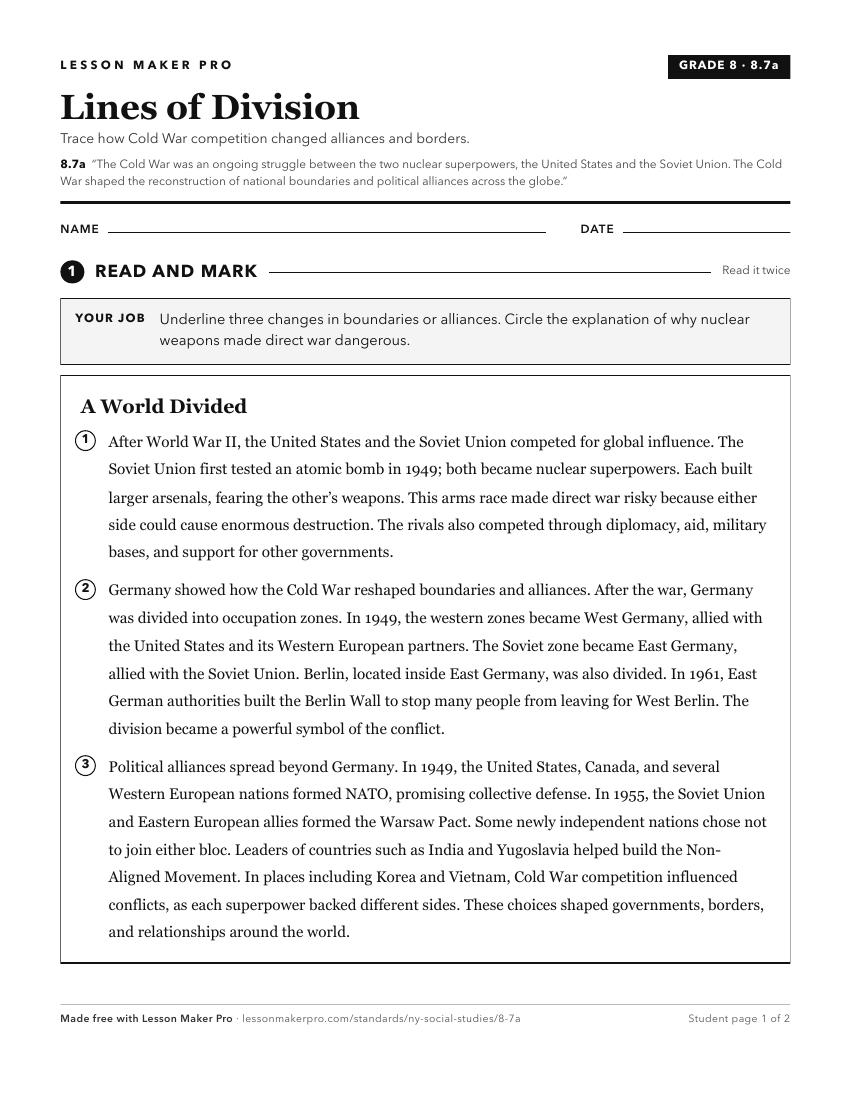
A ready-to-print activity worksheet aligned to 8.7a, with an answer key for the teacher on its own page. No account needed.
PDF, US Letter, prints cleanly in black and white.
Download the worksheetTurn this exact standard into a lesson
Grade, subject, topic, and the complete standard are prefilled. Create one free, no account needed.
Also for this standard:Make a WorksheetMake a QuizMake a Sub Lesson