NY Social Studies 8.6b
The Standard
From 1939 to 1941, the United States government tried to maintain neutrality while providing aid to Britain but was drawn into the war by the Japanese attack on Pearl Harbor. The United States fought a war on multiple fronts. At home, the economy was converted to war production, and essential resources were rationed to ensure adequate supplies for military use.
New York State K–12 Social Studies Framework
Key Idea 8.6
WORLD WAR II: The aggression of the Axis powers threatened United States security and led to its entry into World War II. The nature and consequences of warfare during World War II transformed the United States and the global community. The damage from total warfare and atrocities such as the Holocaust led to a call for international efforts to protect human rights and prevent future wars.
Teacher's field guide
What This Standard Means
What Students Need to Do
- Students trace how neutrality shifted to aid and then war after Pearl Harbor. They explain military strategy in Europe and the Pacific, then analyze production, rationing, segregation, and Japanese American incarceration at home.
What Mastery Looks Like
- A student can sequence Lend-Lease, Pearl Harbor, D-Day, and major Pacific campaigns, then explain why each mattered. The student uses evidence to describe the Tuskegee Airmen, wartime work and rationing, and New York's contribution. The student can explain Korematsu and judge the conflict between security claims and constitutional rights.
Common Misconceptions
- Students often treat neutrality as complete noninvolvement, missing Lend-Lease and other aid to Britain. They may mix up D-Day with Pacific island-hopping or assume rationing meant the United States lacked all goods. Some accept incarceration as proof of disloyalty, overlook the lack of individual evidence, or describe the military as integrated.
How to Assess It
- Exit ticket: Explain how Pearl Harbor changed United States policy, then use one detail about rationing, war production, or incarceration to show a home-front effect.
Lesson moves
Ways to Teach It
Sort photo and document cards into neutrality, combat, war production, rationing, Tuskegee Airmen, and incarceration, then label cause and effect pairs.
Read Korematsu majority and dissent excerpts, then write: Which side better balances national security and constitutional rights?
Run a map relay where teams place Normandy, Pearl Harbor, Midway, and Iwo Jima, then explain each site's strategic role.
Use a Brooklyn Navy Yard production photo and payroll chart to calculate workforce growth and connect New York jobs to wartime demand.
Free download
Printable 8.6b Worksheet
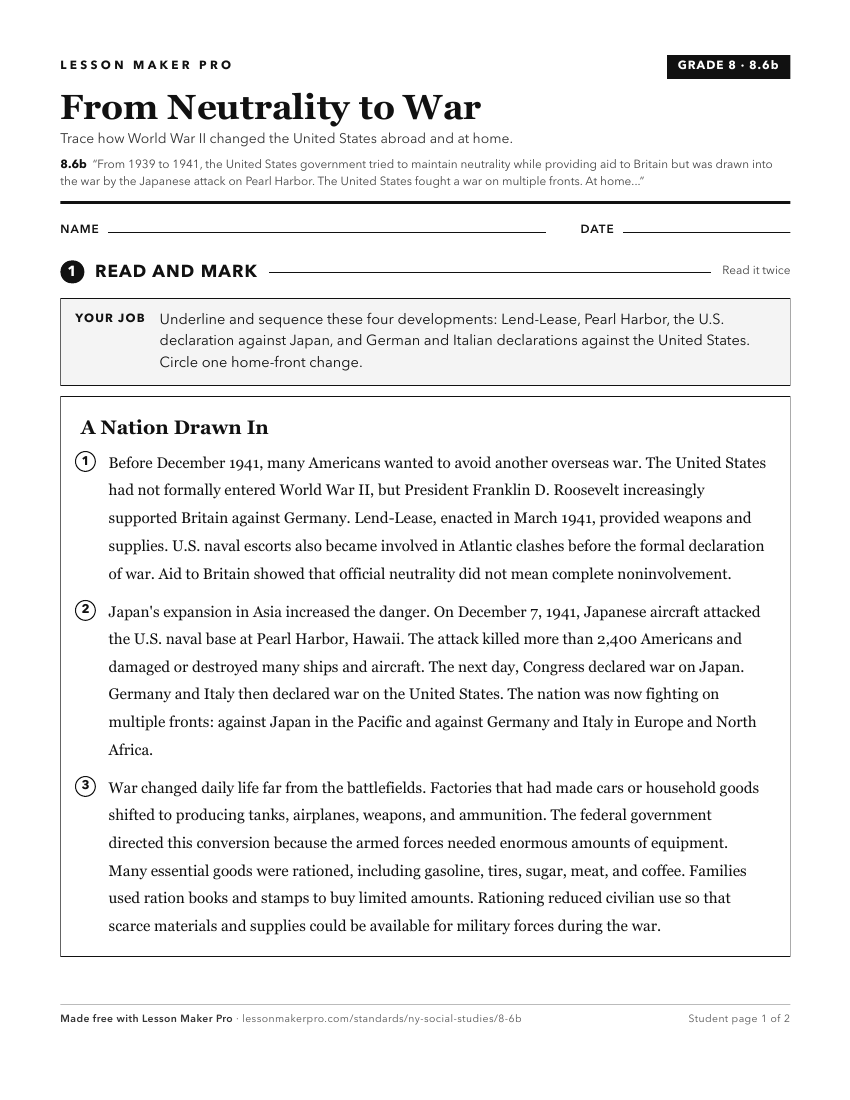
A ready-to-print activity worksheet aligned to 8.6b, with an answer key for the teacher on its own page. No account needed.
PDF, US Letter, prints cleanly in black and white.
Download the worksheetTurn this exact standard into a lesson
Grade, subject, topic, and the complete standard are prefilled. Create one free, no account needed.
Also for this standard:Make a WorksheetMake a QuizMake a Sub Lesson