NY Social Studies 8.4b
The Standard
International, economic, and military developments swayed opinion in favor of the United States siding with the Allies and entering World War I. Domestic responses to World War I limited civil liberties within the United States.
New York State K–12 Social Studies Framework
Key Idea 8.4
WORLD WAR I AND THE ROARING TWENTIES: Various diplomatic, economic, and ideological factors contributed to the United States decision to enter World War I. Involvement in the war significantly altered the lives of Americans. Postwar America was characterized by economic prosperity, technological innovations, and changes in the workplace.
Teacher's field guide
What This Standard Means
What Students Need to Do
- Students explain how trade and loans, unrestricted submarine warfare, and the Zimmermann Telegram shifted American opinion toward entering the war. They analyze propaganda, then explain how wartime laws restricted dissent and civil liberties.
What Mastery Looks Like
- Given several sources, a student can sequence key events and use evidence to explain why the United States entered the war in 1917. The student can interpret propaganda and explain how wartime laws punished speech, publications, or actions viewed as disloyal.
Common Misconceptions
- Students may think the sinking of the Lusitania caused immediate entry, although nearly two years passed. They may also assume neutrality meant no economic ties, or that wartime laws targeted only spies rather than critics and protesters.
How to Assess It
- Exit ticket: Choose unrestricted submarine warfare, the Zimmermann Telegram, or Allied trade and loans. Explain how it encouraged entry, then identify one freedom restricted by a wartime law.
Lesson moves
Ways to Teach It
Have pairs sort event, economic tie, and law cards into causes of entry, support-building tools, and limits on civil liberties.
Ask students to write: When, if ever, should national security permit limits on speech during war?
Play a source-match relay where teams pair propaganda posters with intended audiences, emotional appeals, and requested actions.
Compare a World War I poster with a current public-service campaign, noting audience, emotion, evidence, and desired action.
Free download
Printable 8.4b Worksheet
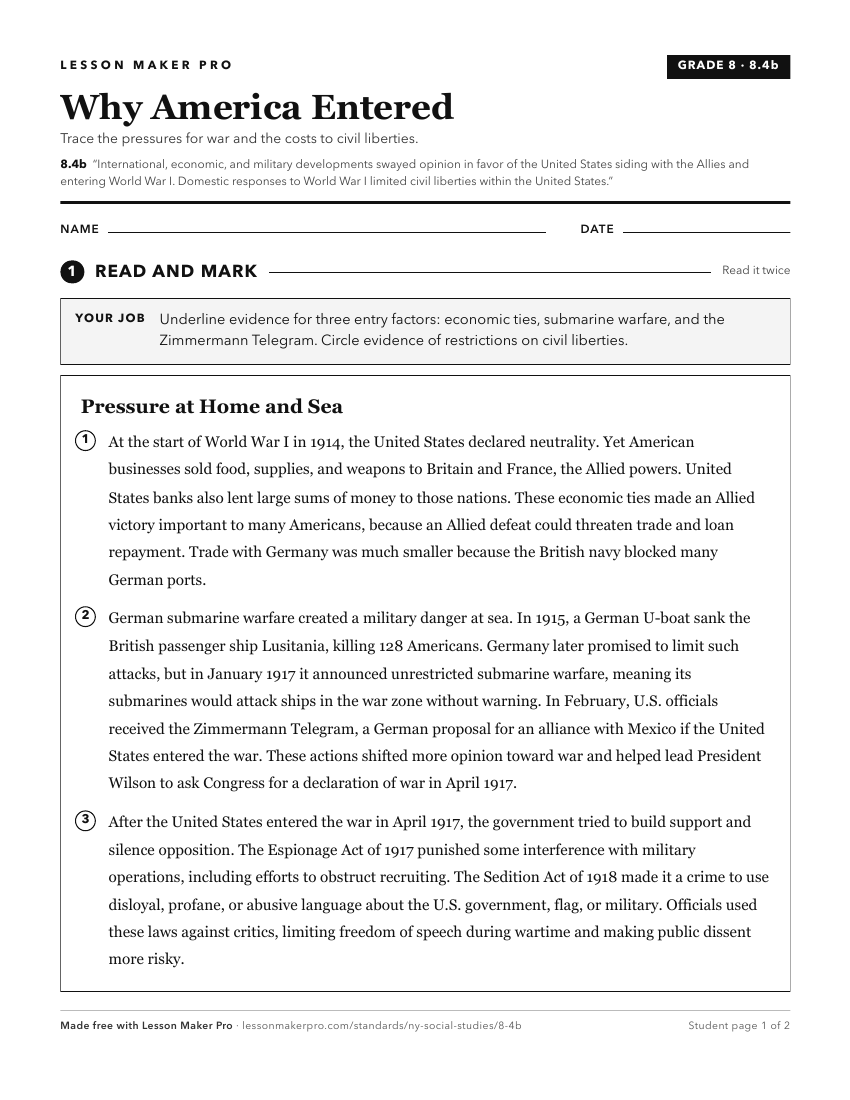
A ready-to-print activity worksheet aligned to 8.4b, with an answer key for the teacher on its own page. No account needed.
PDF, US Letter, prints cleanly in black and white.
Download the worksheetTurn this exact standard into a lesson
Grade, subject, topic, and the complete standard are prefilled. Create one free, no account needed.
Also for this standard:Make a WorksheetMake a QuizMake a Sub Lesson