NY Social Studies 7.5d
The Standard
Foreign and domestic disputes tested the strength of the Constitution, particularly the separation of powers, the system of checks and balances, and the issue of States rights. The United States sought to implement isolationism while protecting the Western Hemisphere from European interference.
New York State K–12 Social Studies Framework
Key Idea 7.5
THE CONSTITUTION IN PRACTICE: The United States Constitution serves as the foundation of the United States government and outlines the rights of citizens. The Constitution is considered a living document that can respond to political and social changes. The New York State Constitution also has been changed over time.
Teacher's field guide
What This Standard Means
What Students Need to Do
- Students explain how Hamilton’s economic plan, the Louisiana Purchase, Marbury v. Madison, and the War of 1812 raised constitutional questions. They identify which branch acted, what power it claimed, and how other branches or states responded. They also explain how the Monroe Doctrine limited European interference without ending all foreign involvement.
What Mastery Looks Like
- Students can connect each event to a specific issue involving federal power, states’ rights, judicial review, or checks and balances. They support each connection with accurate evidence. They can also distinguish the Monroe Doctrine from complete isolationism.
Common Misconceptions
- Students may think the Constitution clearly authorized the Louisiana Purchase and explicitly established judicial review. They may treat the Monroe Doctrine as a law that ended all European activity in the Americas. They may also confuse states’ rights objections with ordinary political disagreement.
How to Assess It
- Exit ticket: Pick one of the four early national events. Name the constitutional question, identify the branch or level of government involved, and explain the result. Then explain why the Monroe Doctrine was not complete isolation.
Lesson moves
Ways to Teach It
Give pairs event cards and branch labels, then have them sort Hamilton’s plan, Louisiana Purchase, Marbury, and the War of 1812 by constitutional issue.
Write: Which early national event stretched constitutional power most, and what evidence supports your choice?
Play a claim-and-evidence match using cards for each event, government action, constitutional question, and outcome.
Compare the Monroe Doctrine with a current U.S. response to foreign influence in the Western Hemisphere using two short news excerpts.
Free download
Printable 7.5d Worksheet
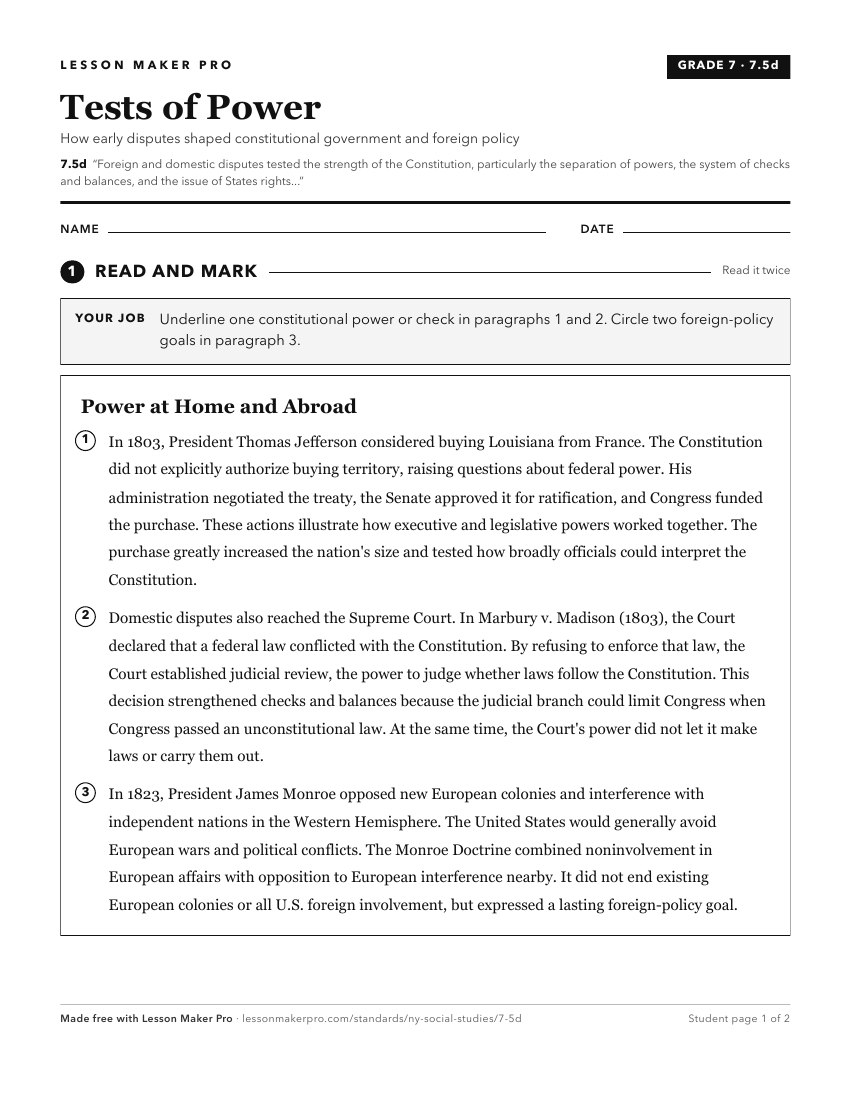
A ready-to-print activity worksheet aligned to 7.5d, with an answer key for the teacher on its own page. No account needed.
PDF, US Letter, prints cleanly in black and white.
Download the worksheetTurn this exact standard into a lesson
Grade, subject, topic, and the complete standard are prefilled. Create one free, no account needed.
Also for this standard:Make a WorksheetMake a QuizMake a Sub Lesson