NY Social Studies 7.2e
The Standard
Over the course of the 17th and 18th centuries, slavery grew in the colonies. Enslaved Africans utilized a variety of strategies to both survive and resist their conditions.
New York State K–12 Social Studies Framework
Key Idea 7.2
COLONIAL DEVELOPMENTS: European exploration of the New World resulted in various interactions with Native Americans and in colonization. The American colonies were established for a variety of reasons and developed differently based on economic, social, and geographic factors. Colonial America had a variety of social structures under which not all people were treated equally.
Teacher's field guide
What This Standard Means
What Students Need to Do
- Students trace how slavery expanded across colonial regions and explain how crops, trade, and labor demands shaped that growth. They describe the Middle Passage, examine conditions in New York, and compare survival and resistance strategies. They also distinguish lifelong racial slavery from time-limited indentured servitude.
What Mastery Looks Like
- Students use maps and primary sources to explain where slavery grew and why. They can describe specific conditions enslaved people faced and support claims about survival or resistance with evidence. They clearly explain how slavery differed from indentured servitude.
Common Misconceptions
- Students may think slavery existed only in the South or that New York played little role. They may treat resistance as only armed revolt, overlooking escape, work slowdowns, cultural traditions, and family networks. They may also confuse indentured servants with enslaved people because both performed forced or restricted labor.
How to Assess It
- Exit ticket: In four bullets, describe one Middle Passage condition, explain why slavery grew in one region, identify one resistance strategy, and distinguish slavery from indentured servitude.
Lesson moves
Ways to Teach It
Give pairs a colonial map and crop cards; have them place crops by region, then connect labor demand to slavery's growth.
Ask students to write: How did family, faith, work slowdowns, escape, and revolt serve different goals under slavery?
Run a card sort where teams classify examples as survival, resistance, revolt, indentured servitude, or slavery, then defend two choices.
Use a New York runaway notice or census record and ask what it reveals and hides about an enslaved person's life.
Free download
Printable 7.2e Worksheet
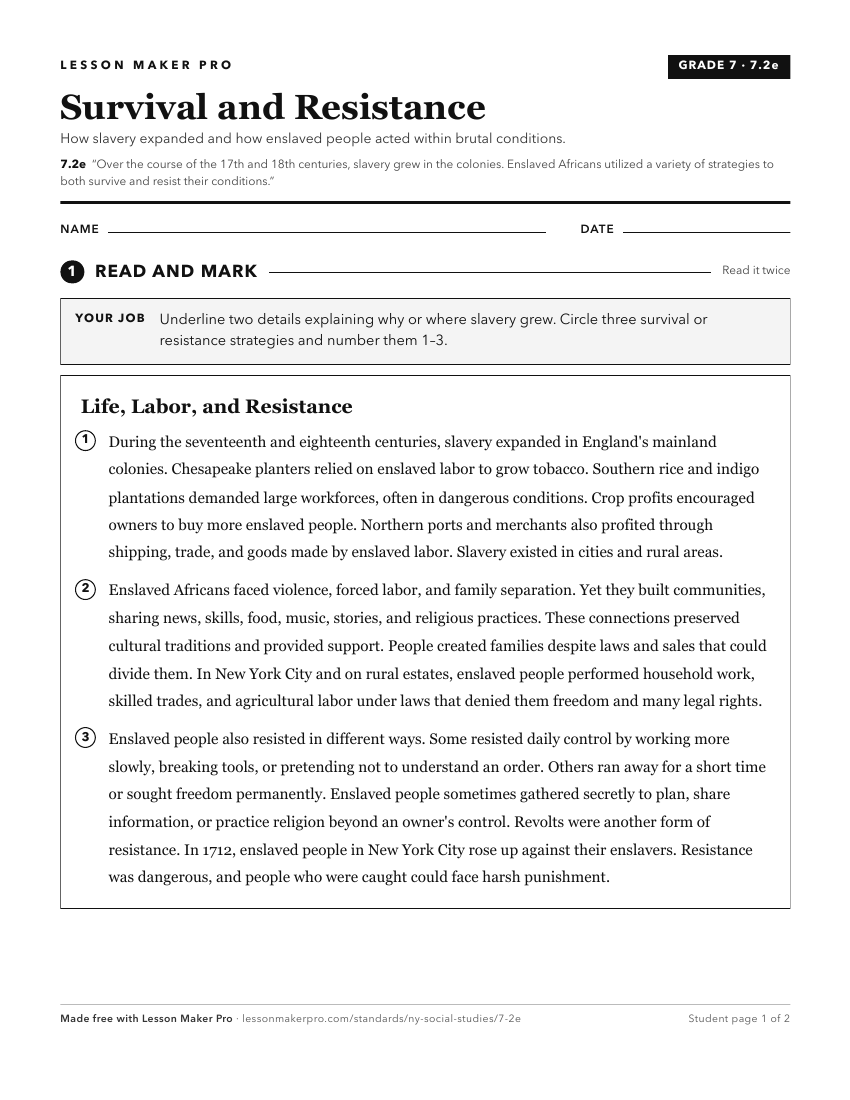
A ready-to-print activity worksheet aligned to 7.2e, with an answer key for the teacher on its own page. No account needed.
PDF, US Letter, prints cleanly in black and white.
Download the worksheetTurn this exact standard into a lesson
Grade, subject, topic, and the complete standard are prefilled. Create one free, no account needed.
Also for this standard:Make a WorksheetMake a QuizMake a Sub Lesson