NY Social Studies 7.2d
The Standard
In New York, the Dutch established settlements along the Hudson River and the French established settlements in the Champlain Valley. Dutch contributions to American society were long-lasting.
New York State K–12 Social Studies Framework
Key Idea 7.2
COLONIAL DEVELOPMENTS: European exploration of the New World resulted in various interactions with Native Americans and in colonization. The American colonies were established for a variety of reasons and developed differently based on economic, social, and geographic factors. Colonial America had a variety of social structures under which not all people were treated equally.
Teacher's field guide
What This Standard Means
What Students Need to Do
- Students compare Dutch, French, and English settlements by government, economy, social life, landholding, and location. They explain the patroon system, changes in African American status, Dutch influences, and shifting relations with Native nations.
What Mastery Looks Like
- Students can complete a comparison chart with accurate evidence for each colonial system. They can explain how rule changes affected Africans and identify lasting Dutch practices such as petition rights and limited religious toleration.
Common Misconceptions
- Students may treat Dutch religious toleration as full religious freedom or social equality. They may assume slavery began under English rule and describe Dutch relations with Native nations as always peaceful.
How to Assess It
- Give students a three-column exit ticket labeled Dutch, French, and English. Have them add one accurate feature to each column and explain one change caused by English rule.
Lesson moves
Ways to Teach It
Place settlement, trade, landholding, religion, and labor source cards on a Hudson and Champlain Valley map, then label each colonial system.
Write a claim explaining how Dutch rule differed from French and English rule, using one political, economic, and social example.
Play a sorting game with patroon estates, fur trade, petitions, slavery, religious toleration, and Native alliances, then defend disputed placements.
Trace Dutch place names, foods, or customs still found in New York, and connect one example to its colonial origin.
Free download
Printable 7.2d Worksheet
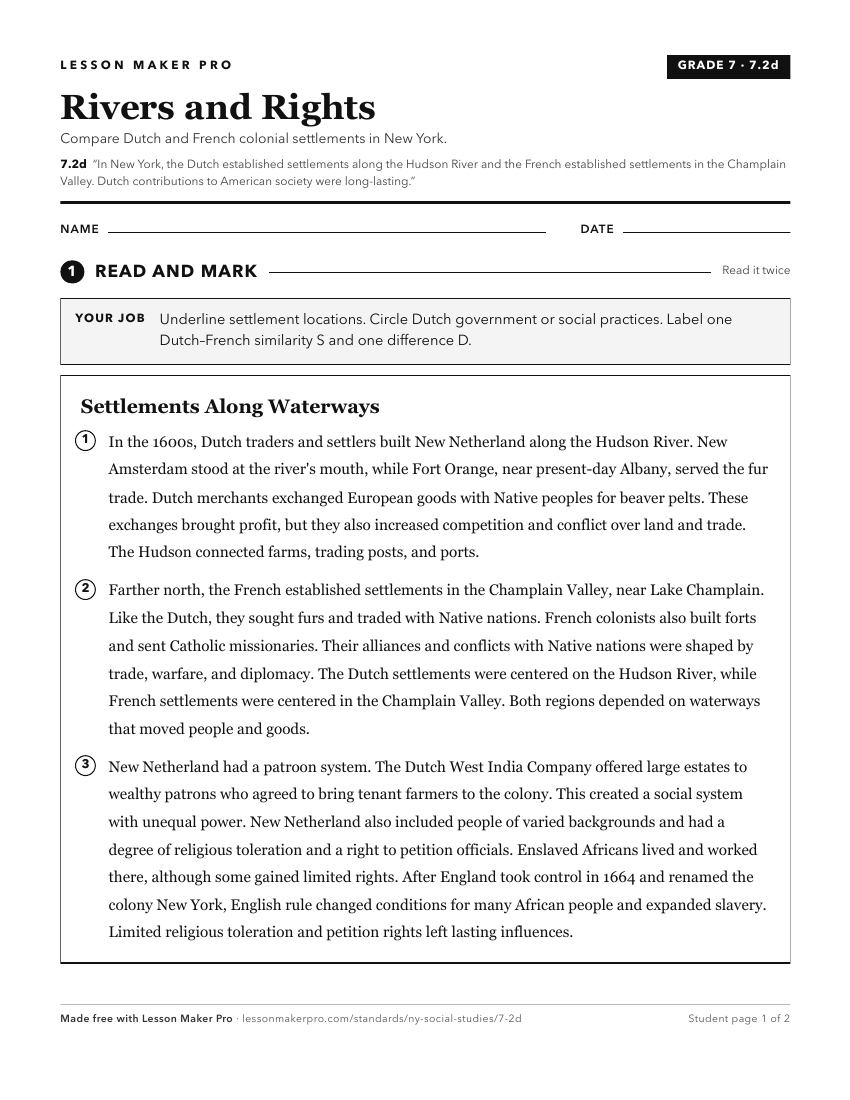
A ready-to-print activity worksheet aligned to 7.2d, with an answer key for the teacher on its own page. No account needed.
PDF, US Letter, prints cleanly in black and white.
Download the worksheetTurn this exact standard into a lesson
Grade, subject, topic, and the complete standard are prefilled. Create one free, no account needed.
Also for this standard:Make a WorksheetMake a QuizMake a Sub Lesson