NY Social Studies 7.2b
The Standard
Different European groups had varied interactions and relationships with the Native American societies they encountered. Native American societies suffered from loss of life due to disease and conflict and loss of land due to encroachment of European settlers and differing conceptions of property and land ownership.
New York State K–12 Social Studies Framework
Key Idea 7.2
COLONIAL DEVELOPMENTS: European exploration of the New World resulted in various interactions with Native Americans and in colonization. The American colonies were established for a variety of reasons and developed differently based on economic, social, and geographic factors. Colonial America had a variety of social structures under which not all people were treated equally.
Teacher's field guide
What This Standard Means
What Students Need to Do
- Students compare British, Dutch, French, and Spanish relations with specific Algonquian, Haudenosaunee, and Muscogee peoples. They use maps and sources to explain why Native populations fell and how Native lands were taken.
What Mastery Looks Like
- A student can compare two colonial encounters using accurate names, actions, motives, outcomes, and source evidence. The student can connect epidemics, warfare, settlement, and different ideas about land ownership to population and land loss.
Common Misconceptions
- Students often treat Europeans or Native peoples as single groups with shared goals. They may assume colonists found unused land or that signed deeds held the same meaning for both sides. Some blame population loss only on warfare and overlook epidemics, displacement, and damaged food systems.
How to Assess It
- Compare one British encounter with one Dutch, French, or Spanish encounter involving a named Native nation. Give one similarity, one difference, and one cause of population or land loss.
Lesson moves
Ways to Teach It
Place trade goods, treaty cards, mission symbols, disease markers, and settlement pieces on a map to model changing relationships and land control.
Write from two sourced viewpoints: What did this land agreement mean, and why might each side understand ownership differently?
Run a four-corner match where students link European case cards to Native nations, actions, and outcomes.
Use a local map and an official Native nation website to trace one nearby homeland, treaty, reservation, or displacement route.
Free download
Printable 7.2b Worksheet
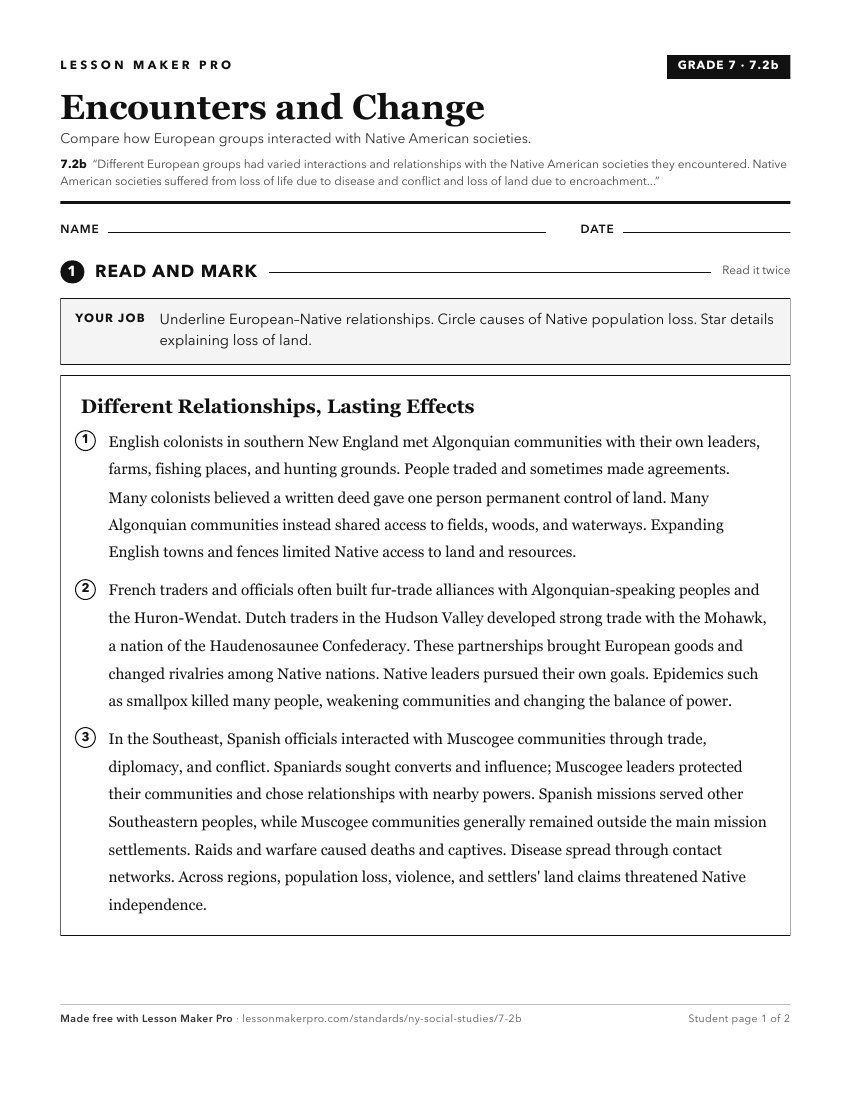
A ready-to-print activity worksheet aligned to 7.2b, with an answer key for the teacher on its own page. No account needed.
PDF, US Letter, prints cleanly in black and white.
Download the worksheetTurn this exact standard into a lesson
Grade, subject, topic, and the complete standard are prefilled. Create one free, no account needed.
Also for this standard:Make a WorksheetMake a QuizMake a Sub Lesson