NY Social Studies 6.6b
The Standard
The Byzantine Empire preserved elements of the Roman Empire, controlled lands within the Mediterranean basin, and began to develop Orthodox Christianity.
New York State K–12 Social Studies Framework
Key Idea 6.6
MEDITERRANEAN WORLD: FEUDAL WESTERN EUROPE, THE BYZANTINE EMPIRE, AND THE ISLAMIC CALIPHATES (ca. 600 C.E. – ca. 1450): The Mediterranean world was reshaped with the fall of the Roman Empire. Three distinct cultural regions developed: feudal Western Europe, the Byzantine Empire, and the Islamic caliphates. These regions interacted with each other and clashed over control of holy lands.
Teacher's field guide
What This Standard Means
What Students Need to Do
- Students locate Constantinople and Byzantine territory on a Mediterranean map. They explain how Roman law and government mixed with Greek language and culture, and how the emperor held political and religious authority.
What Mastery Looks Like
- Students can use a map or source to identify Roman continuities, Greek influences, and the importance of Constantinople. They can explain how the emperor connected government with the Orthodox Church.
Common Misconceptions
- Students may treat the Byzantine Empire as separate from Roman history or assume its people called themselves Byzantine. They may also confuse Orthodox Christianity with Islam or assume the emperor served only as a political ruler.
How to Assess It
- Give an exit ticket: Name one Roman continuity, one Greek influence, and one way the emperor linked church and government. Add Constantinople to a blank map.
Lesson moves
Ways to Teach It
Have pairs layer tracing paper over Roman and Byzantine maps, then mark shared territory, Constantinople, and major Mediterranean trade routes.
Ask students to write: Was the Byzantine Empire more Roman, more Greek, or equally both? Support the claim with two examples.
Play a card sort using examples labeled Roman continuity, Greek influence, Orthodox Christianity, or geographic advantage.
Compare images of Hagia Sophia as a church, mosque, and museum, then discuss how one building reflects Constantinople’s changing history.
Free download
Printable 6.6b Worksheet
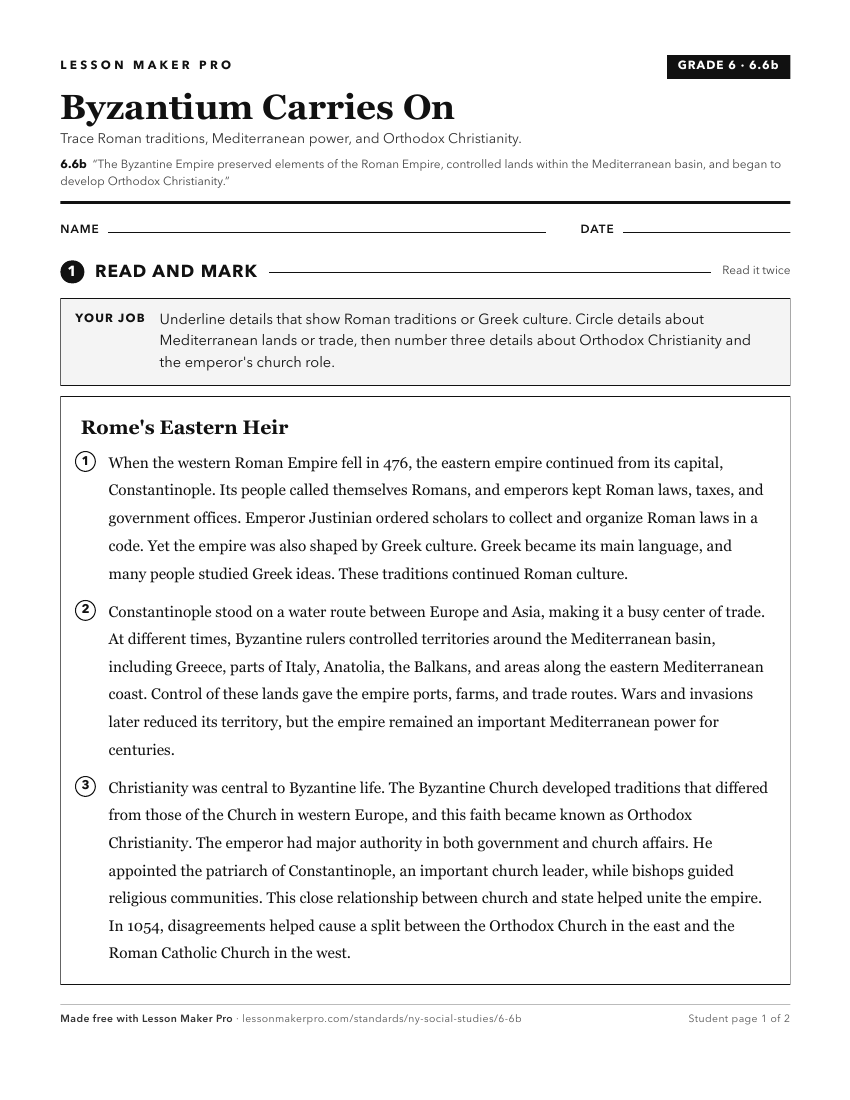
A ready-to-print activity worksheet aligned to 6.6b, with an answer key for the teacher on its own page. No account needed.
PDF, US Letter, prints cleanly in black and white.
Download the worksheetTurn this exact standard into a lesson
Grade, subject, topic, and the complete standard are prefilled. Create one free, no account needed.
Also for this standard:Make a WorksheetMake a QuizMake a Sub Lesson