NY Social Studies 6.6a
The Standard
Overexpansion, corruption, invasions, civil wars, and discord led to the fall of Rome. Feudalism developed in Western Europe in reaction to a need for order and to meet basic needs.
New York State K–12 Social Studies Framework
Key Idea 6.6
MEDITERRANEAN WORLD: FEUDAL WESTERN EUROPE, THE BYZANTINE EMPIRE, AND THE ISLAMIC CALIPHATES (ca. 600 C.E. – ca. 1450): The Mediterranean world was reshaped with the fall of the Roman Empire. Three distinct cultural regions developed: feudal Western Europe, the Byzantine Empire, and the Islamic caliphates. These regions interacted with each other and clashed over control of holy lands.
Teacher's field guide
What This Standard Means
What Students Need to Do
- Students trace how several pressures weakened Roman rule and reduced central control. They explain how local lords, manors, feudal ties, and the Christian Church met needs for protection, food, law, and order.
What Mastery Looks Like
- A student can use evidence to explain how several pressures combined to weaken Roman rule, rather than naming one cause. They can connect weakened central authority to feudal ties, local protection, manorial production, and the Church’s wider influence.
Common Misconceptions
- Students may treat Rome’s fall as a single sudden event caused only by invasions. They may confuse feudalism with slavery, assume kings held strong centralized power, or think the Christian Church directly replaced Roman government.
How to Assess It
- Exit ticket: Choose two causes of Rome’s decline and explain how they worked together. Then explain why weakened central rule increased reliance on lords and the Church.
Lesson moves
Ways to Teach It
Give groups cards on invasions, taxes, civil wars, corruption, and overexpansion, then arrange them into a cause-and-effect chain.
Write a response to this prompt: Why might families trade freedom and labor for land, food, and protection?
Play a matching game connecting feudal roles, such as king, lord, knight, peasant, and clergy, to duties and benefits.
Compare a medieval manor’s services with services provided by local governments today, then list one similarity and two differences.
Free download
Printable 6.6a Worksheet
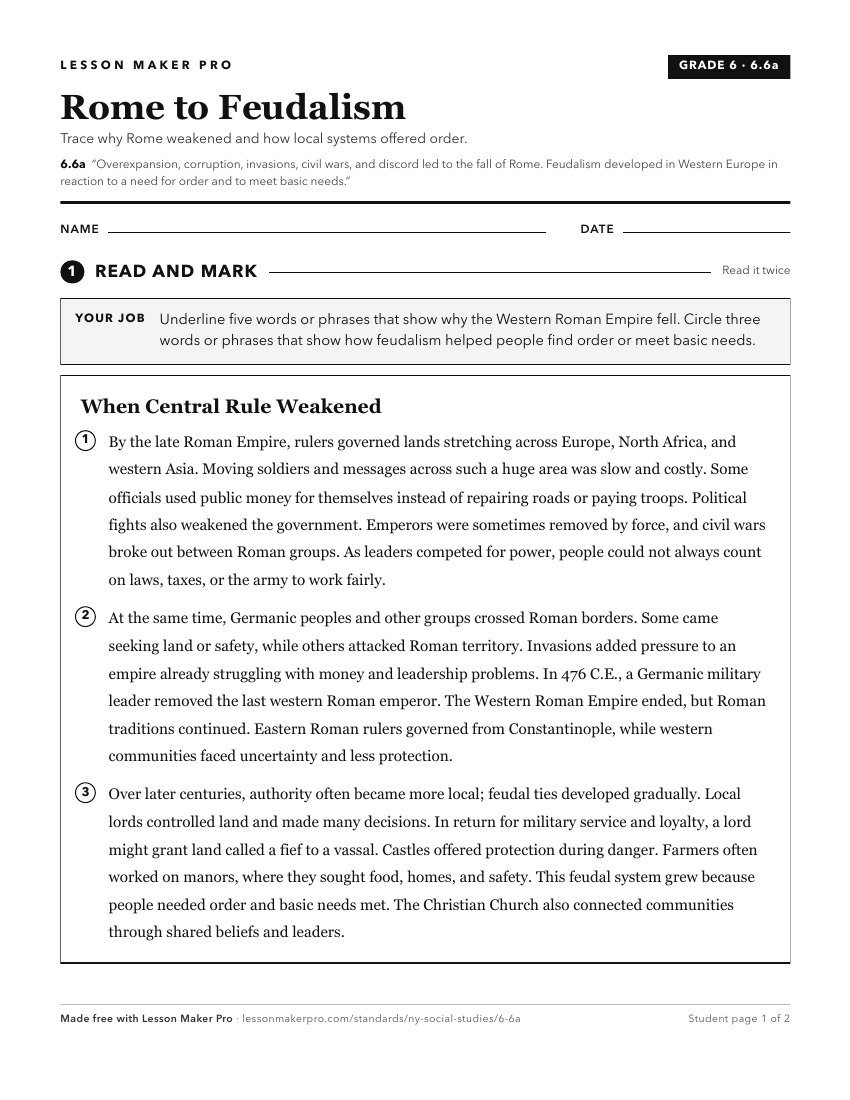
A ready-to-print activity worksheet aligned to 6.6a, with an answer key for the teacher on its own page. No account needed.
PDF, US Letter, prints cleanly in black and white.
Download the worksheetTurn this exact standard into a lesson
Grade, subject, topic, and the complete standard are prefilled. Create one free, no account needed.
Also for this standard:Make a WorksheetMake a QuizMake a Sub Lesson