NY Social Studies 6.3b
The Standard
Complex societies and civilizations share the common characteristics of religion, job specialization, cities, government, language/record keeping system, technology, and social hierarchy. People in Mesopotamia, the Yellow River valley, the Indus River valley, and the Nile River valley developed complex societies and civilizations.
New York State K–12 Social Studies Framework
Key Idea 6.3
EARLY RIVER VALLEY CIVILIZATIONS IN THE EASTERN HEMISPHERE (ca. 3500 B.C.E. – ca. 500 B.C.E.): Complex societies and civilizations developed in the Eastern Hemisphere. Although these complex societies and civilizations have certain defining characteristics in common, each is also known for unique cultural achievements and contributions. Early human communities in the Eastern Hemisphere adapted to and modified the physical environment.
Teacher's field guide
What This Standard Means
What Students Need to Do
- Students use artifacts, maps, buildings, and written records to investigate at least two early river valley societies. They identify signs of organized leadership, specialized work, belief systems, cities, record keeping, technology, and social rank. They compare shared patterns and unique achievements, backing each claim with evidence.
What Mastery Looks Like
- Given a source set, a student correctly links evidence, such as a law code or seal, to a feature of complex society. The student compares two regions and explains one similarity and one difference with accurate evidence.
Common Misconceptions
- Students may assume all river valley societies developed the same institutions or that one society copied another. They may treat an artifact as proof without explaining what it shows. They may also confuse a modern nation with an ancient river valley region.
How to Assess It
- Exit ticket: Choose two societies studied. Name one shared feature and one difference, then cite one artifact, text, map detail, or structure that supports each claim.
Lesson moves
Ways to Teach It
Give groups artifact cards from Mesopotamia and the Indus Valley to sort under leadership, work, beliefs, records, technology, cities, or social rank.
Ask students to write: Which shared feature best shows that both societies were complex, and what evidence supports your choice?
Play Evidence Match: teams pair source cards with society features, then earn a point by defending each match aloud.
Have students audit their town for specialized jobs, government, records, technology, and social groups, then compare findings with one ancient city.
Free download
Printable 6.3b Worksheet
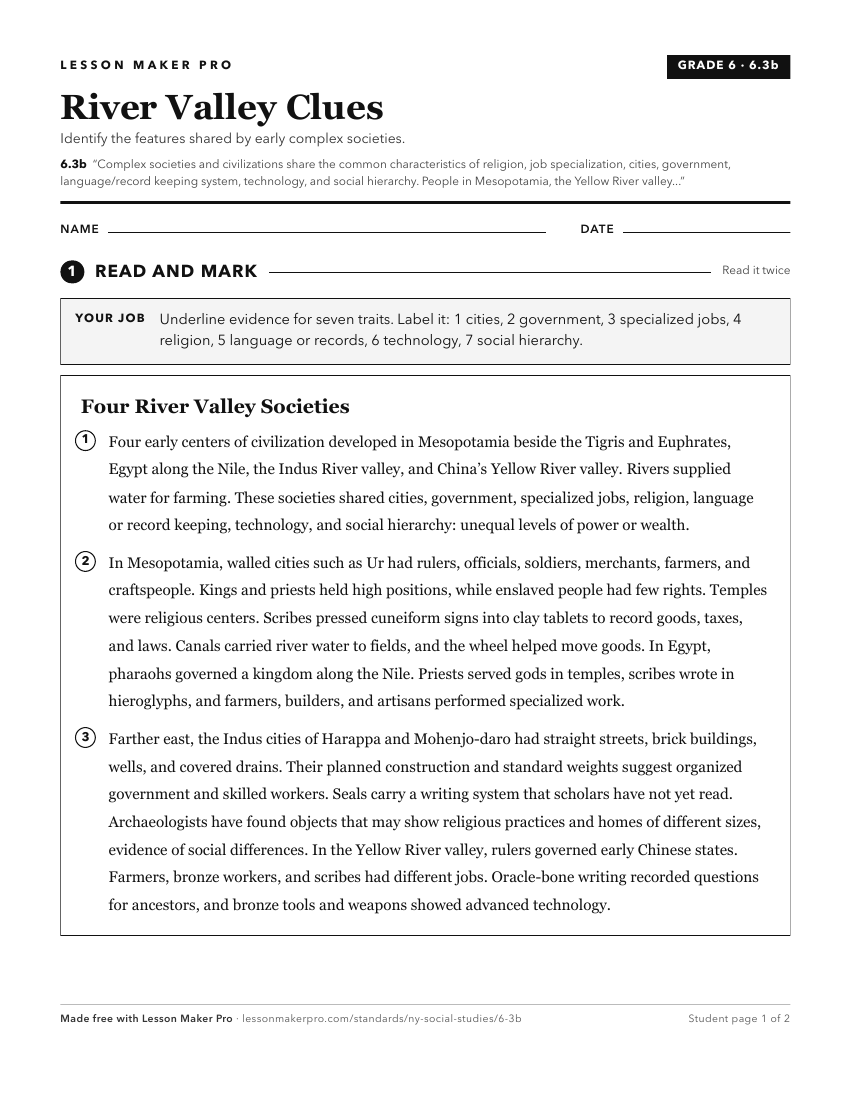
A ready-to-print activity worksheet aligned to 6.3b, with an answer key for the teacher on its own page. No account needed.
PDF, US Letter, prints cleanly in black and white.
Download the worksheetTurn this exact standard into a lesson
Grade, subject, topic, and the complete standard are prefilled. Create one free, no account needed.
Also for this standard:Make a WorksheetMake a QuizMake a Sub Lesson