NY Social Studies 6.2a
The Standard
Human populations that settled along rivers, in rainforests, along coastlines, in deserts, and in mountains made use of the resources and the environment around them in developing distinct ways of life.
New York State K–12 Social Studies Framework
Key Idea 6.2
THE FIRST HUMANS THROUGH THE NEOLITHIC REVOLUTION IN THE EASTERN HEMISPHERE: The first humans modified their physical environment as well as adapted to their environment.
Teacher's field guide
What This Standard Means
What Students Need to Do
- Students explain how geography and available resources shaped food, shelter, clothing, travel, and work. They compare how people adapted to different environments and changed those environments.
What Mastery Looks Like
- Students use details from maps, images, or short sources to connect an environmental feature with a specific way of life. They explain both adaptation and environmental modification.
Common Misconceptions
- Students may think environment completely determines culture or that every group in one region lived the same way. They may also confuse adapting to nature with changing nature.
How to Assess It
- Give students a river valley and desert resource map. Ask them to name one likely adaptation and one environmental change for each location, with map evidence.
Lesson moves
Ways to Teach It
Give groups terrain maps and resource cards, then have them build and label a settlement plan suited to one environment.
Ask students to write: How might moving from a coastline to a desert change a community’s food, homes, and travel?
Play a matching game connecting environments, resources, and choices such as irrigation, fishing, terrace farming, or portable shelters.
Map your community’s water, landforms, and climate, then identify two ways they affect local housing, transportation, or jobs.
Free download
Printable 6.2a Worksheet
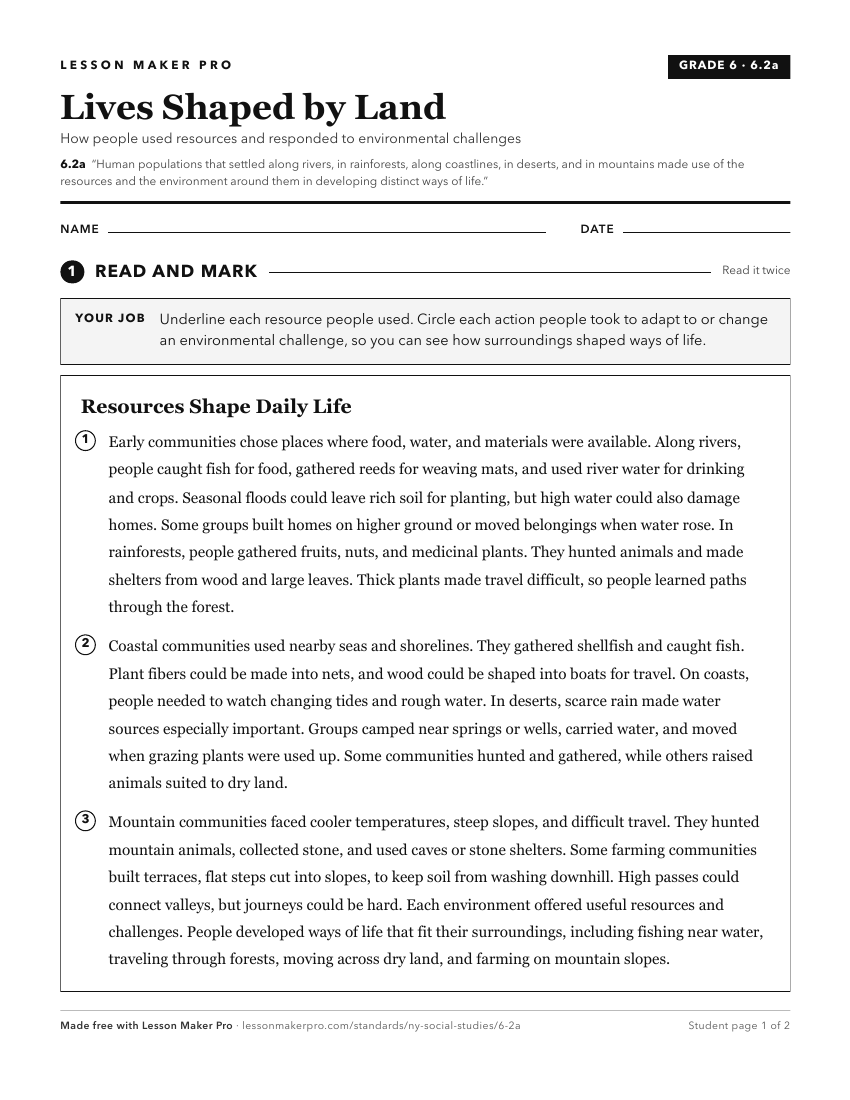
A ready-to-print activity worksheet aligned to 6.2a, with an answer key for the teacher on its own page. No account needed.
PDF, US Letter, prints cleanly in black and white.
Download the worksheetTurn this exact standard into a lesson
Grade, subject, topic, and the complete standard are prefilled. Create one free, no account needed.
Also for this standard:Make a WorksheetMake a QuizMake a Sub Lesson