NY Social Studies 5.3c
The Standard
The transatlantic trade of goods, movement of people, and spread of ideas and diseases resulted in cultural diffusion. This cultural diffusion became known as the Columbian Exchange which reshaped the lives and influenced the beliefs of people.
New York State K–12 Social Studies Framework
Key Idea 5.3
EUROPEAN EXPLORATION AND ITS EFFECTS: Various European powers explored and eventually colonized the Western Hemisphere. This had a profound effect on Native Americans and led to the transatlantic slave trade.
Teacher's field guide
What This Standard Means
What Students Need to Do
- Students map how people, plants, animals, goods, ideas, and diseases moved among Africa, Europe, and the Americas. They explain how these exchanges changed food, culture, population, and beliefs, including the devastating effects of disease on Native peoples.
What Mastery Looks Like
- Given examples such as horses, maize, smallpox, and enslaved Africans, students can show where each began, where it moved, and one result. They can explain why introduced diseases caused severe Native population loss and connect the exchange to lasting cultural change.
Common Misconceptions
- Students may treat the exchange as one voyage led only by Columbus, rather than a long process involving many peoples. They often reverse the direction of crops and animals, or describe every movement as voluntary and beneficial. Some assume Native peoples had immunity to European diseases or that disease was the only cause of population decline.
How to Assess It
- On an exit ticket, ask: “On a map of Africa, Europe, and the Americas, draw and label three movement arrows: one crop or animal, one group of people, and one disease. Beside each arrow, write one effect.”
Lesson moves
Ways to Teach It
Place a large floor map down, then have pairs move picture cards for maize, horses, smallpox, and enslaved Africans along labeled yarn arrows.
Ask, “Which exchange changed life most, and for whom?” Students cite two mapped examples and consider both benefits and harms.
Run a card-sort relay where teams match each item to its origin, destination, movement type, and one historical effect.
Examine cafeteria foods such as corn, potatoes, tomatoes, and wheat, then trace each ingredient’s route onto a lunch tray map.
Free download
Printable 5.3c Worksheet
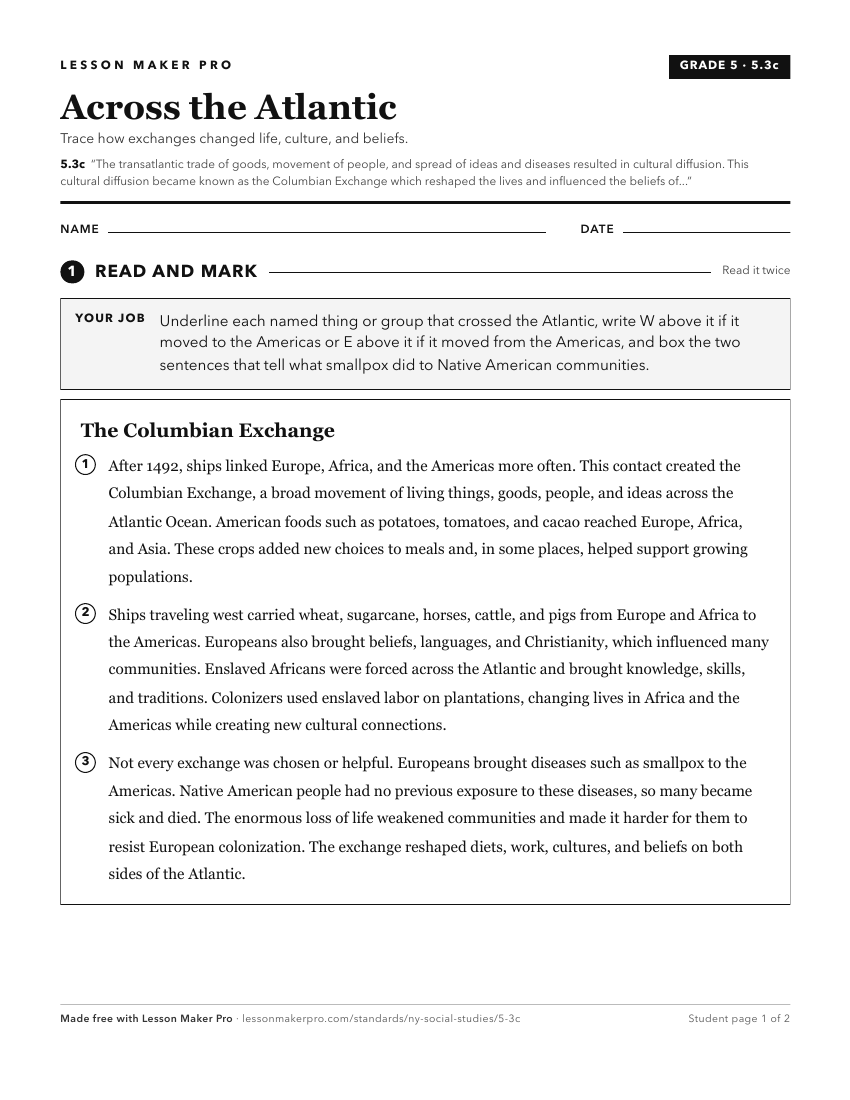
A ready-to-print activity worksheet aligned to 5.3c, with an answer key for the teacher on its own page. No account needed.
PDF, US Letter, prints cleanly in black and white.
Download the worksheetTurn this exact standard into a lesson
Grade, subject, topic, and the complete standard are prefilled. Create one free, no account needed.
Also for this standard:Make a WorksheetMake a QuizMake a Sub Lesson