NY Social Studies 5.1c
The Standard
Early peoples living together in settlements developed shared cultures with customs, beliefs, values, and languages that give identity to the group. These early peoples also developed patterns of organization and governance to manage their societies.
New York State K–12 Social Studies Framework
Key Idea 5.1
EARLY PEOPLES OF THE AMERICAS: The first humans in the Western Hemisphere modified their physical environment as well as adapted to their environment. Their interactions with their environment led to various innovations and to the development of unique cultures.
Teacher's field guide
What This Standard Means
What Students Need to Do
- Students locate one Native culture group from the present-day United States, Canada, and Caribbean on maps. They compare how each group used local resources for food, clothing, and shelter. They also compare language, customs, beliefs, values, leadership, and decision-making.
What Mastery Looks Like
- Students make an accurate three-group comparison using details from maps and reliable sources. They connect at least one environmental resource to a basic need and describe how each group organized community decisions. They name similarities without treating the groups as interchangeable.
Common Misconceptions
- Students may treat all Native peoples as one culture or assume every group used tipis and hunted buffalo. They may think environment completely determined culture, or confuse language, religion, and government. Some also speak of Native peoples only in the past, although Native nations and communities continue today.
How to Assess It
- Give students a map and three short source cards for the Hopi, Cree, and Taíno. Ask them to record one resource adaptation and one cultural or governance feature for each, then write one supported comparison.
Lesson moves
Ways to Teach It
Students place resource, shelter, language, and leadership cards for the Hopi, Cree, and Taíno onto a three-region floor map, citing card evidence.
Write: Which two groups responded most differently to their environments, and which source details support your claim?
Play a source-card match: teams pair facts with groups, earn a point for each correct match, and explain one clue.
Visit current tribal nation or Indigenous community websites, then compare one modern language or government program with a historical source.
Free download
Printable 5.1c Worksheet
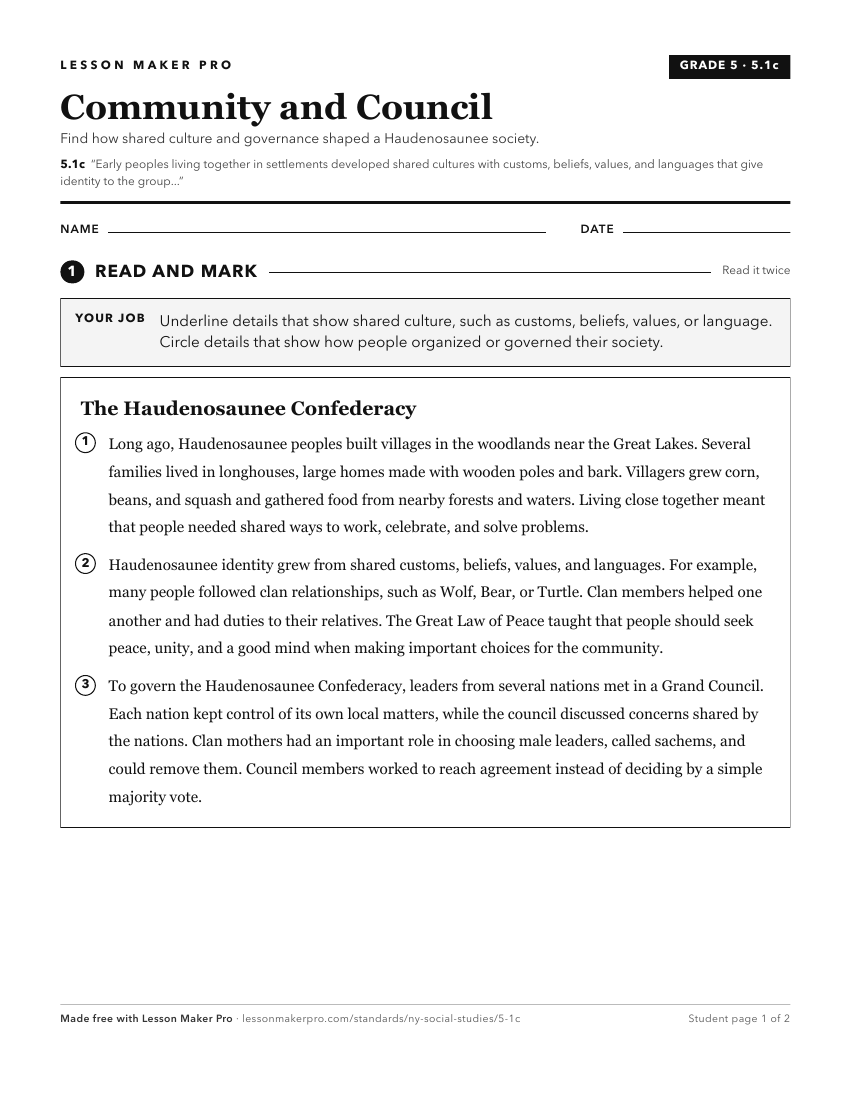
A ready-to-print activity worksheet aligned to 5.1c, with an answer key for the teacher on its own page. No account needed.
PDF, US Letter, prints cleanly in black and white.
Download the worksheetTurn this exact standard into a lesson
Grade, subject, topic, and the complete standard are prefilled. Create one free, no account needed.
Also for this standard:Make a WorksheetMake a QuizMake a Sub Lesson