NY Social Studies 4.3d
The Standard
Growing conflicts between England and the 13 colonies over issues of political and economic rights led to the American Revolution. New York played a significant role during the Revolution, in part due to its geographic location.
New York State K–12 Social Studies Framework
Key Idea 4.3
COLONIAL AND REVOLUTIONARY PERIOD IN NEW YORK: European exploration led to the colonization of the region that became New York State. Beginning in the early 1600s, colonial New York was home to people from many different countries. Colonial New York was important during the Revolutionary Period.
Teacher's field guide
What This Standard Means
What Students Need to Do
- Students explain how taxes, trade rules, and lack of colonial representation increased conflict with Britain. They use maps and sources to analyze New York’s geography, wartime loyalties, British occupation, and major battles. They explain why Saratoga changed the course of the war.
What Mastery Looks Like
- Students connect a colonial grievance to the demand for political or economic rights. They can use evidence to explain Patriot, Loyalist, Haudenosaunee, and African American choices. They can show why Long Island mattered and how Saratoga helped bring French support.
Common Misconceptions
- Students may think all colonists supported independence or that every Haudenosaunee nation chose the same side. They may assume African Americans fought only for the Patriots, overlooking British promises of freedom. They may also treat Saratoga as important only because the Patriots won.
How to Assess It
- Give students a New York map and ask: Explain one grievance, one wartime choice, one geographic advantage, and why Saratoga changed the war.
Lesson moves
Ways to Teach It
Place battle, fort, river, and occupation cards on a floor map of New York, then trace likely British and Patriot routes with yarn.
Write a diary entry explaining why a Patriot, Loyalist, Haudenosaunee person, or African American volunteer chose a side, using two source details.
Sort grievance, response, and result cards into cause-and-effect chains, then challenge pairs to defend one chain aloud.
Compare a modern New York transportation map with a colonial map, then explain why the Hudson River corridor still connects important places.
Free download
Printable 4.3d Worksheet
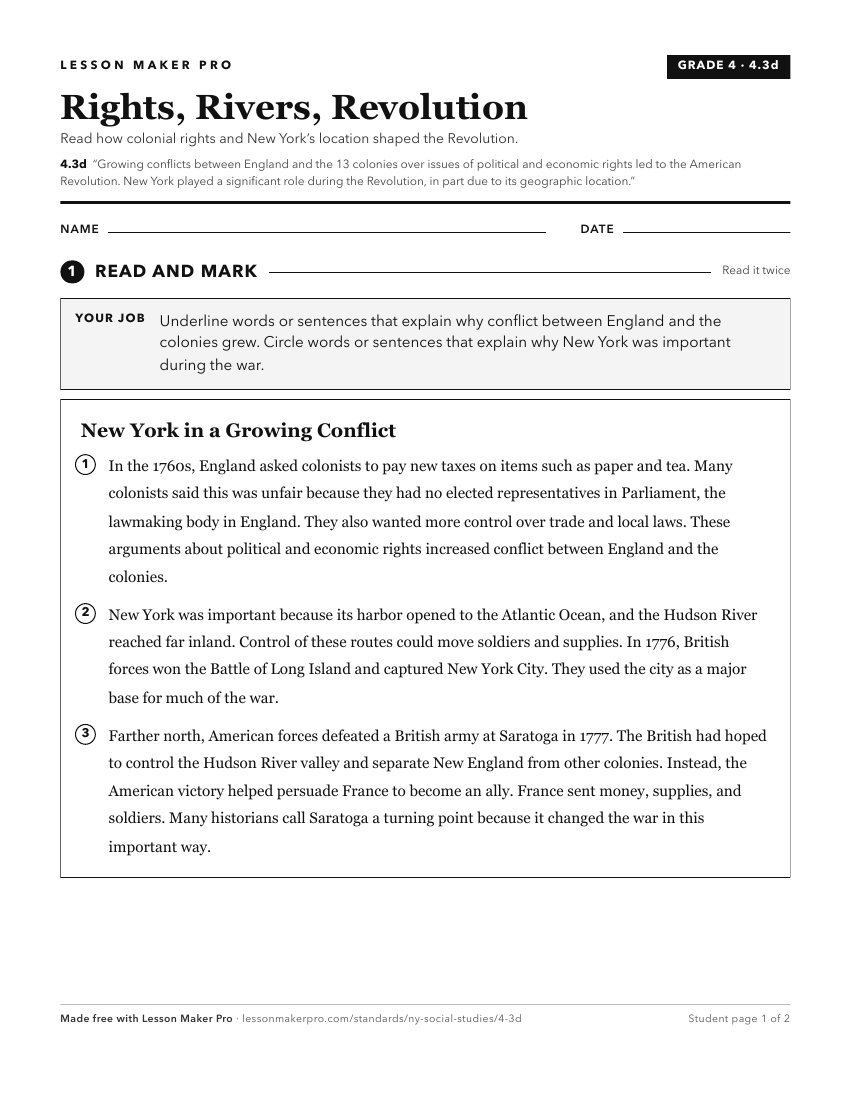
A ready-to-print activity worksheet aligned to 4.3d, with an answer key for the teacher on its own page. No account needed.
PDF, US Letter, prints cleanly in black and white.
Download the worksheetTurn this exact standard into a lesson
Grade, subject, topic, and the complete standard are prefilled. Create one free, no account needed.
Also for this standard:Make a WorksheetMake a QuizMake a Sub Lesson