NY Social Studies 4.2b
The Standard
Native American groups developed specific patterns of organization and governance to manage their societies.
New York State K–12 Social Studies Framework
Key Idea 4.2
NATIVE AMERICAN GROUPS AND THE ENVIRONMENT: Native American groups, chiefly the Haudenosaunee (Iroquois) and Algonquian-speaking groups, inhabited the region that became New York State. These people interacted with the environment and developed unique cultures.
Teacher's field guide
What This Standard Means
What Students Need to Do
- Students compare how Haudenosaunee and Munsee communities organized clans, selected leaders, made group decisions, and kept records. They use maps, accounts, and artifacts as evidence.
What Mastery Looks Like
- Students can name similarities and differences in clan structure, councils, leadership, and record keeping. They can support each comparison with evidence from a source.
Common Misconceptions
- Students may think a chief ruled alone, all Native nations governed the same way, or clan membership followed the father. They may also mistake wampum for ordinary money or written language.
How to Assess It
- Give students a Venn diagram and ask them to compare Haudenosaunee and Munsee governance with one similarity, one difference, and two source details.
Lesson moves
Ways to Teach It
Give groups clan mother, sachem, clan, and council role cards, then have them reach consensus on where to store shared corn.
Ask students to write: How did clan ties and councils limit one leader's power in Haudenosaunee or Munsee communities?
Play a card sort matching evidence to clans, councils, decision making, or record keeping, then require one sentence of proof.
Use a map and an official local Native nation website to identify how that nation represents its government today.
Free download
Printable 4.2b Worksheet
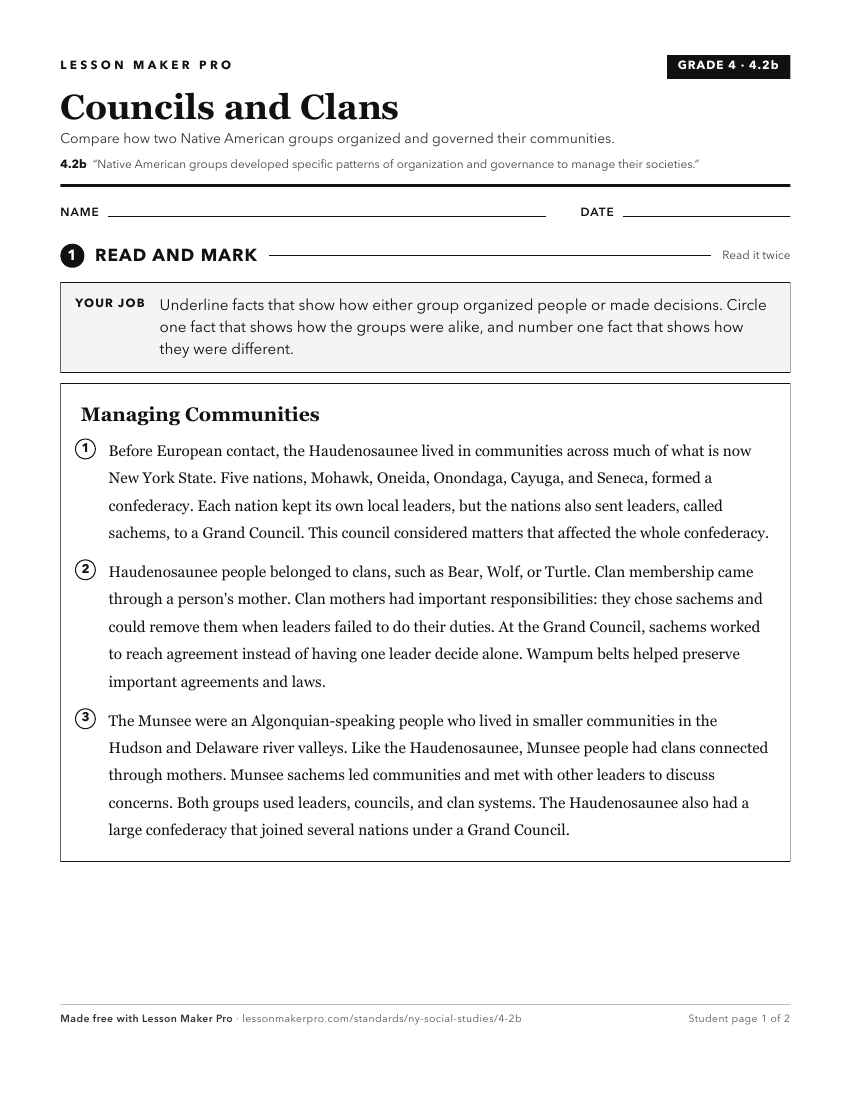
A ready-to-print activity worksheet aligned to 4.2b, with an answer key for the teacher on its own page. No account needed.
PDF, US Letter, prints cleanly in black and white.
Download the worksheetTurn this exact standard into a lesson
Grade, subject, topic, and the complete standard are prefilled. Create one free, no account needed.
Also for this standard:Make a WorksheetMake a QuizMake a Sub Lesson